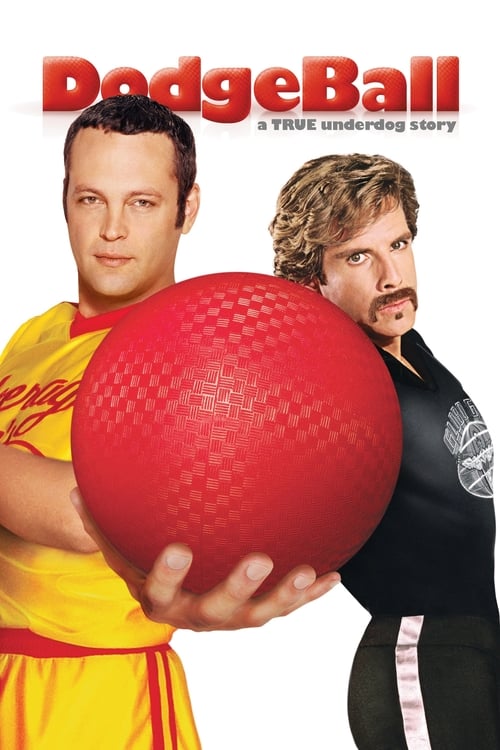
DodgeBall: A True Underdog Story (2004)
Directed by Rawson Marshall Thurber
No — DodgeBall: A True Underdog Story is not woke, scoring 14 out of 100 on our wokeness meter.
Two decades on, this remains a proudly silly sports comedy with a mild grudge against the corporate fitness industry.
Consciousness Markers
In the closing scene, Kate reveals her bisexuality and kisses her friend Joyce, then Peter — a genuine same-sex moment, though staged as a comedic shock punchline rather than an affirming statement.
The plot's engine is a scrappy independent gym fighting a soulless corporate fitness chain, ending with the underdog seizing control of the corporation — a mild 'little guy vs. big business' sentiment delivered as light comedy rather than ideology.
Kate Veatch is a competent attorney who rebuffs Goodman's harassment and proves skilled at the sport, but the film remains a male-driven goofball comedy with no sustained feminist argument.
The ensemble is overwhelmingly white, with a few token minority and disabled background bits played for comedy rather than any deliberate diversity casting. No meaningful representation agenda is present.
Race is simply not a subject the film engages with at any point; there is no racial consciousness in its plot, themes, or dialogue.
No environmental or climate theme appears anywhere in the film.
The film mocks and degrades bodies rather than celebrating them — Goodman's arc literally ends with him regaining weight as a punchline, the opposite of body positivity.
No neurodivergent characters or themes are present; quirks like the pirate persona are comedic affectations, not depictions of neurodivergence.
The film has no historical subject matter to revise.
This is an unapologetically silly sports comedy that never pauses to preach; there is no lecture or moralizing energy.
Why it received this score
Two decades on, this remains a proudly silly sports comedy with a mild grudge against the corporate fitness industry. The plot runs on a scrappy neighborhood gym, its delinquent membership, and a gleaming chain across the street whose owner wants to pave the place into a parking structure. The little guy wins by seizing a controlling stake in the conglomerate and firing the villain. That is a satisfying reversal, delivered as a punchline, not a manifesto. The film's politics extend about as far as wanting the underdog to get paid.
The social content is thinner than the runtime suggests. Kate Veatch is a capable attorney who shrugs off her boss's advances and turns out to be the best athlete in the room, but the film belongs to the men and never builds an argument from her competence. The closing beat, in which a friend arrives from Guam and kisses her before she explains her bisexuality, is staged for the shock of the men watching. Bodies are the other running target. The villain's punishment is to regain the weight he lost, which the film treats as a fitting humiliation. Race is not a subject the screenplay touches. Neither is the climate, nor neurodivergence, nor any historical record in need of correction.
What keeps the whole enterprise from aging into a sermon is its refusal to preach. It has no lesson, no moral, no closing appeal to the audience's better nature. The jokes are thrown hard and low, and the film never stops to explain why they matter. Progressive sentiment here is incidental, a residue of the era's comedy instincts instead of a design. We grade it as such.
Analysis generated by our Consciousness Algorithm


Synopsis
When megalomaniacal White Goodman, the owner of a trendy, high-end fitness center, makes a move to take over the struggling local gym run by happy-go-lucky Pete La Fleur, there's only one way for La Fleur to fight back: dodgeball. Aided by a dodgeball guru and Goodman's attorney, La Fleur and his rag-tag team of underdogs launch a knock-down, drag-out battle in which the winner takes all.
Questions about DodgeBall: A True Underdog Story
Is DodgeBall: A True Underdog Story woke?
No — DodgeBall: A True Underdog Story is not woke, scoring 14 out of 100 on our wokeness meter. That earns it a verdict of Ultra Based.
Does DodgeBall: A True Underdog Story have any woke elements?
Very few. None of the 10 markers reaches 30, the level where a marker counts as present; the highest is Eat the Rich at 25.
How does DodgeBall: A True Underdog Story compare to other 2004 movies?
It ranks #53 of the 178 films from 2004 we've scored; their average is 12. The wokest is Tropical Malady (62).
How is the Woke Score calculated?
An AI-assisted process researches the film and its reception, scores it 0–100 on ten markers, then combines those into one 0–100 Woke Score. It measures a specific set of 2020s cultural themes, not film quality.