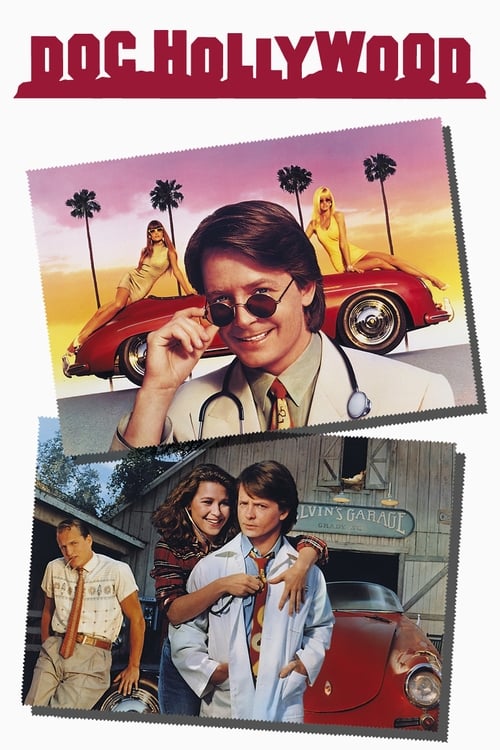
Doc Hollywood (1991)
Directed by Michael Caton-Jones
No — Doc Hollywood is not woke, scoring 10 out of 100 on our wokeness meter.
Doc Hollywood arrives in 1991 as a specimen of a genre that has since gone extinct: the studio romantic comedy in which a handsome doctor learns humility from a town full of eccentrics.
Consciousness Markers
The film carries a mild 'back-to-basics' anti-greed message, contrasting wholesome small-town medicine with the superficiality of Beverly Hills plastic surgery, though it resolves by celebrating professional success rather than rejecting wealth.
The film gestures at a moral about small-town values versus big-city shallowness, but delivers it with a light Capraesque touch rather than preachy sermonizing.
The cast is overwhelmingly white, with Mel Winkler and Helen Martin appearing in minor supporting roles. Minority presence is incidental and unremarked upon, typical of early-90s studio casting.
Julie Warner's Lou is a single mother studying law, granting her a sliver of independence, but the film remains a conventional romance in which her arc is defined by her romantic choice between two men.
The film engages no racial themes whatsoever; the small-town South Carolina setting is presented as a racially unexamined idyll.
No LGBTQ+ characters, themes, or subtext of any kind appear in the film.
No environmental or climate themes are present.
No body-positivity themes are present.
No neurodivergence themes or characters are present.
The film makes no historical claims and engages in no historical revisionism.
Why it received this score
Doc Hollywood arrives in 1991 as a specimen of a genre that has since gone extinct: the studio romantic comedy in which a handsome doctor learns humility from a town full of eccentrics. Michael J. Fox plays Ben Stone, a plastic surgeon bound for Beverly Hills who wrecks his Porsche against a judge's fence in Grady, South Carolina, and is sentenced to thirty-two hours of clinic duty. He resents it. Then he does not. The film was shot in Florida standing in for the Carolinas, which tells us most of what we need to know about its relationship to authenticity.
The cast is white to a degree that would today require a memo. Mel Winkler and Helen Martin appear briefly and without comment, and the town's racial composition goes unexamined, as it did in most studio product of the era. Julie Warner's Lou is a single mother studying law, which grants her a measure of self-direction, though the screenplay finally defines her by which man she chooses. The film's only discernible thesis is that small-town general practice beats big-city vanity surgery, a back-to-basics moral that was evidently in the water that season, shared with City Slickers and Northern Exposure. It stops well short of any economic argument. Ben does not renounce wealth. He returns to it, and the town buys him a plane ticket.
There is no environmental lament, no body politics, no neurodivergent reading of the locals, and no historical claim of any kind. The film is not hostile to such concerns so much as chronologically innocent of them. Its sermonizing is gentle and brief, a Capraesque nudge delivered with a shrug. We are left with a competent, amiable picture that has aged into a document of what mainstream American comedy looked like before it started carrying a syllabus. It is pleasant. It is also inert. The markers of modern social consciousness are simply absent here, and the absence is not a failure of nerve. It is a matter of the calendar.
Returning to the ledger: the casting reflects the demographic habits of its moment, the romance observes conventional gender arrangements, and the anti-greed gesture is soft enough to be missed by a distracted viewer. Everything else registers at zero, honestly and without apology. We classify accordingly and move on to the next vintage.
{"thematic_tags": ["book_adaptation"]}
Analysis generated by our Consciousness Algorithm
Part of


Synopsis
After leaving Washington D.C. hospital, plastic surgeon Ben Stone heads for California, where a lucrative practice in Beverly Hills awaits. After a car accident, he's sentenced to perform as the community's general practitioner.
Questions about Doc Hollywood
Is Doc Hollywood woke?
No — Doc Hollywood is not woke, scoring 10 out of 100 on our wokeness meter. That earns it a verdict of Ultra Based.
Does Doc Hollywood have any woke elements?
Very few. None of the 10 markers reaches 30, the level where a marker counts as present; the highest is Eat the Rich at 22.
How does Doc Hollywood compare to other 1991 movies?
It ranks #28 of the 68 films from 1991 we've scored; their average is 14. The wokest is Paris Is Burning (77).
How is the Woke Score calculated?
An AI-assisted process researches the film and its reception, scores it 0–100 on ten markers, then combines those into one 0–100 Woke Score. It measures a specific set of 2020s cultural themes, not film quality.