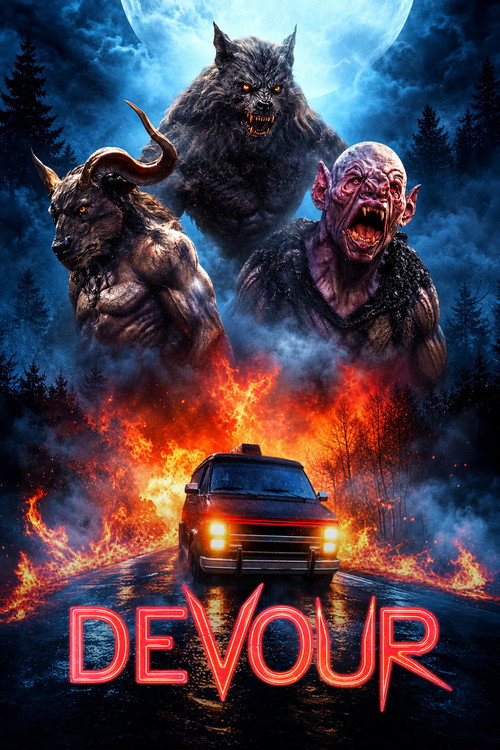
Devour (2026)
Directed by Scott B. Hansen
No — Devour is not woke, scoring 8 out of 100 on our wokeness meter.
Devour arrives bearing the most tantalizing of premises: an all-female heavy metal band, stranded in a town overrun by warlocks, cannibals, vampires, and a werewolf, fighting for survival.
Consciousness Markers
The film is built around an all-female heavy metal band as its central premise, and the marketing leaned into this as a statement. Critics noted, however, that the actual screen time is dominated by a male vampire's voiceover narration, which rather deflates the gesture.
The surface framing of women surviving supernatural horror through agency and solidarity is present in the premise. The execution, per multiple reviewers, reassigns narrative authority to the male roadie-vampire Jerry, leaving the feminist scaffolding largely decorative.
No LGBTQ+ themes, characters, or subtext were identified in the film or its surrounding discourse.
No racial consciousness themes or commentary were identified in the film or its critical reception.
No climate themes of any kind are present in a film about cannibals, vampires, and a warlock in a small town.
No anti-capitalist framing or critique of wealth and power structures was identified.
No body positivity themes were identified. The film's body-related content is predominantly concerned with bodies being eaten.
No neurodivergence themes or representation were identified in the film or its discourse.
No revisionist historical framing was identified. The film's historical content, such as it is, concerns a vampire's long existence rather than any ideological reinterpretation of the past.
No sermonizing or heavy-handed messaging was identified. The film appears to have been too busy deploying AI-generated establishing shots to pause for moral instruction.
Why it received this score
Devour arrives bearing the most tantalizing of premises: an all-female heavy metal band, stranded in a town overrun by warlocks, cannibals, vampires, and a werewolf, fighting for survival. This is, on paper, a complete cinematic ecosystem. The marketing department clearly agreed, positioning the film as a female-empowerment B-movie in the tradition of grindhouse survival horror. The actual film, it turns out, had other plans. The narrative is in fact delivered through the voiceover of Jerry, a male vampire with a long history and a great deal to say about it. The women of the band are present. They are in the town. They fight things. They are not, by any critical measure, the protagonists of their own story.
The more urgent controversy surrounding Devour concerns not its gender politics but its enthusiastic embrace of generative AI imagery. Sequences produced by Sora are stitched into a film that also features handcrafted practical creature effects, and the contrast is, by all accounts, jarring. This is the cinematic equivalent of serving a hand-thrown ceramic bowl alongside a plate printed at a FedEx Office. The practical work, designed by Wayne Anderson, represents genuine craft. The AI sequences represent a different set of priorities entirely. Critics across the genre press noted the disconnect with the weary precision of people who had been hoping for something else.
As a specimen of progressive social consciousness, Devour is a largely inert object. The female-band framing earns a modest score for representation ambition, and the survival-horror premise gestures toward feminist solidarity in the way that all films about women not dying immediately do. Beyond that, the film is innocent of ideology. It is a horror movie about monsters eating people, delivered partly by a man who has been alive for centuries and has thoughts about it. The AI discourse it generated is, in its own way, more culturally revealing than anything on screen.
Analysis generated by our Consciousness Algorithm


Synopsis
Stranded after a disastrous gig, an all-girl heavy metal band finds a woman in danger in a town ruled by a warlock, and crawling with cannibals, vampires, and a deadly werewolf, forcing them to fight for survival.
Questions about Devour
Is Devour woke?
No — Devour is not woke, scoring 8 out of 100 on our wokeness meter. That earns it a verdict of Ultra Based.
Does Devour have any woke elements?
Very few. None of the 10 markers reaches 30, the level where a marker counts as present; the highest is Representation Casting at 22.
How does Devour compare to other 2026 movies?
It ranks #442 of the 800 films from 2026 we've scored; their average is 23. The wokest is Between Us (89).
How is the Woke Score calculated?
An AI-assisted process researches the film and its reception, scores it 0–100 on ten markers, then combines those into one 0–100 Woke Score. It measures a specific set of 2020s cultural themes, not film quality.