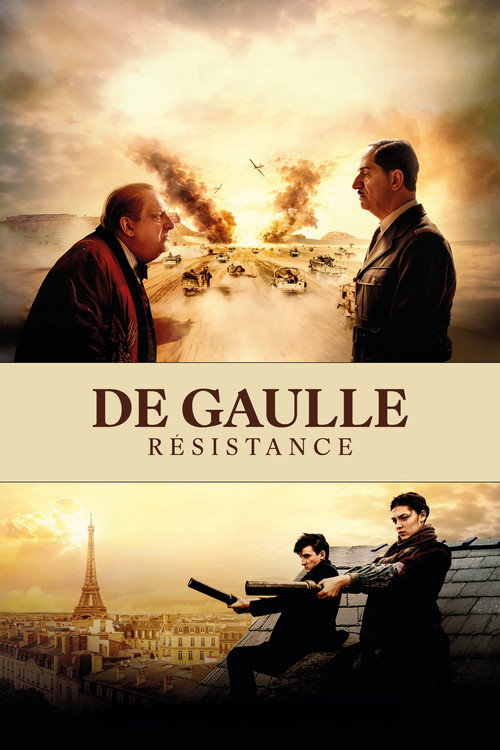
De Gaulle: Résistance (2026)
Directed by Antonin Baudry
No — De Gaulle: Résistance is not especially woke, scoring 28 out of 100 on our wokeness meter.
France is in flames, and one man refuses to accept it.
Consciousness Markers
The film invents the Jewish resistance fighter Livia wholesale, restructures documented timelines, and has drawn formal criticism from historians for its narrative liberties. It also excises Communist resistance factions entirely, streamlining a morally complicated history into a cleaner providential myth. This is not accidental compression but deliberate revisionism.
Simon Abkarian, a French-Armenian actor, leads as de Gaulle, and the film visibly incorporates Black colonial troops from North Africa among the Free French Forces. This is not a systematic diversity casting exercise, but the choices are legible as gestures toward a more inclusive portrait of French resistance.
The depiction of Black colonial troops has been noted by critics as speaking to contemporary French debates about nationhood and identity. The film does not foreground this as a racial consciousness argument, but the framing is aware of its modern resonance.
The film deploys Vichy antisemitism as a blunt moral binary to distinguish the villains from the heroes, and critics have noted its tendency toward one-note nationalist simplification. The sermonizing is present but operates in service of French patriotism rather than progressive social instruction.
The invented character Livia, a Jewish resistance fighter, is female and active. She functions primarily as a romantic subplot and moral device, however, not as a statement about gender equity or female empowerment.
No LGBTQ+ characters, themes, or subtext appear in any available material about this film.
No climate, environmental, or ecological themes are present. The film is set in 1940 and concerns itself with fascism, not carbon footprints.
No anti-capitalist themes are present. The enemy is Nazi Germany and Vichy collaboration, not the bourgeoisie or corporate malfeasance.
No body positivity themes, messaging, or relevant casting choices are present in any available material.
No neurodivergent characters or themes are present. None.
Why it received this score
France is in flames, and one man refuses to accept it. Director Antonin Baudry, a former diplomat who has clearly never lost faith in the power of the right general at the right microphone, presents Charles de Gaulle as a figure of almost geological inevitability. Simon Abkarian, drawing on what he describes as his Armenian understanding of exile and resistance, plays the general with a brooding intensity that the film rewards at every turn. The result is a historical epic that is less interested in the messy plurality of French resistance than in the clean lines of a national creation myth. Historians have noted the omissions. The Communist factions who formed a substantial part of the actual resistance are largely absent. What fills the space instead is a more photogenic moral universe.
The film's most telling invention is Livia, a Jewish resistance fighter conjured from whole cloth to serve as both romantic interest and ethical compass. Her function is to make the moral geography legible: Vichy characters are antisemitic, Free French characters are not, and the audience is spared the discomfort of a history in which these categories overlapped in inconvenient ways. Critics in the Jewish press have noted this binary with some precision. It is a technique borrowed less from Julian Jackson's meticulous biography, on which the film is nominally based, than from the grammar of prestige cinema, where invented characters exist to simplify what archival reality complicates. The casting of Mathieu Kassovitz, director of La Haine, as the collaborationist Admiral Darlan adds a layer of irony that the film does not appear to have sought.
On the spectrum of progressive cultural markers, this film sits in a peculiar position. Its racial consciousness is present but decorative: Black colonial troops appear, critics have noted their symbolic weight for contemporary French audiences, and then the film moves on. Its revisionism is the more consequential quality, a confident reshaping of 1940 into something a modern French audience can gather around without argument. That is not a progressive project exactly. It is something older and, in its way, more ambitious: the manufacture of consensus through the selective arrangement of the past. The film does this with considerable craft and no apparent self-consciousness whatsoever.
Analysis generated by our Consciousness Algorithm
Synopsis
June, 1940. France collapses and signs the armistice. In the midst of the chaos, one man refuses to give up. Alone against the odds, this unknown general flees to London to save what remains of freedom.
Questions about De Gaulle: Résistance
Is De Gaulle: Résistance woke?
No — De Gaulle: Résistance is not especially woke, scoring 28 out of 100 on our wokeness meter. That earns it a verdict of Based.
Does De Gaulle: Résistance have any woke elements?
1 of the 10 markers register at 30 or above, led by Revisionist History (48). On Revisionist History: The film invents the Jewish resistance fighter Livia wholesale, restructures documented timelines, and has drawn formal criticism from historians for its narrative liberties.
How does De Gaulle: Résistance compare to other 2026 movies?
It ranks #243 of the 800 films from 2026 we've scored; their average is 23. The wokest is Between Us (89).
How is the Woke Score calculated?
An AI-assisted process researches the film and its reception, scores it 0–100 on ten markers, then combines those into one 0–100 Woke Score. It measures a specific set of 2020s cultural themes, not film quality.