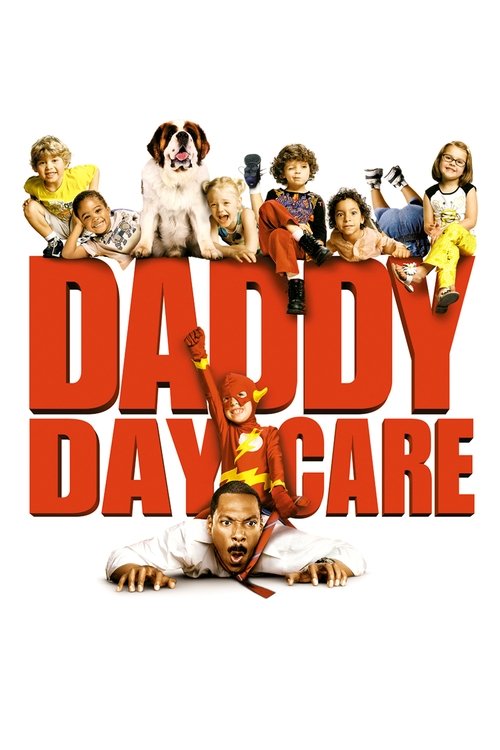
Daddy Day Care (2003)
Directed by Steve Carr
No — Daddy Day Care is not woke, scoring 18 out of 100 on our wokeness meter.
Two marketing executives lose their jobs and their dignity in the same afternoon, and the film's response is to open a daycare in a suburban living room.
Consciousness Markers
The film features a diverse ensemble led by Eddie Murphy with Regina King in a prominent supporting role, but their presence is entirely natural to the story and never framed as a statement.
The plot is kicked off by a heartless corporate layoff and pits the scrappy, affordable home daycare against the elitist, expensive Chapman Academy, giving it a mild small-business-versus-big-money streak.
There is a mild final-act sermon about prioritizing family over money and a confrontation speech against the snobbish academy director, but the messaging stays gentle and comedic.
The premise of stay-at-home dads and a wife returning to work as a lawyer mildly inverts traditional gender roles, but it plays as light comedy rather than any articulated feminist thesis.
The cast is racially mixed without comment; the film engages no racial themes, history, or commentary whatsoever.
There are no LGBTQ+ characters, themes, or subtext anywhere in the film.
No environmental or climate themes appear in the film.
No body positivity themes or messaging are present.
The nerdy sidekick Marvin is played for comic awkwardness, but the film offers no neurodivergence framing or representation.
The film is a contemporary fictional comedy with no historical subject matter to revise.
Why it received this score
Two marketing executives lose their jobs and their dignity in the same afternoon, and the film's response is to open a daycare in a suburban living room. Daddy Day Care regards this as the natural next step in the American career arc. The food company that cuts Charlie and Phil loose does so with the chilly efficiency of a spreadsheet, and the villainous Chapman Academy charges tuition that would make a private university blush. The film's sympathies sit squarely with the affordable option, the scrappy home operation, the small business run out of a kitchen. This is populism of the gentlest sort, delivered without a raised voice.
The premise inverts a few household roles and extracts a mild chuckle from the reversal. Kim returns to the office as a lawyer while Charlie learns to wrangle toddlers, and the film never pushes the observation any further than that. The cast is thoroughly multiracial and the film says nothing about it, which we may read as admirable restraint or as an absence of ambition. Regina King runs the enterprise with competence and no ceremony. Marvin, the nerdy colleague, is played for awkwardness and nothing else. The film exhibits no interest in diagnosis, identity, or the planet.
Then comes the closing speech, in which Charlie stands before a room of assembled parents and explains, at some length, that children matter more than salaries. The film means it. The film is sweet about it. The film also takes care not to linger there. A critic once compared the experience to ninety minutes in a pre-K classroom, and the comparison holds. The sermonizing is brief, the snob gets her comeuppance at a crosswalk, and the whole enterprise settles into a gentle, well-meaning nap.
Analysis generated by our Consciousness Algorithm


Synopsis
Two men get laid off and have to become stay-at-home dads when they can't find jobs, which inspires them to open their own day-care center.
Questions about Daddy Day Care
Is Daddy Day Care woke?
No — Daddy Day Care is not woke, scoring 18 out of 100 on our wokeness meter. That earns it a verdict of Ultra Based.
Does Daddy Day Care have any woke elements?
Very few. None of the 10 markers reaches 30, the level where a marker counts as present; the highest is Representation Casting at 28.
How does Daddy Day Care compare to other 2003 movies?
It ranks #33 of the 150 films from 2003 we've scored; their average is 12. The wokest is Mona Lisa Smile (60).
How is the Woke Score calculated?
An AI-assisted process researches the film and its reception, scores it 0–100 on ten markers, then combines those into one 0–100 Woke Score. It measures a specific set of 2020s cultural themes, not film quality.