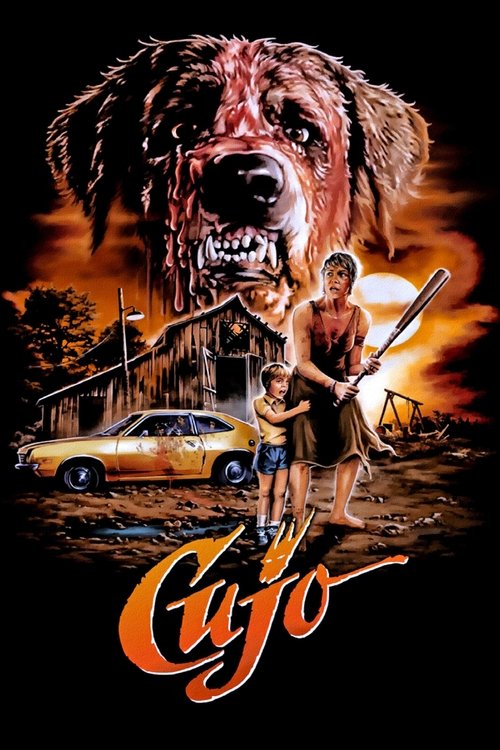
Cujo (1983)
Directed by Lewis Teague
No — Cujo is not woke, scoring 5 out of 100 on our wokeness meter.
Lewis Teague's Cujo arrives from 1983, a year when a rabid St. Bernard could still carry an entire motion picture on its foaming shoulders.
Consciousness Markers
Donna is a resourceful survivor and central protagonist, but the film treats her ordeal as a conventional woman-in-peril horror scenario rather than advancing a feminist agenda.
The cast is entirely white, with no notable racial or ethnic diversity in the principal or supporting roles.
No LGBTQ+ characters, themes, or subtext are present.
No engagement with racial issues or racial consciousness.
No environmental or climate themes.
No critique of capitalism or wealth inequality.
No body positivity themes.
No neurodivergent characters or themes.
No historical revisionism.
The film does not lecture or preach on social issues.
Why it received this score
Lewis Teague's Cujo arrives from 1983, a year when a rabid St. Bernard could still carry an entire motion picture on its foaming shoulders. The plot is a marvel of economy: dog bites bat, dog goes mad, dog besieges a mother and her son inside a Ford Pinto under a California sun that shows no mercy. Stephen King's novel is faithfully stripped of its more metaphysical flourishes. What remains is a sweaty, single-location siege picture, and it works, mostly, because Dee Wallace commits to the screaming and the dehydration with a sincerity that borders on the medical.
The cultural ledger here is remarkably clean. The cast is uniformly white and uniformly unconcerned with the fact. No character pauses to interrogate the racial order, the class order, or the environmental order. Joe Camber beats his wife and drinks too much, and the film presents this as weather instead of indictment. There is no sermon waiting at the end of the driveway. The horror is a dog, and the dog has no politics. A modern studio would find this unbearable.
Donna Trenton deserves a moment of acknowledgment. She fights the beast with a baseball bat, gets bitten for her trouble, and ultimately puts a bullet in its face while her son cooks in the back seat. This is competence, not commentary. She survives because the script requires a survivor, and the film frames her ordeal in the oldest tradition available: a woman in peril, menaced by nature, saved at last by her returning husband. Progressive readings will find little purchase. The dog is the villain, the sun is the accomplice, and the Pinto is simply a bad car.
Analysis generated by our Consciousness Algorithm


Synopsis
A friendly St. Bernard named "Cujo" contracts rabies and conducts a reign of terror on a small American town.
Questions about Cujo
Is Cujo woke?
No — Cujo is not woke, scoring 5 out of 100 on our wokeness meter. That earns it a verdict of Ultra Based.
Does Cujo have any woke elements?
Very few. None of the 10 markers reaches 30, the level where a marker counts as present; the highest is Feminist Agenda at 10.
How does Cujo compare to other 1983 movies?
It ranks #20 of the 38 films from 1983 we've scored; their average is 10. The wokest is Sans Soleil (68).
How is the Woke Score calculated?
An AI-assisted process researches the film and its reception, scores it 0–100 on ten markers, then combines those into one 0–100 Woke Score. It measures a specific set of 2020s cultural themes, not film quality.