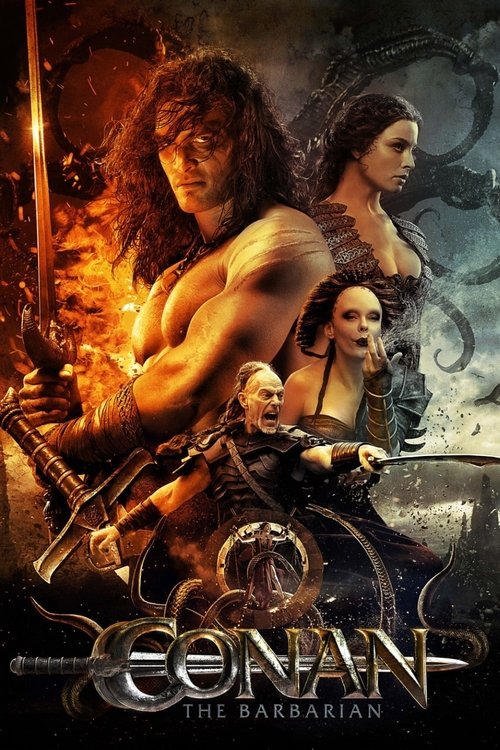
Conan the Barbarian (2011)
Directed by Marcus Nispel
No — Conan the Barbarian is not woke, scoring 11 out of 100 on our wokeness meter.
Conan the Barbarian (2011) is a sword-and-sorcery revenge picture built around oiled musculature, a stolen sword, and a childhood massacre.
Consciousness Markers
Jason Momoa headlines as a Polynesian Conan, with Nonso Anozie, Bob Sapp, and Saïd Taghmaoui in supporting roles, but the multiethnic casting is unremarked-upon genre convention rather than a stated representational project.
Rose McGowan's witch Marique was rewritten from a male character and Tamara is a competent, defiant companion, but both remain ornamental to a hyper-masculine revenge narrative centered on Conan's muscles and his father's sword.
No LGBTQ+ characters, themes, or subtext of any kind; the film's erotic energy is entirely heterosexual and, in Marique's case, deliberately incestuous rather than queer.
The film features a Kushite warlord and a Zamoran pirate, but race is never a subject of commentary, critique, or thematic weight in this Hyborian fantasy.
No environmental themes whatsoever; the only thing the film wants to save is a sword and a bloodline.
No economic critique; the villain's ambition is supernatural empire-building, not capitalism, and the film has no interest in class or wealth.
The film's relationship to bodies is the opposite of body positivity — it is a shrine to the oiled, hypertrophied, six-week-stunt-training physique.
No neurodivergent characters or themes; the blind archers are a combat gimmick, not a depiction of disability as identity.
Set in the fictional Hyborian Age, the film makes no claims about real history and therefore cannot revise it.
A sword-and-sorcery revenge picture with zero didactic impulse; it preaches nothing except that a hot blade must be cooled and tempered.
Why it received this score
Conan the Barbarian (2011) is a sword-and-sorcery revenge picture built around oiled musculature, a stolen sword, and a childhood massacre. The casting is diverse by genre standards: Jason Momoa headlines as a Polynesian Conan, with Nonso Anozie, Bob Sapp, and Saïd Taghmaoui in support. The film never comments on this arrangement. It simply proceeds as if a multiethnic Hyboria were the default, which it is for this sort of picture. That keeps the representation score modest: visible, unremarked, and not framed as a statement.
Rose McGowan's Marique was rewritten from a male character, and Rachel Nichols's Tamara is a defiant companion. Both remain ornamental to a revenge narrative centered on Conan's muscles and his father's sword. The film has no LGBTQ characters or subtext. Its erotic energy is entirely heterosexual and, in Marique's case, deliberately incestuous. A Kushite warlord and a Zamoran pirate appear, but race is never a subject of commentary. There is no environmental theme, no economic critique, and no interest in class. The villain seeks supernatural empire, not market share.
Bodies here are not celebrated in their variety. They are displayed as proof of six weeks of stunt training. The blind archers are a combat gimmick, not a depiction of disability as identity. The Hyborian Age is fictional, so no real history is revised. The film lectures about nothing. Its only sermon is metallurgical: a hot blade must be cooled and tempered. The overall impression is of a production that studied the market for swords and sorcery and found no further social obligations to meet.
Analysis generated by our Consciousness Algorithm


Synopsis
A quest that begins as a personal vendetta for the fierce Cimmerian warrior soon turns into an epic battle against hulking rivals, horrific monsters, and impossible odds, as Conan realizes he is the only hope of saving the great nations of Hyboria from an encroaching reign of supernatural evil.
Questions about Conan the Barbarian
Is Conan the Barbarian woke?
No — Conan the Barbarian is not woke, scoring 11 out of 100 on our wokeness meter. That earns it a verdict of Ultra Based.
Does Conan the Barbarian have any woke elements?
1 of the 10 markers register at 30 or above, led by Representation Casting (30). On Representation Casting: Jason Momoa headlines as a Polynesian Conan, with Nonso Anozie, Bob Sapp, and Saïd Taghmaoui in supporting roles, but the multiethnic casting is unremarked-upon genre convention rather than a stated representational project.
How does Conan the Barbarian compare to other 2011 movies?
It ranks #81 of the 245 films from 2011 we've scored; their average is 11. The wokest is Paul (68).
How is the Woke Score calculated?
An AI-assisted process researches the film and its reception, scores it 0–100 on ten markers, then combines those into one 0–100 Woke Score. It measures a specific set of 2020s cultural themes, not film quality.