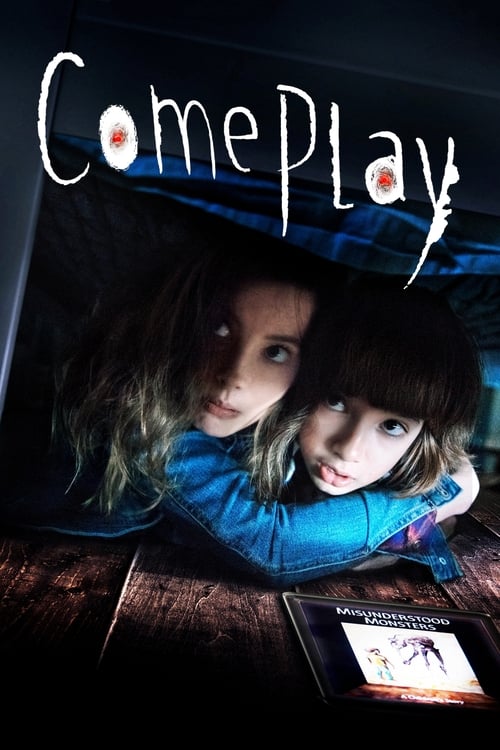
Come Play (2020)
Directed by Jacob Chase
No — Come Play is not especially woke, scoring 37 out of 100 on our wokeness meter.
Come Play arrives from the Amblin stable with a monster named Larry, a creature who lives inside our screens and wishes, with touching sincerity, for a friend.
Consciousness Markers
The film's central subject is an autistic, non-verbal boy whose sensory overload, communication apps, and therapy are treated with genuine care; the monster 'Larry' is explicitly a 'misunderstood monster' mirroring Oliver's own isolation. This is the film's defining thematic concern.
The film centers a non-verbal autistic boy as its protagonist, with a diverse supporting cast including Black performers as the speech therapist and teacher. The representation is organic to the story rather than performative.
The film gestures at themes of understanding autistic children and the loneliness of being misunderstood, but delivers them through horror mechanics rather than direct preaching.
The mother Sarah is the primary protector and ultimately sacrifices herself for her son, but the film frames this as maternal devotion rather than a feminist statement.
No LGBTQ+ characters or themes appear anywhere in the film.
Black characters appear in supporting roles but the film engages no racial themes or commentary whatsoever.
No environmental or climate themes are present.
No economic or class-based critique; the monster is supernatural, not systemic.
No body positivity themes or messaging.
No historical revisionism; the film is a contemporary supernatural horror.
Why it received this score
Come Play arrives from the Amblin stable with a monster named Larry, a creature who lives inside our screens and wishes, with touching sincerity, for a friend. The premise is sturdy, the execution uneven, and the film's real preoccupation lies elsewhere entirely. Oliver, our young protagonist, is autistic and non-verbal, and he navigates the world through a tablet that speaks on his behalf. The horror does not spring from his condition. It springs from the isolation surrounding it, from bullies, from a marriage quietly collapsing, from a boy who cannot make himself understood by the people closest to him.
This is where the film earns its keep. The sensory overload that ends Oliver's friendship is rendered without judgment, and the translation app that eventually repairs it functions as a small, honest miracle. The misunderstood monster of the film's digital bedtime story mirrors the misunderstood boy, and the screenplay knows it. Supporting players, among them a speech therapist and a teacher, are cast with a quiet diversity that never announces itself. We are not lectured. We are shown a child loved imperfectly by parents doing their best, and the film trusts us to feel the weight of that.
The mother, Sarah, becomes the film's engine, shielding her son and finally trading herself for him, a sacrifice framed as maternal devotion. Whether that constitutes a statement about women is a question the movie declines to answer. It is a genre picture first. The scares are competent, the third act sags, and the ending lands on a ghostly reassurance that sits somewhere between tender and silly. A modest fright machine with an unexpectedly gentle heart, and a monster who only wanted someone to talk to.
Analysis generated by our Consciousness Algorithm


Synopsis
Oliver, a lonely autistic boy, seeks solace and refuge in his ever-present cell phone and tablet. When a mysterious creature uses the boy's devices against him, his parents must fight to save their son from the monster beyond the screen.
Questions about Come Play
Is Come Play woke?
No — Come Play is not especially woke, scoring 37 out of 100 on our wokeness meter. That earns it a verdict of Based.
Does Come Play have any woke elements?
2 of the 10 markers register at 30 or above, led by Neurodivergence (80) and Representation Casting (45). On Neurodivergence: The film's central subject is an autistic, non-verbal boy whose sensory overload, communication apps, and therapy are treated with genuine care; the monster 'Larry' is explicitly a 'misunderstood monster' mirroring Oliver's own isolation.
How does Come Play compare to other 2020 movies?
It ranks #42 of the 227 films from 2020 we've scored; their average is 21. The wokest is One Night in Miami... (83).
How is the Woke Score calculated?
An AI-assisted process researches the film and its reception, scores it 0–100 on ten markers, then combines those into one 0–100 Woke Score. It measures a specific set of 2020s cultural themes, not film quality.