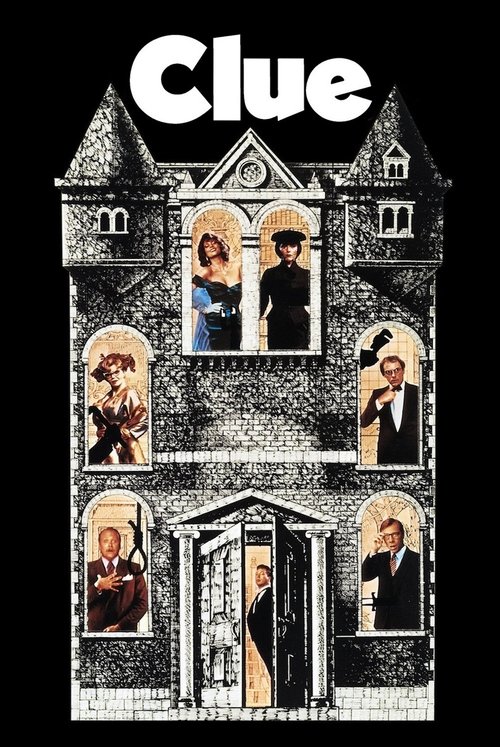
Clue (1985)
Directed by Jonathan Lynn
No — Clue is not woke, scoring 8 out of 100 on our wokeness meter.
Clue arrives from 1985 as a board game adaptation that, against reasonable odds, developed a cult following on the strength of its cast and its willingness to be silly.
Consciousness Markers
The cast includes several women in major roles and a few minority actors in supporting parts, but this is incidental to the 1985 ensemble comedy rather than a deliberate diversity statement.
Mr. Green is a closeted homosexual whose secret is used for blackmail, but the film treats this as a punchline and ultimately reveals he is straight, so LGBTQ+ content is present but not progressive.
No feminist agenda; female characters are defined by comedic archetypes and criminal secrets.
No racial themes or commentary.
No environmental themes.
No critique of capitalism or wealth; the blackmail plot is personal, not systemic.
No body positivity themes; the maid is described as voluptuous in an objectifying manner.
No neurodivergence themes.
Set in 1954 but not a revisionist historical narrative.
The film is a farce and does not lecture the audience.
Why it received this score
Clue arrives from 1985 as a board game adaptation that, against reasonable odds, developed a cult following on the strength of its cast and its willingness to be silly. The film assembles six blackmailed strangers in a New England mansion, hands them weapons from the box, and lets Tim Curry run the room until the lights go out. The social consciousness on display is minimal and largely accidental. Women occupy major roles, and a few minority actors appear in supporting parts, but the film never pauses to congratulate itself for this arrangement. The cast simply exists, which in the present climate feels almost quaint.
The one piece of identity politics the film engages is Mr. Green, a State Department employee whose closeted homosexuality is the secret being used against him. The film plays this for laughs and then, in its final resolution, undoes it by having Green announce that he is going home to sleep with his wife. In 1985 this landed as a gag. Viewed today, it reads as a curiosity, evidence that the closet was a punchline before it was a cause. The film does not lecture. It does not moralize about wealth, race, climate, or the body. It has no interest in any of that.
The blackmail is personal, the mansion is old, and the spinner lands where it lands. As an artifact of progressive sensibility, Clue remains inert. As a machine for delivering one good line after another, it holds up with unsettling reliability.
Analysis generated by our Consciousness Algorithm
Part of


Synopsis
Clue finds six colorful dinner guests gathered at the mansion of their host, Mr. Boddy -- who turns up dead after his secret is exposed: He was blackmailing all of them. With the killer among them, the guests and Boddy's chatty butler must suss out the culprit before the body count rises.
Questions about Clue
Is Clue woke?
No — Clue is not woke, scoring 8 out of 100 on our wokeness meter. That earns it a verdict of Ultra Based.
Does Clue have any woke elements?
Very few. None of the 10 markers reaches 30, the level where a marker counts as present; the highest is LGBTQ+ Themes at 15.
How does Clue compare to other 1985 movies?
It ranks #15 of the 68 films from 1985 we've scored; their average is 8. The wokest is The Color Purple (62).
How is the Woke Score calculated?
An AI-assisted process researches the film and its reception, scores it 0–100 on ten markers, then combines those into one 0–100 Woke Score. It measures a specific set of 2020s cultural themes, not film quality.