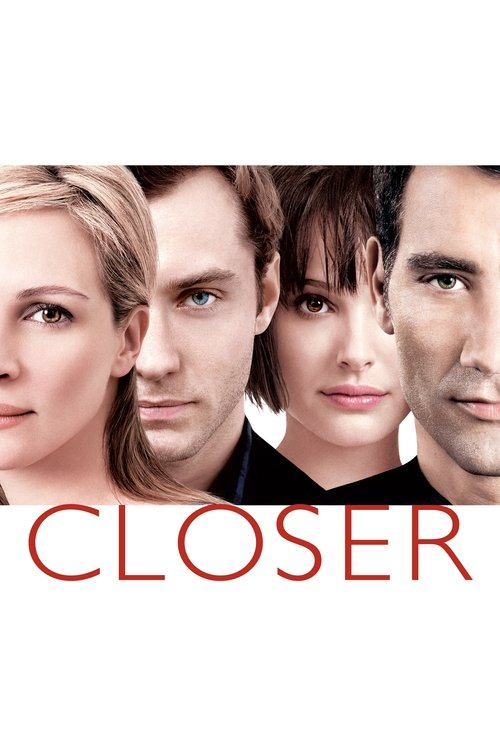
Closer (2004)
Directed by Mike Nichols
No — Closer is not woke, scoring 0 out of 100 on our wokeness meter.
Closer arrives from 2004 with the confidence of a film that knows exactly what it is and declines to apologize for it.
Consciousness Markers
The cast is entirely white and the film makes no effort to diversify its four principal roles or supporting players along racial or ethnic lines.
There are no LGBTQ+ characters, relationships, or themes; the plot revolves exclusively around heterosexual infidelity.
The film depicts women in relationships and as a stripper, but it does not advance a feminist critique or agenda; it is a relationship drama about deceit and desire.
Race is never addressed, and the film features no racial consciousness or commentary on systemic issues.
Climate change, environmentalism, or ecological themes are entirely absent.
The film does not critique capitalism, wealth inequality, or class structures; its conflicts are personal and romantic.
There is no body positivity message; the film does not challenge beauty standards or celebrate diverse body types.
Neurodivergence is not depicted or discussed; no character is identified as neurodivergent or coded as such.
The film is a contemporary relationship drama with no historical revisionism or reimagining of past events.
The dialogue is sharp and provocative but does not function as a social lecture or deliver progressive moral instruction.
Why it received this score
Closer arrives from 2004 with the confidence of a film that knows exactly what it is and declines to apologize for it. Mike Nichols directs Patrick Marber's adaptation of his own play, and the result is four attractive people in London treating honesty as a negotiable instrument. Dan, Anna, Alice, and Larry lie to each other, sleep with each other, and lie about sleeping with each other, in a cycle that runs four years and ends with nobody improved. The dialogue is sharp, cruel, and articulate. It is also entirely concerned with the personal, which is where the film's cultural ledger stays.
There is no broader social project here, and the film makes no attempt to construct one. The cast is uniformly white, the relationships uniformly heterosexual, and the conflicts uniformly romantic. Race goes unmentioned. Class goes unmentioned, unless we count a dermatologist's income. The environment, capital, and the body as a political site all sit outside the frame. A stripper appears, and the film regards her with the same unsentimental eye it turns on everyone else, which is to say it offers no thesis about her labor or her worth. The characters are articulate and self-destructive, not representative and instructive. Nobody learns anything useful. The final image, a woman crossing against the signal in New York, is a mood, not a moral.
What remains is a well-acted chamber piece about appetite and deceit. It is not trying to improve anyone, and it does not pretend otherwise. A sommelier might call it a dry, acidic vintage, best served cold and without accompaniment. The cellar is full of louder bottles. This one simply refuses to lecture, which in its own quiet way is a kind of integrity.
Analysis generated by our Consciousness Algorithm


Synopsis
The relationships of two couples become complicated and deceitful when the man from one couple meets the woman of the other.
Questions about Closer
Is Closer woke?
No — Closer is not woke, scoring 0 out of 100 on our wokeness meter. That earns it a verdict of Ultra Based.
Does Closer have any woke elements?
No. All 10 markers score zero.
How does Closer compare to other 2004 movies?
It ranks #151 of the 178 films from 2004 we've scored; their average is 12. The wokest is Tropical Malady (62).
How is the Woke Score calculated?
An AI-assisted process researches the film and its reception, scores it 0–100 on ten markers, then combines those into one 0–100 Woke Score. It measures a specific set of 2020s cultural themes, not film quality.