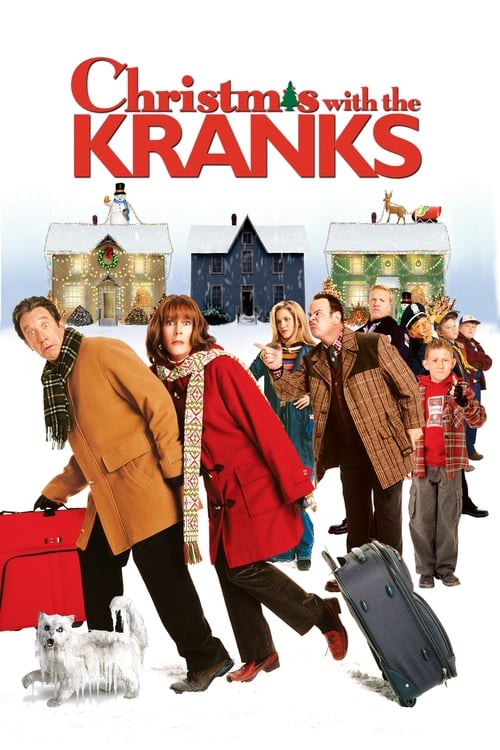
Christmas with the Kranks (2004)
Directed by Joe Roth
No — Christmas with the Kranks is not woke, scoring 7 out of 100 on our wokeness meter.
Christmas with the Kranks, a 2004 holiday comedy directed by Joe Roth, arrives with the modest ambition of a fruitcake at a potluck.
Consciousness Markers
The cast is overwhelmingly white, with Cheech Marin in a minor supporting role and a Peruvian fiancé (Enrique) appearing late as a plot device rather than a developed character. Diversity exists only incidentally, without comment or emphasis.
Luther's calculation of $6,000 in holiday spending and his rebellion against consumerist Christmas gestures at anti-consumerism, but the film ultimately celebrates conformity and tradition rather than critiquing capital. A faint thread, not a thesis.
The daughter's Peace Corps service in Peru and her Peruvian fiancé introduce a faint multicultural note, but race is never examined or made a subject of the narrative. It is set dressing, not consciousness.
The film's moral about community and togetherness is delivered through sentimental resolution rather than preachy monologue. It is gooey, not sermonizing.
Nora Krank is defined almost entirely as a wife and mother obsessed with Christmas tradition; the film offers no feminist critique or agency-driven arc. She exists to react to her husband's scheme.
No LGBTQ+ characters, themes, or subtext whatsoever. The film is a conventional heterosexual family holiday comedy.
No environmental or climate themes appear anywhere in the film. The concerns are entirely domestic and holiday-centric.
No body positivity themes. Physical comedy around the characters' bodies is played for slapstick, not affirmation.
No neurodivergent characters or themes are present or implied.
The film is a contemporary fictional comedy with no historical subject matter to revise.
Why it received this score
Christmas with the Kranks, a 2004 holiday comedy directed by Joe Roth, arrives with the modest ambition of a fruitcake at a potluck. Based on John Grisham's novel Skipping Christmas, it follows Luther and Nora Krank as they attempt to forgo the yuletide excess, only to be dragged back by their aggressively festive neighbors. The cast is a study in suburban homogeneity, with Cheech Marin appearing briefly and a Peruvian fiancé serving as a late-arriving plot device. Such diversity as exists is incidental, never examined, and certainly not the point.
The film gestures toward an anti-consumerist critique when Luther tallies the $6,000 spent on the previous Christmas, but any rebellion against commercialism is quickly abandoned in favor of conformity. Nora exists primarily as a wife and mother, her agency subsumed by her husband's scheme and her neighbors' demands. The daughter's Peace Corps service in Peru and her foreign fiancé add a faint multicultural note, but race remains set dressing. The moral about community and togetherness arrives through sentimental resolution, not sermonizing. It is gooey, not preachy, and the lecture energy is minimal.
In the taxonomy of social consciousness, this film registers as a period piece of the early 2000s, before such markers became a cultural flashpoint. It has no LGBTQ+ themes, no climate concerns, no body positivity, and no neurodivergent characters. Its historical revisionism is nonexistent, given its contemporary setting. What remains is a moderately successful box office performer that critics largely dismissed. The film's faint progressive threads are exactly that: faint. It is a holiday comedy that wants to be about connection, but its execution is as thin as a dried-up Christmas tree. We file it accordingly, with a sigh and a shrug.
Analysis generated by our Consciousness Algorithm


Synopsis
When their only daughter Blair leaves the family nest, Luther and Nora Krank decide to book an island cruise to beat the yuletide blues and just skip the holidays. But their decision to boycott tradition has the whole neighborhood in an uproar, and when Blair calls on Christmas Eve to announce a surprise visit with her new fiancée, the Kranks have just twelve hours to perform a miracle and pull themselves and their neighbors together to throw the best celebration ever!
Questions about Christmas with the Kranks
Is Christmas with the Kranks woke?
No — Christmas with the Kranks is not woke, scoring 7 out of 100 on our wokeness meter. That earns it a verdict of Ultra Based.
Does Christmas with the Kranks have any woke elements?
Very few. None of the 10 markers reaches 30, the level where a marker counts as present; the highest is Eat the Rich at 12.
How does Christmas with the Kranks compare to other 2004 movies?
It ranks #98 of the 178 films from 2004 we've scored; their average is 12. The wokest is Tropical Malady (62).
How is the Woke Score calculated?
An AI-assisted process researches the film and its reception, scores it 0–100 on ten markers, then combines those into one 0–100 Woke Score. It measures a specific set of 2020s cultural themes, not film quality.