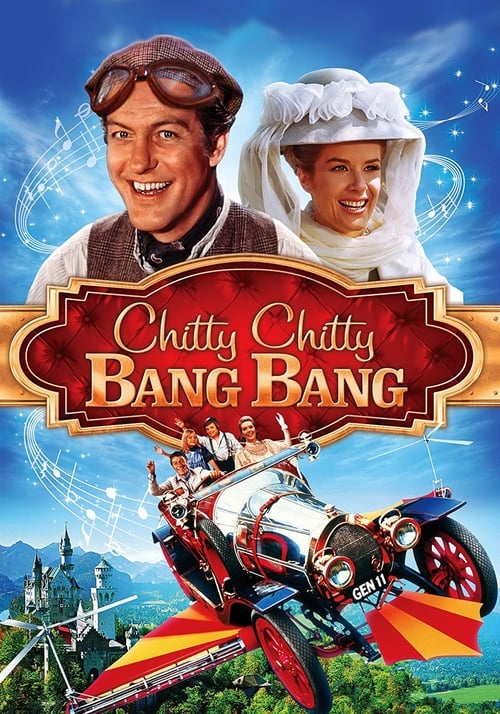
Chitty Chitty Bang Bang (1968)
Directed by Ken Hughes
No — Chitty Chitty Bang Bang is not woke, scoring 3 out of 100 on our wokeness meter.
Chitty Chitty Bang Bang arrives from 1968, a children's musical assembled by people with no interest in instructing anyone.
Consciousness Markers
Truly Scrumptious is a headstrong heiress who speaks her mind, but the film resolves her entirely into a marriage plot and the Baroness's child-hatred is played as a villainous quirk, not a feminist statement.
The cast is uniformly white British and American performers; no meaningful representation casting is present or attempted.
There are no LGBTQ+ characters, themes, or subtext anywhere in the film.
The film engages no racial themes whatsoever; the fictional Vulgaria is a white European fantasy land.
No environmental or climate themes appear; the flying car is pure whimsy, not ecological commentary.
The Scrumptious candy company and the tyrant Baron are plot devices, not vehicles for an economic critique of capitalism.
No body-positivity themes; the film makes no comment on body image or size acceptance.
Caractacus is an eccentric inventor played for comic whimsy, never framed through the lens of neurodivergence.
The film is set in a fantastical 1910s England and Vulgaria and makes no revisionist historical claims.
This is a gentle children's musical with songs and slapstick; it never pauses to deliver a social or political sermon.
Why it received this score
Chitty Chitty Bang Bang arrives from 1968, a children's musical assembled by people with no interest in instructing anyone. Ian Fleming wrote the source novel for his son. Roald Dahl and Ken Hughes wrote the screenplay. The Sherman Brothers supplied the songs. What they built is a long contraption about a widowed inventor, a flying car, and a foreign tyrant who wants to steal it. The film runs past two hours and never once stops to tell us how to live. In this classification exercise, that makes it a rare and restful specimen.
There is one flicker of modern sensibility, and it is faint. Truly Scrumptious is an heiress who speaks her mind, scolds the hero, and drives her own motorcar. The story then marries her off in the final minutes, her independence folded neatly into a wedding. The Baroness, meanwhile, despises children, and the film treats this as a villainous tic instead of a statement about anything. No argument is made. No thesis is advanced. The romance simply concludes, as romances did in 1968.
The rest of the ledger is blank. The cast is uniformly white British and American. Vulgaria is a white European fantasy kingdom with a griffin on its flag. Race is never engaged. Neither is climate, though the car flies. The Scrumptious candy company and the Baron's regime are plot machinery, not an economic critique of capital. Caractacus is an eccentric inventor played for whimsy, never framed through any clinical lens. Nobody pauses to address body image. Nobody revises history. Nobody lectures. The film wants to show us a car that floats, flies, and sings, and then it wants to go home. That is its entire political program, and it is executed without apology.
Analysis generated by our Consciousness Algorithm


Synopsis
A hapless inventor finally finds success with a flying car, which a dictator from a foreign government sets out to take for himself.
Questions about Chitty Chitty Bang Bang
Is Chitty Chitty Bang Bang woke?
No — Chitty Chitty Bang Bang is not woke, scoring 3 out of 100 on our wokeness meter. That earns it a verdict of Ultra Based.
Does Chitty Chitty Bang Bang have any woke elements?
Very few. None of the 10 markers reaches 30, the level where a marker counts as present; the highest is Feminist Agenda at 5.
How does Chitty Chitty Bang Bang compare to other 1968 movies?
It ranks #17 of the 23 films from 1968 we've scored; their average is 7. The wokest is Night of the Living Dead (27).
How is the Woke Score calculated?
An AI-assisted process researches the film and its reception, scores it 0–100 on ten markers, then combines those into one 0–100 Woke Score. It measures a specific set of 2020s cultural themes, not film quality.