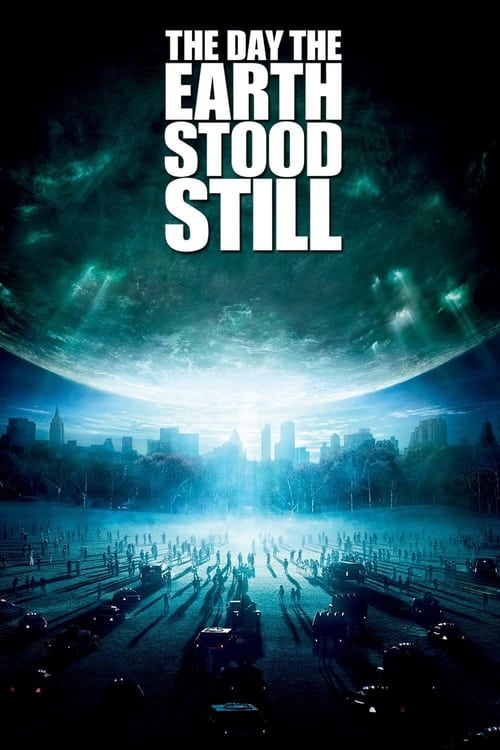
The Day the Earth Stood Still (2008)
Directed by Scott Derrickson
Partly — The Day the Earth Stood Still is somewhat woke, scoring 41 out of 100 on our wokeness meter.
The 2008 reimagining of The Day the Earth Stood Still trades the original's Cold War dread for an ecological indictment.
Consciousness Markers
The entire premise is reframed around environmentalism: Klaatu's species survived its own climate change, and he arrives to judge humanity for ecocide and environmental degradation of Earth.
The cast is naturally diverse (Keanu Reeves, Jaden Smith, James Hong, Brandon T. Jackson), but the film makes no comment on this diversity and it functions as ordinary ensemble casting rather than a statement.
The environmental message is central and delivered through dialogue and plot, but the screenwriter deliberately scrapped Klaatu's closing sermon to avoid preaching, keeping the lecturing relatively restrained.
Helen Benson is upgraded from a secretary in the original to a Princeton astrobiologist, and the Secretary of Defense is a woman (Kathy Bates), giving women prominent professional roles, though without an explicit feminist thesis.
The film features minority actors in supporting roles but engages in no racial commentary or exploration of race as a theme.
The film's critique targets human environmental destruction broadly, not capitalism or economic systems specifically; there is no eat-the-rich messaging.
There are no LGBTQ+ characters, themes, or subtext anywhere in the film.
No body positivity themes or content are present.
No neurodivergent characters or themes are depicted.
The film is a science-fiction remake, not a historical narrative, and does not reinterpret historical events.
Why it received this score
The 2008 reimagining of The Day the Earth Stood Still trades the original's Cold War dread for an ecological indictment. Klaatu, played by Keanu Reeves with the warmth of a tax audit, arrives not to warn about nuclear annihilation but to judge humanity for wrecking its own habitat. The planet is the victim here, and people are the infestation. The film's moral architecture is unmistakably green. Climate degradation is the central sin, and the alien's ultimatum is framed as a necessary correction. The screenplay avoids a closing sermon, yet the message still arrives through dialogue and plot with the subtlety of a recycling bin.
Jennifer Connelly's Helen Benson has been promoted from secretary to Princeton astrobiologist, and Kathy Bates occupies the Secretary of Defense chair. Women are granted professional authority without an explicit feminist argument. The ensemble is diverse in a casual, unremarked way. Jaden Smith, James Hong, and Brandon T. Jackson appear as ordinary pieces of a studio cast. The film does not explore race as a theme. It contains no LGBTQ characters or subtext, no body positivity, and no neurodivergent perspective. Its critique of human behavior aims at the species in general, not at capitalism or class. There is no appetite for eating the rich, only for preserving the zoological record.
This is a remake, adapted from a 1951 film and a 1940 short story, and it has no interest in revising history. Its project is contemporary anxiety dressed in sleek science fiction. The lecture energy is real but restrained, a product of a screenwriter who feared audiences would reject outright preaching. The film settles into a somber, well-tailored exercise in environmental guilt. The giant robot swarm consumes man-made objects, the electronics go dark, and the credits roll on a planet politely asked to do better. It is not a bad film. It is a very serious one, and seriousness, in this case, is the whole point.
Analysis generated by our Consciousness Algorithm


Synopsis
A representative of an alien race that went through drastic evolution to survive its own climate change, Klaatu comes to Earth to assess whether humanity can prevent the environmental damage they have inflicted on their own planet. When barred from speaking to the United Nations, he decides humankind shall be exterminated so the planet can survive.
Questions about The Day the Earth Stood Still
Is The Day the Earth Stood Still woke?
Partly — The Day the Earth Stood Still is somewhat woke, scoring 41 out of 100 on our wokeness meter. That earns it a verdict of Woke-Adjacent.
What makes The Day the Earth Stood Still woke?
3 of the 10 markers register at 30 or above, led by Climate Crusade (85), Lecture Energy (30) and Representation Casting (30). On Climate Crusade: The entire premise is reframed around environmentalism: Klaatu's species survived its own climate change, and he arrives to judge humanity for ecocide and environmental degradation of Earth.
How does The Day the Earth Stood Still compare to other 2008 movies?
It ranks #9 of the 212 films from 2008 we've scored; their average is 12. The wokest is Milk (68).
How is the Woke Score calculated?
An AI-assisted process researches the film and its reception, scores it 0–100 on ten markers, then combines those into one 0–100 Woke Score. It measures a specific set of 2020s cultural themes, not film quality.