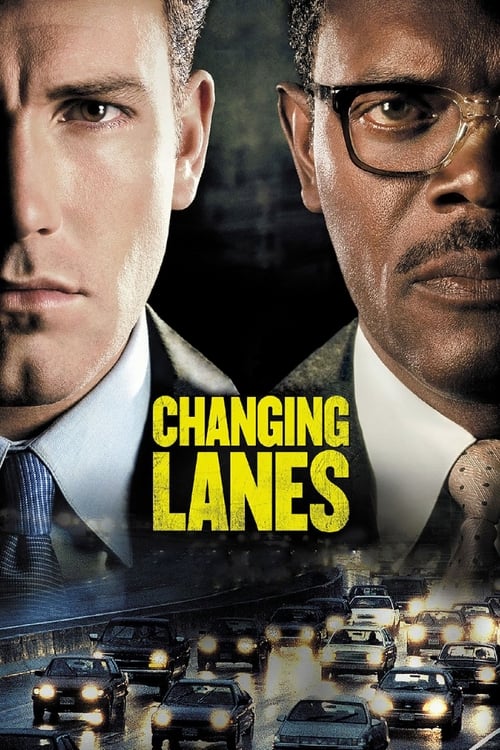
Changing Lanes (2002)
Directed by Roger Michell
No — Changing Lanes is not especially woke, scoring 23 out of 100 on our wokeness meter.
Changing Lanes arrives from 2002, a year when a studio thriller could still put two men in a car crash and call it a moral inquiry.
Consciousness Markers
Samuel L. Jackson anchors the film as a Black co-lead opposite Ben Affleck, and the supporting cast is reasonably mixed, but the casting reflects standard 2002 studio practice rather than a deliberate diversity mandate.
The film critiques corporate law-firm corruption, forged documents, and a shady 'fixer,' but this is a moral-ethical indictment of individual malfeasance rather than a systemic eat-the-rich polemic.
The white lawyer versus Black working-class salesman dynamic carries implicit racial and class subtext, but the film never explicitly engages race as a theme, treating the conflict as purely personal.
The film explores ethical dilemmas and moral consequences, but it does so through escalating thriller mechanics rather than direct moralizing or preachy exposition.
Toni Collette and Amanda Peet appear in supporting roles, but the film is a two-hander about men and offers no feminist framing or commentary.
No LGBTQ+ characters, themes, or subtext appear anywhere in the film.
No environmental or climate themes are present.
No body-positivity themes or messaging appear in the film.
Doyle's alcoholism and AA attendance are depicted, but addiction is not framed as neurodivergence and no neurodivergent identity is explored.
The film is a contemporary fictional thriller with no historical revisionism or recontextualization of past events.
Why it received this score
Changing Lanes arrives from 2002, a year when a studio thriller could still put two men in a car crash and call it a moral inquiry. Ben Affleck plays Gavin Banek, a Wall Street attorney with a forged document in his briefcase. Samuel L. Jackson plays Doyle Gipson, a recovering alcoholic insurance salesman trying to keep custody of his sons. A fender-bender on the FDR Drive turns them into mutual saboteurs for ninety minutes. Roger Michell directs with the grim efficiency of a man who knows the audience came for the escalation and will tolerate the sermon if it stays brief.
The social content is present but muted. Jackson's casting gives the story an implicit racial and class charge, the white lawyer with the blank check against the Black salesman who wants to do things properly, though the screenplay never names race and treats the whole feud as personal. The corporate villainy is real: a law firm that forges a dead man's signature, a hacker who ruins a credit rating for cash, a senior partner played by Sydney Pollack with practiced contempt. This is an indictment of individual rot, not a systemic howl. Toni Collette and Amanda Peet appear in supporting roles and are given very little to do.
The absences are more telling than the presences. There is no romantic subplot worth the name, no identity politics, no environmental sermon, no lecture delivered to camera. The ethical dilemmas arrive through plot mechanics, which is the older and quieter way of making a point. Doyle's alcoholism is a character flaw, not a diagnosis. We are left with a competent, well-acted thriller that asks whether a man can be decent after he has already been terrible, and answers yes, with a handshake. A modest vintage. Drinkable, unremarkable, faintly dusty.
Analysis generated by our Consciousness Algorithm
Part of


Synopsis
A rush-hour fender-bender on New York City's crowded FDR Drive, under most circumstances, wouldn't set off a chain reaction that could decimate two people's lives. But on this day, at this time, a minor collision will turn two complete strangers into vicious adversaries. Their means of destroying each other might be different, but their goals, ultimately, will be the same: Each will systematically try to dismantle the other's life in a reckless effort to reclaim something he has lost.
Questions about Changing Lanes
Is Changing Lanes woke?
No — Changing Lanes is not especially woke, scoring 23 out of 100 on our wokeness meter. That earns it a verdict of Based.
Does Changing Lanes have any woke elements?
1 of the 10 markers register at 30 or above, led by Representation Casting (35). On Representation Casting: Samuel L.
How does Changing Lanes compare to other 2002 movies?
It ranks #19 of the 150 films from 2002 we've scored; their average is 12. The wokest is Far from Heaven (78).
How is the Woke Score calculated?
An AI-assisted process researches the film and its reception, scores it 0–100 on ten markers, then combines those into one 0–100 Woke Score. It measures a specific set of 2020s cultural themes, not film quality.