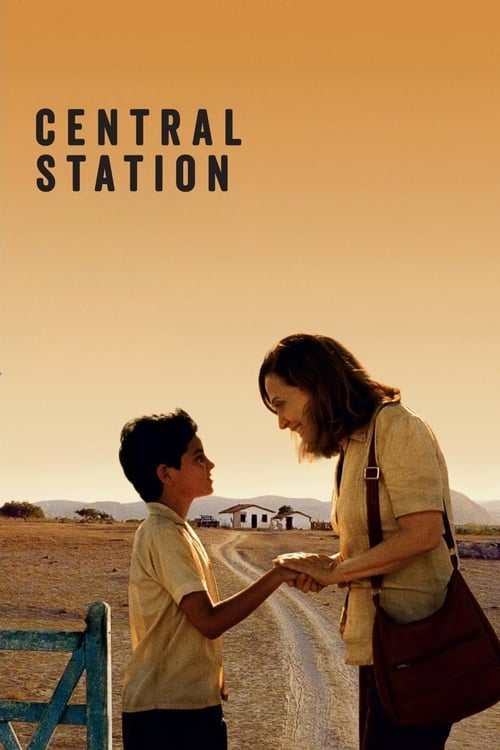
Central Station (1998)
Directed by Walter Salles
No — Central Station is not woke, scoring 7 out of 100 on our wokeness meter.
Walter Salles opens his 1998 road drama in the clamor of Rio de Janeiro's Central Station, where Dora, a retired schoolteacher of corrosive disposition, scratches out a living writing letters for the illiterate.
Consciousness Markers
Dora is a complex, unsentimental female protagonist, but the film is a humanist character study rather than a vehicle for a feminist agenda.
The cast is entirely Brazilian, which is natural and unremarkable for a Brazilian production rather than a deliberate diversity statement. No commentary is made on representation.
The film is a quiet, unforced road drama that shows rather than preaches, with no didactic messaging.
No LGBTQ+ characters or themes appear anywhere in the narrative.
The film depicts poverty and illiteracy in Brazil without framing them through a racial-consciousness lens.
No environmental or climate themes are present.
The film critiques individual moral failings (letter hoarding, child trafficking) rather than capitalism or class structures as a system.
No body-positivity themes or messaging appear.
No neurodivergence is depicted or discussed.
The story is fictional and makes no revisionist claims about historical events.
Why it received this score
Walter Salles opens his 1998 road drama in the clamor of Rio de Janeiro's Central Station, where Dora, a retired schoolteacher of corrosive disposition, scratches out a living writing letters for the illiterate. She does not mail them. She files them in a drawer, or tears them up, and the film observes this petty cruelty without a flicker of editorializing. When a customer is killed by a bus and leaves behind a nine-year-old boy named Josué, Dora trafficks him to a corrupt couple, then steals him back out of guilt, then hauls him across the backlands in search of a father who has long since vanished. Fernanda Montenegro plays her with a sour, guarded intelligence that never once begs for our affection.
The picture is a road drama of the old school: unforced, patient, allergic to sermons. It shows poverty and illiteracy as facts of the landscape, not as theses to be advanced. The truck driver who abandons them is a decent evangelical with his own reasons. The pilgrimage crowd that rescues Dora's finances is simply a crowd. Nobody delivers a speech about the dignity of the poor, and the film trusts us to draw our own conclusions, which is an increasingly rare courtesy. The warmth it eventually locates between the woman and the child arrives quietly, through photographs and a letter left deliberately unmailed.
For the purposes of cultural accounting, the ledger is thin. The cast is entirely Brazilian, which for a Brazilian production is not a statement but a circumstance. There is no racial framing, no environmental lament, no critique of capital as a system, no body politics, no neurodivergence, no revisionist claim upon history. Dora is a difficult woman rendered without sentiment, which is not the same as a manifesto. What remains is a well-made film about broken lives and the small, ordinary miracle of hope. The classification is uneventful. Not every vintage requires a sommelier. Some simply require a glass.
Some simply require a glass, and this one goes down cleanly enough, leaving behind only the faint mineral aftertaste of craftsmanship and no ideological residue whatsoever. We file it accordingly, under Drama, Brazilian, road, unremarkable in the categories that concern us most, and quietly excellent in the ones that do not. The sommelier sets down his pen. The cellar remains undisturbed. The evening concludes without incident, which for a film of this vintage is its own small distinction. We note the year, we note the absence of agenda, and we move on to the next bottle with the weary gratitude of a man who has tasted too many vintages that shouted their virtues at him. This one merely poured, and waited, and was gone. The ledger closes balanced. The station empties. The letters, for once, stay in the drawer, and nobody lectures us about it, which is the highest compliment available in this line of work, and one we do not bestow lightly, or often, or ever again. The classification stands.
Analysis generated by our Consciousness Algorithm
Synopsis
An emotional journey of a former school teacher, who writes letters for illiterate people, and a young boy, whose mother has just died, as they search for the father he never knew.
Questions about Central Station
Is Central Station woke?
No — Central Station is not woke, scoring 7 out of 100 on our wokeness meter. That earns it a verdict of Ultra Based.
Does Central Station have any woke elements?
Very few. None of the 10 markers reaches 30, the level where a marker counts as present; the highest is Feminist Agenda at 15.
How does Central Station compare to other 1998 movies?
It ranks #67 of the 118 films from 1998 we've scored; their average is 12. The wokest is Show Me Love (60).
How is the Woke Score calculated?
An AI-assisted process researches the film and its reception, scores it 0–100 on ten markers, then combines those into one 0–100 Woke Score. It measures a specific set of 2020s cultural themes, not film quality.