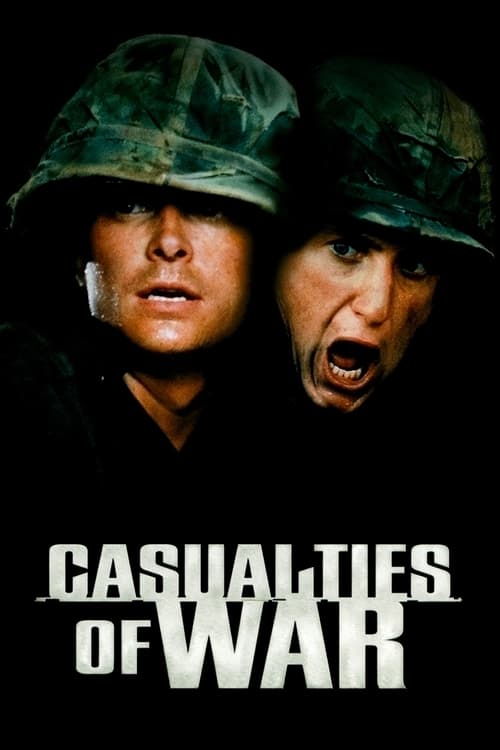
Casualties of War (1989)
Directed by Brian De Palma
No — Casualties of War is not woke, scoring 17 out of 100 on our wokeness meter.
Casualties of War presents a harrowing historical account of military misconduct that feels both overplayed and necessary.
Consciousness Markers
The squad is naturally multiethnic (Ving Rhames, Wendell Pierce, John Leguizamo, Erik King) and a Vietnamese actress (Thuy Thu Le) carries the central victim role, but this is period-appropriate ensemble casting rather than a deliberate diversity statement.
The atrocity is rooted in the dehumanization of the Vietnamese as subhuman, and the film indicts that racism, but it is framed as a war-crime drama rather than a meditation on racial consciousness.
The film carries a heavy moral message and a somewhat didactic closing scene in which the murdered girl's double assures Eriksson 'it's over now,' but it persuades through drama rather than preaching.
The film condemns the rape and murder of a Vietnamese woman, but she functions largely as a catalyst for the male protagonist's moral awakening and has almost no agency of her own.
The film faithfully dramatizes a documented 1966 war crime rather than reinterpreting history through a modern ideological lens; its counter-narrative of American misconduct is a moral indictment, not a revisionist reframing.
No LGBTQ+ characters, themes, or subtext of any kind.
No environmental or climate themes whatsoever.
No critique of capitalism, class, or economic structures.
No body-positivity themes or messaging.
No neurodivergence themes or characters.
Why it received this score
Casualties of War presents a harrowing historical account of military misconduct that feels both overplayed and necessary. Director Brian De Palma stages a period-specific ensemble piece that uses a naturally diverse cast to explore the dark underbelly of the Vietnam conflict. The story centers on the documented atrocities of 1966, focusing on the dehumanization of the Vietnamese people. The film operates as a moral indictment of American behavior rather than a modern progressive commentary on identity or social structure. It is not a film concerned with the contemporary cultural conversation surrounding gender or sexuality.
We see a heavy-handed moral message delivered through the trauma of the central female character. While the film condemns the systemic racism depicted in the war, it is framed strictly as a war crime drama. The characters involved in the incident are given limited agency, functioning primarily as catalysts for the protagonist’s moral reckoning. The final sequences, which involve a tense court-martial and a fateful encounter on a San Francisco transit line, carry a significant lecture energy. This ending attempts to wrap a complex, brutal reality into a neat, highly dramatic bow.
This is a powerful piece of cinematic history, but its focus remains firmly planted in the past. The film is dedicated to detailing past failings, avoiding any revision of the historical record. It is a grim exercise in acknowledging uncomfortable truths about war, rather than engaging in any progressive social critique. The result is a film that is morally severe, if somewhat fatigued by its own insistence on historical gravity.
Analysis generated by our Consciousness Algorithm


Synopsis
During the Vietnam War, a soldier finds himself the outsider of his own squad when they unnecessarily kidnap a female villager.
Questions about Casualties of War
Is Casualties of War woke?
No — Casualties of War is not woke, scoring 17 out of 100 on our wokeness meter. That earns it a verdict of Ultra Based.
Does Casualties of War have any woke elements?
1 of the 10 markers register at 30 or above, led by Representation Casting (30). On Representation Casting: The squad is naturally multiethnic (Ving Rhames, Wendell Pierce, John Leguizamo, Erik King) and a Vietnamese actress (Thuy Thu Le) carries the central victim role, but this is period-appropriate ensemble casting rather than a deliberate diversity statement.
How does Casualties of War compare to other 1989 movies?
It ranks #9 of the 68 films from 1989 we've scored; their average is 10. The wokest is Do the Right Thing (72).
How is the Woke Score calculated?
An AI-assisted process researches the film and its reception, scores it 0–100 on ten markers, then combines those into one 0–100 Woke Score. It measures a specific set of 2020s cultural themes, not film quality.