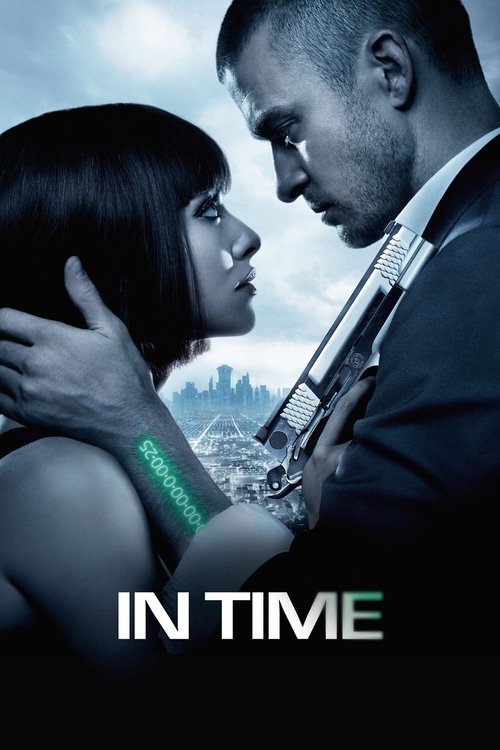
In Time (2011)
Directed by Andrew Niccol
Partly · Woke-Adjacent
How we score movies →Consciousness Markers
The film's central premise and narrative structure function as an extended critique of capitalism and wealth inequality. Time as currency serves as an explicit metaphor for capitalist exploitation, and the film presents the redistribution of resources as morally justified.
The film frequently prioritizes ideological exposition over character development or narrative complexity. Scenes are constructed to illustrate class differences, and dialogue often functions as direct commentary on economic systems rather than organic character interaction.
The cast includes some minority actors in supporting roles, but there is no deliberate attention to casting diversity or addressing representation as a thematic concern. Minority characters serve the plot rather than being centered in any meaningful way.
Female characters exist in the narrative but are not developed with attention to feminist themes. Amanda Seyfried's character functions primarily as a love interest and plot device rather than as an agent of her own story.
While minority actors appear in the cast, there is no explicit engagement with racial consciousness or racial justice as a thematic element. Race is not addressed in the narrative.
No LGBTQ+ themes, representation, or representation are present in the film. Sexual orientation and gender identity are not addressed.
Climate change and environmental concerns are not addressed in the film. The narrative does not engage with ecological themes.
The film contains no engagement with body positivity, disability representation, or acceptance of diverse body types. No commentary on these subjects is present.
Neurodivergence is not addressed or represented in the film. No characters are coded as neurodivergent, and the subject receives no thematic attention.
The film is set in a dystopian future and does not engage with historical revision or reinterpretation of past events. It does not reframe historical narratives.


Synopsis
In the not-too-distant future, the aging gene has been switched off. To avoid overpopulation, time has become the currency and the way people pay for luxuries and necessities. The rich can live forever, while the rest struggle to negotiate for their immortality. A poor young man who suddenly comes into a fortune of time finds himself on the run from a corrupt police force known as the "time keepers".
Why it received this score
"In Time" presents itself as a scathing critique of capitalism dressed in the garb of a science fiction thriller, which is to say it wears its social consciousness on its sleeve with the subtlety of a sledgehammer. Andrew Niccol's examination of wealth inequality, expressed through the conceit of time as currency, makes the film's anti-capitalist preoccupations impossible to ignore. The narrative machinery exists primarily to illustrate the binary opposition between the proletariat and the bourgeoisie, with little interest in the messy complications of human motivation or character development. One watches the film less as entertainment and more as a visual essay on class struggle.
However, the film's progressive sensibilities are limited almost entirely to its economic messaging. The representation of marginalized groups remains incidental to the plot rather than integral to its thematic project. Female characters exist in the narrative but receive no particular attention to their agency or perspective. There is no visible LGBTQ+ representation, no examination of neurodivergence or disability, and no engagement with racial consciousness beyond the presence of minority actors in supporting roles. The film's lecture energy is undeniable, but it lectures on one subject only, and that subject is delivered with all the nuance of a political pamphlet.
This represents a kind of proto-woke cinema, one that engages seriously with economic justice but has not yet absorbed the broader constellation of progressive cultural markers that would emerge as dominant in the 2020s. The film is, in its way, admirably focused in its commitment to a single ideological argument, which is also precisely its limitation.
Analysis generated by our Consciousness Algorithm
Critic Reviews
“Coming now, today, In Time is not just satisfying. I wouldn't go so far as to say it's important, because that would overstate it, but it certainly feels like part of the national conversation. It arrives in theaters at a time when people are camped out in New York saying the same things as the people in the movie. It's weird the way films often anticipate the near future. ”
“In Time has so much style and energy that it comes across as an act of boldness rather than just a liberal-minded tract, though of course, it's that too. If there were ever a movie made for the 99 percent, this is it.”
“Justin Timberlake continues to demonstrate that he is a real actor, with screen presence. But after the precise timing and intelligence he brought to "The Social Network," it's a little disappointing to find him in a role that requires less. He has a future in the movies. ”
“Niccol fashioned an uninspired and downright dull sci-fi gimmick and doesn't even explain how it happened.”