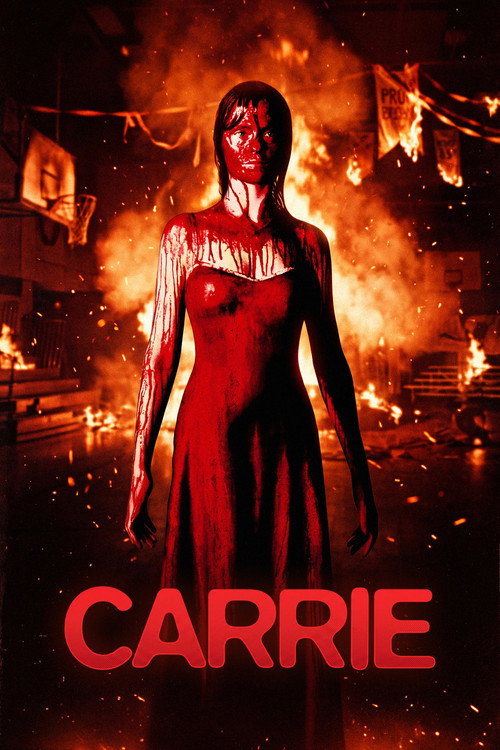
Carrie (2002)
Directed by David Carson
No — Carrie is not woke, scoring 11 out of 100 on our wokeness meter.
Every few years, someone decides the culture needs another Carrie, and in 2002 that someone was NBC, which commissioned a two-hour remake as a backdoor pilot and then, once the ratings arrived respectable, quietly declined to order the series.
Consciousness Markers
The cast includes Kandyse McClure as Sue Snell, a prominent role for a Black actress in a 2002 TV film, though the diversity is unremarked upon and largely incidental to the story.
The story centers on a girl's puberty, bullying, and rage against her tormentors and abusive mother, giving it a female-centric coming-of-age frame, but it advances no explicit feminist thesis.
No LGBTQ+ characters, themes, or subtext appear anywhere in the film.
Race is never a subject of the narrative; the film engages no racial themes or commentary.
No environmental or climate themes are present.
The film contains no critique of capitalism, wealth, or class structures.
No body-positivity messaging; the film treats menstruation as a source of shame and horror rather than affirmation.
No neurodivergent characters or themes are depicted.
The film is a contemporary-set horror story with no historical revisionism.
The film is a straightforward horror narrative and does not pause to deliver social or political sermons to the audience.
Why it received this score
Every few years, someone decides the culture needs another Carrie, and in 2002 that someone was NBC, which commissioned a two-hour remake as a backdoor pilot and then, once the ratings arrived respectable, quietly declined to order the series. What we have instead is a strange artifact in Bryan Fuller's filmography, a mood board for the sharper work he would later produce. Angela Bettis plays the telekinetic outcast with a hard, watchful stillness, and Patricia Clarkson renders the mother as a woman who has mistaken the Old Testament for a parenting manual. The prom still happens. The blood still falls. The gym still burns. The revised ending keeps Carrie alive for a sequel that never came, which lends the whole enterprise the melancholy of an unreturned phone call.
On the question of social consciousness, the ledger is nearly empty. Kandyse McClure takes the substantial role of Sue Snell, a piece of casting that would have read as unremarkable in 1976 and registers as quietly progressive here, though the screenplay never once acknowledges it. The narrative is built around a girl's body, her first period, the shame assigned to it, and the rage that follows, which gives the material a female-centric spine. It stops well short of argument. Menstruation is framed as sin and horror, never as anything to celebrate, so no affirmation can be found in it. Race never enters the conversation. Neither does queerness, nor the climate, nor the economy, nor the question of who qualifies as neurotypical. The film has no thesis to press.
This leaves a curiosity: a competent, overlong, bloodless remake that treats its audience as viewers and not as students. In an era when even the prom massacre would be expected to carry a lesson, this one simply kills everyone and drives off into the Florida night. Almost quaint.
Analysis generated by our Consciousness Algorithm


Synopsis
An awkward, telekinetic teenage girl's lonely life is dominated by relentless bullying at school and an oppressive religious fanatic mother at home. When her tormentors pull a humiliating prank at the senior prom, she unleashes a horrifying chaos on everyone, leaving nothing but destruction in her wake.
Questions about Carrie
Is Carrie woke?
No — Carrie is not woke, scoring 11 out of 100 on our wokeness meter. That earns it a verdict of Ultra Based.
Does Carrie have any woke elements?
Very few. None of the 10 markers reaches 30, the level where a marker counts as present; the highest is Representation Casting at 25.
How does Carrie compare to other 2002 movies?
It ranks #53 of the 150 films from 2002 we've scored; their average is 12. The wokest is Far from Heaven (78).
How is the Woke Score calculated?
An AI-assisted process researches the film and its reception, scores it 0–100 on ten markers, then combines those into one 0–100 Woke Score. It measures a specific set of 2020s cultural themes, not film quality.