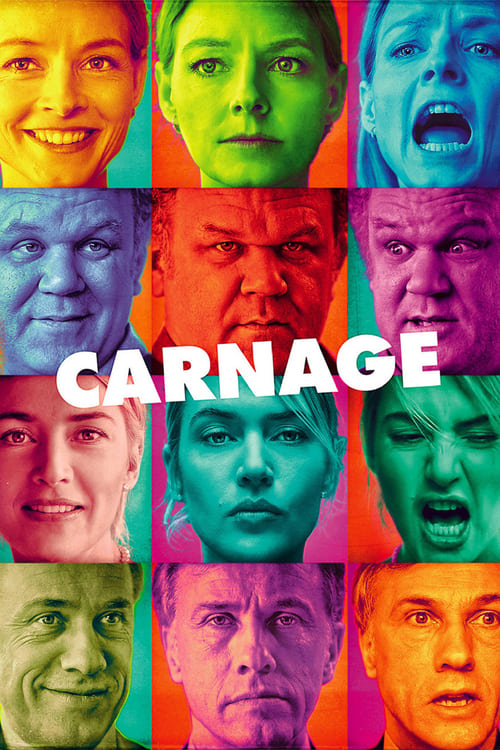
Carnage (2011)
Directed by Roman Polanski
No — Carnage is not woke, scoring 7 out of 100 on our wokeness meter.
Roman Polanski's Carnage assembles four excellent actors in a Brooklyn apartment and lets them dismantle one another for eighty minutes.
Consciousness Markers
Alan's role as a corporate lawyer defending a risky pharmaceutical drug and his constant business calls carry a mild satirical jab at corporate amorality, but it is incidental to the domestic comedy.
The film is a dialogue-driven argument, but it aims to amuse and expose hypocrisy rather than to instruct the audience on a social message.
Foster and Winslet play forceful, complex women who dominate the escalating conflict, but the film advances no feminist thesis or critique of patriarchy.
The four leads are all white, and the supporting cast offers no meaningful diversity. Casting is entirely conventional for a 2011 stage adaptation.
No LGBTQ+ characters, themes, or subtext appear anywhere in the film.
Race is never addressed or thematized; the characters' conflicts are entirely personal and class-inflected.
No environmental or climate themes are present.
No body-positive themes or messaging appear.
No neurodivergent characters or themes are depicted.
The film makes no historical claims and revises no historical record.
Why it received this score
Roman Polanski's Carnage assembles four excellent actors in a Brooklyn apartment and lets them dismantle one another for eighty minutes. The premise is a meeting between two sets of parents whose sons have exchanged a stick to the face. The meeting is meant to be brief. It is not brief. Polanski, working from Yasmina Reza's Tony-winning play, keeps the camera close and the exits visible, and the four performers do the heavy lifting with the weary precision of people who have done this on stage before. The film is a comedy of errors, which is to say it is a comedy of people who cannot stop talking long enough to leave.
The two women, played by Jodie Foster and Kate Winslet, hold the room with force and complexity, and they escalate the argument with a conviction the men never quite match. This is not a thesis about patriarchy. It is a play about four people behaving badly, and the film treats their gender as a fact of casting, not a cause for commentary. Christoph Waltz's corporate lawyer, forever taking calls about a risky pharmaceutical he is paid to defend, offers a light jab at professional amorality. The jab lands and then it is over. Nobody in the film is trying to teach us anything about the economy, and the screenplay has no interest in converting its audience.
What we get instead is a hamster, a vase of tulips, a BlackBerry in the water, and a slow collapse into name-calling. The film wants to amuse and to expose hypocrisy, and it does both without a single sermon. There is no racial reckoning here, no environmental conscience, no advocacy of any kind. The characters are white, comfortable, and consumed by their own grievances. The closing shot of two boys quietly reconciling in a park suggests the adults were never the point. A tidy, unfashionable film about the pleasure of watching intelligent people lose an argument.
Analysis generated by our Consciousness Algorithm


Synopsis
Two pairs of parents hold a cordial meeting after their sons are involved in a fight, though as their time together progresses, increasingly childish behavior throws the discussion into chaos.
Questions about Carnage
Is Carnage woke?
No — Carnage is not woke, scoring 7 out of 100 on our wokeness meter. That earns it a verdict of Ultra Based.
Does Carnage have any woke elements?
Very few. None of the 10 markers reaches 30, the level where a marker counts as present; the highest is Eat the Rich at 15.
How does Carnage compare to other 2011 movies?
It ranks #133 of the 245 films from 2011 we've scored; their average is 11. The wokest is Paul (68).
How is the Woke Score calculated?
An AI-assisted process researches the film and its reception, scores it 0–100 on ten markers, then combines those into one 0–100 Woke Score. It measures a specific set of 2020s cultural themes, not film quality.