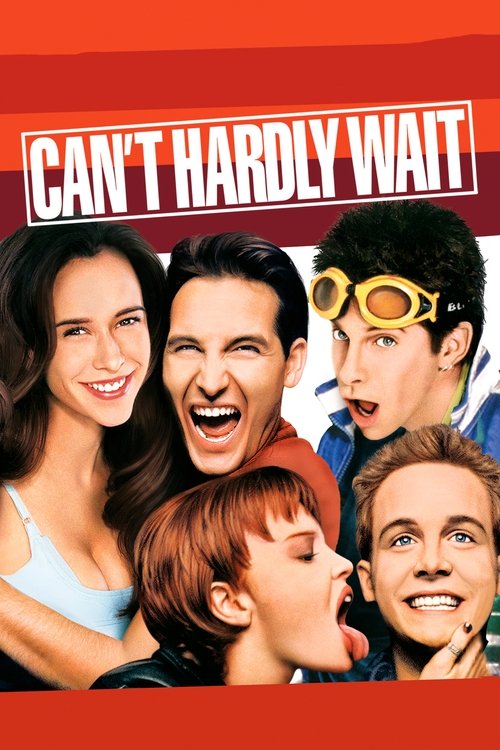
Can't Hardly Wait (1998)
Directed by Harry Elfont
No — Can't Hardly Wait is not woke, scoring 7 out of 100 on our wokeness meter.
We approach this 1998 assembly of suburban nostalgia with the solemnity due a cultural artifact, though we arrive at a deeply uninspired conclusion.
Consciousness Markers
Amanda's arc involves questioning her identity beyond being 'Mike Dexter's girlfriend,' and the film was co-written/co-directed by Deborah Kaplan, but it remains a conventional romance rather than a feminist statement.
The ensemble is overwhelmingly white, with only incidental background diversity typical of late-90s teen comedies; no meaningful representation casting choices.
The film is a breezy party comedy that never preaches; any moralizing is limited to mild 'be yourself' sentiment.
No engagement with race whatsoever; the suburban setting is uniformly white and the film makes no comment on it.
The rich kid's house hosts the party and William's epilogue wealth is played for laughs, but there is no critique of capitalism or class consciousness.
No LGBTQ+ characters or themes; the 'homophobia' keyword refers only to a throwaway gag, not any substantive content.
No environmental themes of any kind.
No body positivity themes; the film trades in standard teen-comedy appearance tropes.
No neurodivergent characters or themes; the 'nerd' archetype is played for comedy, not as representation.
A contemporary teen comedy with no historical subject matter to revise.
Why it received this score
We approach this 1998 assembly of suburban nostalgia with the solemnity due a cultural artifact, though we arrive at a deeply uninspired conclusion. Can't Hardly Wait functions as a brightly lit, extremely air-conditioned snapshot of a bygone era, preoccupied with the universal anxieties of high school graduation. The film’s progressive sensibilities are so peripheral they feel like polite suggestions rather than actual convictions. The ensemble, while energetic, remains firmly rooted in a remarkably homogeneous demographic. Any exploration of identity or social friction is largely confined to the protagonist Amanda, whose quest to define herself beyond her relationship status constitutes the film’s only genuine attempt at a feminist exploration.
The social consciousness of the film is, at best, superficial. We see a wealthy backdrop, but there is no critique of the economic structures that facilitate this environment, nor is there any serious engagement with issues of race or class. While the director, Kaplan, brings a certain cultural awareness to the script, the execution often defaults to established, predictable teen comedy tropes. The moments intended to spark thought are consistently light, never achieving a truly lecture-heavy gravitas, even when the characters are having profound conversations about life's transition.
Ultimately, this is a movie designed for a pleasant, low-stakes viewing. Its primary function is to document the fleeting melodrama of a privileged social circle. It possesses the requisite emotional peaks for a coming-of-age piece, but lacks the structural ambition or specific political commitment necessary to be regarded as anything more than a charming piece of its time. We categorize it not for its groundbreaking social commentary, but for its status as a precursor to its own anticipated sequel.
Analysis generated by our Consciousness Algorithm


Synopsis
It's graduation day at Huntington Hills High, and you know what that means - time to party. And not just any party, either. This one will be a night to remember, as the nerds become studs, the jocks are humiliated, and freshman crushes blossom into grown-up romance.
Questions about Can't Hardly Wait
Is Can't Hardly Wait woke?
No — Can't Hardly Wait is not woke, scoring 7 out of 100 on our wokeness meter. That earns it a verdict of Ultra Based.
Does Can't Hardly Wait have any woke elements?
Very few. None of the 10 markers reaches 30, the level where a marker counts as present; the highest is Feminist Agenda at 22.
How does Can't Hardly Wait compare to other 1998 movies?
It ranks #67 of the 118 films from 1998 we've scored; their average is 12. The wokest is Show Me Love (60).
How is the Woke Score calculated?
An AI-assisted process researches the film and its reception, scores it 0–100 on ten markers, then combines those into one 0–100 Woke Score. It measures a specific set of 2020s cultural themes, not film quality.