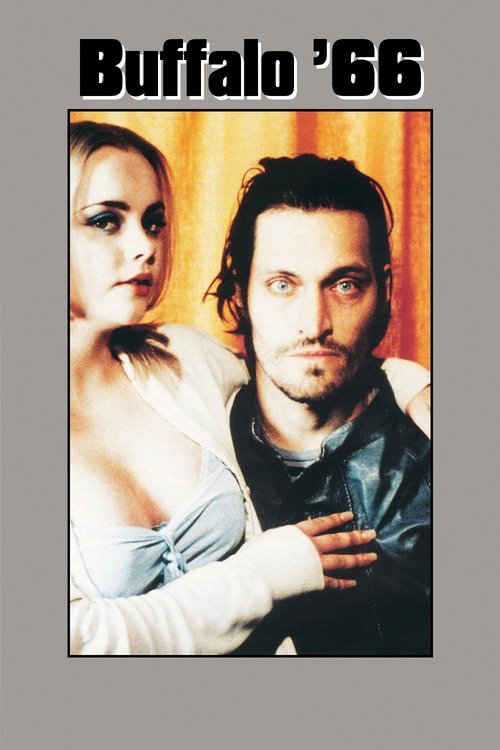
Buffalo '66 (1998)
Directed by Vincent Gallo
No — Buffalo '66 is not woke, scoring 0 out of 100 on our wokeness meter.
Vincent Gallo's Buffalo '66 arrives in 1998 with the confidence of a man who has never once considered whether anyone in the room might be uncomfortable.
Consciousness Markers
The cast is almost entirely white, led by Vincent Gallo, Christina Ricci, Anjelica Huston, Ben Gazzara, and Mickey Rourke. There is no deliberate diverse or color-conscious casting.
No LGBTQ+ characters, themes, or subtext appear anywhere in the film.
The premise is a man kidnapping a young woman and forcing her to pose as his wife; Layla is a passive object of Billy's needs who falls for her captor. This is the opposite of a feminist agenda.
The film engages no racial themes or commentary whatsoever; its concerns are entirely personal and familial.
There is no environmental or climate content in the film.
Gallo, a self-described political conservative, explicitly framed the film as a statement about personal responsibility against victimhood and socialism. It is not an eat-the-rich or anti-capitalist work.
No body-positive themes; if anything, Gallo's off-screen remarks about Ricci's weight run contrary to the marker.
No neurodivergent characters or themes are present or explored.
The film is a personal character study, not a historical narrative, and makes no revisionist historical claims.
The film contains a political thesis per its director, but it is a conservative one about self-reliance, delivered through character rather than a progressive sermon. No woke lecture energy.
Why it received this score
Vincent Gallo's Buffalo '66 arrives in 1998 with the confidence of a man who has never once considered whether anyone in the room might be uncomfortable. Billy Brown exits prison, abducts a teenage tap dancer named Layla, installs her in his parents' dim Buffalo living room as his wife, and then spends the remainder of the runtime being rude to her. The film is a character study of a specific kind of grievance, and it has no interest in correcting that grievance through any contemporary social framework. The camera loves Christina Ricci, the screenplay does not respect her, and nobody involved appears to have noticed the difference.
Our classification apparatus finds this vintage barren. The cast is white and assembled without any apparent color-consciousness. No queer subtext surfaces, no racial commentary, no environmental anxiety, no body-positive gesture. The premise, a man kidnapping a woman who then falls for him, sits far from any feminist reading, and the director's own stated politics, a self-reliance sermon aimed squarely at socialists, place the film on the opposite bank from any eat-the-rich sentiment. There is no lecture here. There is instead a man in a bowling alley, and King Crimson, and a mother who cares more about a football game than her son.
This is not a film that preaches. It is a film that sulks, beautifully, in saturated reversal stock, and asks us to find its sulking profound. The result is a curio: formally adventurous, emotionally stingy, and entirely free of the markers we have been dispatched to tally. We record the score, we note the absence, and we move on to the next screening. The Buffalo Bills still have not won a championship. Neither, in the end, has Billy Brown.
Analysis generated by our Consciousness Algorithm


Synopsis
Billy is released after five years in prison. In the next moment, he kidnaps teenage student Layla and visits his parents with her, pretending she is his girlfriend and they will soon marry.
Questions about Buffalo '66
Is Buffalo '66 woke?
No — Buffalo '66 is not woke, scoring 0 out of 100 on our wokeness meter. That earns it a verdict of Ultra Based.
Does Buffalo '66 have any woke elements?
No. All 10 markers score zero.
How does Buffalo '66 compare to other 1998 movies?
It ranks #110 of the 118 films from 1998 we've scored; their average is 12. The wokest is Show Me Love (60).
How is the Woke Score calculated?
An AI-assisted process researches the film and its reception, scores it 0–100 on ten markers, then combines those into one 0–100 Woke Score. It measures a specific set of 2020s cultural themes, not film quality.