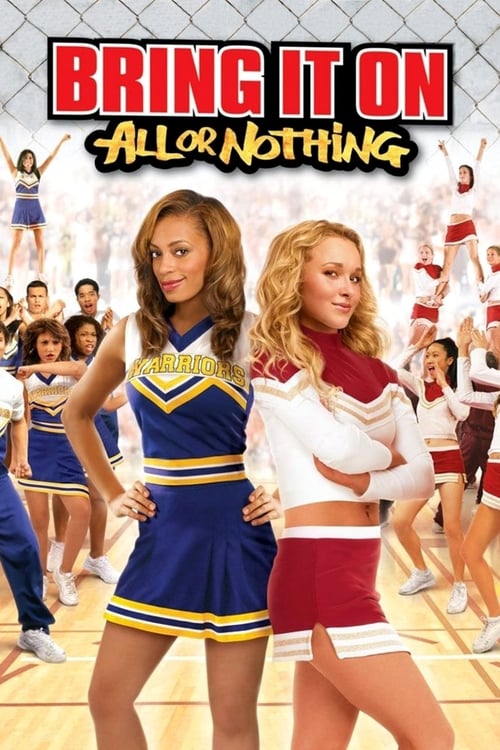
Bring It On: All or Nothing (2006)
Directed by Steve Rash
No — Bring It On: All or Nothing is not especially woke, scoring 32 out of 100 on our wokeness meter.
Bring It On: All or Nothing arrives as the third entry in a franchise that had already moved from theatrical novelty to direct-to-DVD arithmetic.
Consciousness Markers
Race is the film's central dramatic fault line — Winnie's repeated racially insensitive remarks, the rich-white-school versus working-class-Black-school divide, and the krumping/hip-hop appropriation debate are all explicitly staged.
The ensemble is genuinely multiracial, led by Hayden Panettiere opposite Solange Knowles-Smith, with Francia Raisa, Giovonnie Samuels, and a Rihanna cameo, and the plot's whole engine is a white transfer student entering a predominantly Black squad — diversity is structural, not background.
A teammate faints from a crash diet, prompting Britney to apologize for having pressured her squad into weight loss while she was captain — a real, if brief, reckoning with cheerleading's body-image culture.
Female captains, rivalries, and leadership arcs dominate, but the film's resolutions still orbit around boys, homecoming crowns, and romantic reconciliation rather than any articulated feminist thesis.
Moral lessons about racial tolerance and not judging people by their background are delivered in dialogue at key beats, but they are woven into teen-comedy plot mechanics rather than preached directly to the audience.
The competition's prize — new computers for the underfunded Crenshaw Heights school — gestures at resource inequality between wealthy and working-class districts, though it is never developed into a critique.
No LGBTQ+ characters, themes, or subtext appear anywhere in the film.
No environmental themes, imagery, or messaging of any kind.
No neurodivergent characters or themes are present.
The film makes no historical claims to revise; it is a contemporary teen comedy.
Why it received this score
Bring It On: All or Nothing arrives as the third entry in a franchise that had already moved from theatrical novelty to direct-to-DVD arithmetic. Its premise is simple: Britney Allen, a wealthy white cheer captain, transfers to working-class Crenshaw Heights and joins a predominantly Black squad. The film's diversity is not decorative. Solange Knowles-Smith, Francia Raisa, Giovonnie Samuels, and a young Rihanna in a cameo populate a cast whose racial dynamics drive the plot. Winnie, the replacement captain at Pacific Vista, supplies a steady stream of racially insensitive remarks, and the contest between a rich white school and an underfunded Black school gives the comedy a clear fault line. The krumping debate adds another layer, though the film treats hip-hop appropriation with the subtlety of a pep rally.
Elsewhere the social conscience is more modest. Female captains and rivalries dominate the action, yet the story keeps circling back to boys, homecoming crowns, and romantic reconciliation. A teammate faints from a crash diet, which prompts Britney to apologize for having pressured the squad into weight loss. That is a real reckoning, briefly staged. The prize of new computers for Crenshaw Heights gestures at resource inequality, but the film never builds it into a critique. Lessons about tolerance and not judging by background are spoken aloud at key moments, usually just before a dance number. The film has no LGBTQ threads, no environmental agenda, no neurodivergent characters, and no historical claims to revise.
This leaves a teen comedy with an unusually explicit racial frame and a limited appetite for follow-through. It is a sequel, a direct-to-DVD product, and a vehicle for mid-2000s pop. The cultural awareness is genuine enough, but it shares screen time with cheerleading stunts and a Rihanna performance. We are left with a film that says the right things in between the routines, then lets the routines win. The classification is moderate, uneven, and entirely of its moment.
Analysis generated by our Consciousness Algorithm
Part of


Synopsis
A transfer student at a rough high school tries joining the cheer-leading squad and finds that she not only has to face off against the head cheerleader, but also against her former school in preparation for a cheer-off competition.
Questions about Bring It On: All or Nothing
Is Bring It On: All or Nothing woke?
No — Bring It On: All or Nothing is not especially woke, scoring 32 out of 100 on our wokeness meter. That earns it a verdict of Based.
Does Bring It On: All or Nothing have any woke elements?
3 of the 10 markers register at 30 or above, led by Racial Consciousness (58), Representation Casting (55) and Body Positivity (30). On Racial Consciousness: Race is the film's central dramatic fault line — Winnie's repeated racially insensitive remarks, the rich-white-school versus working-class-Black-school divide, and the krumping/hip-hop appropriation debate are all explicitly staged.
How does Bring It On: All or Nothing compare to other 2006 movies?
It ranks #15 of the 211 films from 2006 we've scored; their average is 11. The wokest is An Inconvenient Truth (92).
Is Bring It On: All or Nothing the most woke Bring It On movie?
No. It ranks #3 of the 4 Bring It On films we've scored; the wokest is Bring It On (60).