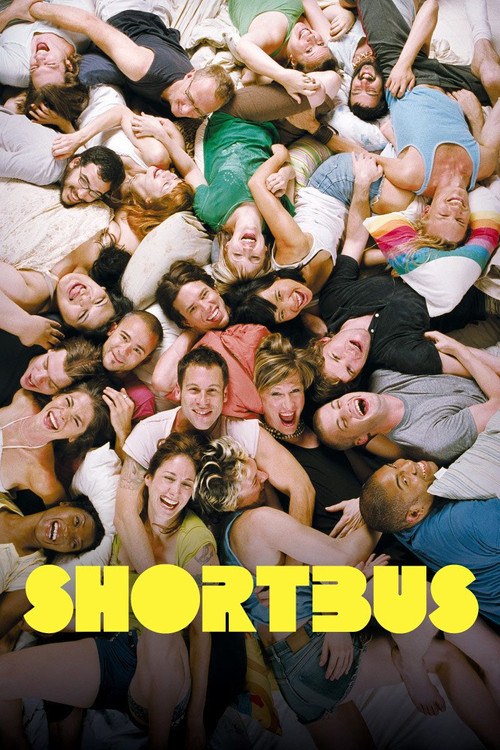
Shortbus (2006)
Directed by John Cameron Mitchell
Yes — Shortbus is woke, scoring 60 out of 100 on our wokeness meter.
John Cameron Mitchell's Shortbus arrives from 2006, a year when explicit unsimulated sex in an art film still qualified as a provocation.
Consciousness Markers
The film's spine is a gay couple opening their relationship, polyamory, a drag salon host, trans and Radical Faerie figures, and explicit same-sex intimacy; LGBTQ+ experience is the subject, not a garnish.
The ensemble is deliberately assembled from a sexually and ethnically diverse pool — an Asian-Canadian lead (Sook-Yin Lee), gay men, a dominatrix, drag artist Justin Vivian Bond, and queercore musicians — cast through open auditions with no story in mind.
The film explicitly celebrates the body and unsimulated sex across varied body types, with critics noting it 'celebrates the body' and the joys and ickiness of sex without shame.
Sofia's arc centers female sexual pleasure and the pursuit of orgasm, and Severin is an autonomous sex worker with artistic ambitions, though the film frames this as erotic liberation rather than a feminist thesis.
Mitchell insists the sex is de-eroticized metaphor rather than sermon, and the film shows more than it tells, though the connection-and-digital-culture themes carry a mild didactic undertow.
Sofia Lin is Asian and the cast is multiracial, but race is never examined or commented upon; diversity is present without racial consciousness.
The title references the 'short bus' for challenged students as a metaphor for outsider status, but no character is depicted as neurodivergent in any substantive way.
No environmental or climate themes appear anywhere in the film.
Mitchell gestures at the loneliness of digital culture, but there is no critique of capitalism, wealth, or class as such.
The film is a contemporary fictional ensemble piece with no historical revisionism.
Why it received this score
John Cameron Mitchell's Shortbus arrives from 2006, a year when explicit unsimulated sex in an art film still qualified as a provocation. Mitchell cast his ensemble through open auditions, nine actors chosen before a single page of story existed, then spent two and a half years improvising a screenplay out of them. The result is a Brooklyn salon of the same name, a weekly gathering of artists, musicians, and people having sex in rooms with names like Sex-Not-Bombs. It is a film about people trying to touch each other in a city that has stopped making that easy.
The material is overwhelmingly queer and treats that fact as its subject, not its seasoning. A gay couple negotiates an open relationship, a drag artist hosts the proceedings, a dominatrix named Severin works toward a life in art, and the camera does not flinch. Sofia Lin, a sex therapist who has never had an orgasm, anchors the emotional through-line, and her pursuit of pleasure gives the film a feminist pulse, though Mitchell frames it as erotic liberation instead of a thesis. The bodies on screen are varied, unglamorous, and unashamed, which is its own argument, delivered without a podium.
Where the film stays quiet is everywhere else. Race goes unremarked in a multiracial cast. Class and capital never come up. The environment does not exist. History is not revised. Mitchell's stated subject is the loneliness of digital culture, and the film gestures at that theme with a light hand, more shrug than sermon. The title's school-bus metaphor for outsider status gets invoked and then abandoned. The film leaves us with a warm, unruly, occasionally shapeless picture that ends in a blackout, a marching band, and an orgasm, which is a resolution as good as any.
Analysis generated by our Consciousness Algorithm


Synopsis
In post-9/11 New York City, an eclectic group of citizens find their lives entangled, personally, romantically, and sexually, at Shortbus, an underground Brooklyn salon infamous for its blend of art, music, politics, and carnality.
Questions about Shortbus
Is Shortbus woke?
Yes — Shortbus is woke, scoring 60 out of 100 on our wokeness meter. That earns it a verdict of Woke.
What makes Shortbus woke?
4 of the 10 markers register at 30 or above, led by LGBTQ+ Themes (90), Representation Casting (68) and Body Positivity (58). On LGBTQ+ Themes: The film's spine is a gay couple opening their relationship, polyamory, a drag salon host, trans and Radical Faerie figures, and explicit same-sex intimacy; LGBTQ+ experience is the subject, not a garnish.
How does Shortbus compare to other 2006 movies?
It ranks #2 of the 211 films from 2006 we've scored; their average is 11. The wokest is An Inconvenient Truth (92).
How is the Woke Score calculated?
An AI-assisted process researches the film and its reception, scores it 0–100 on ten markers, then combines those into one 0–100 Woke Score. It measures a specific set of 2020s cultural themes, not film quality.