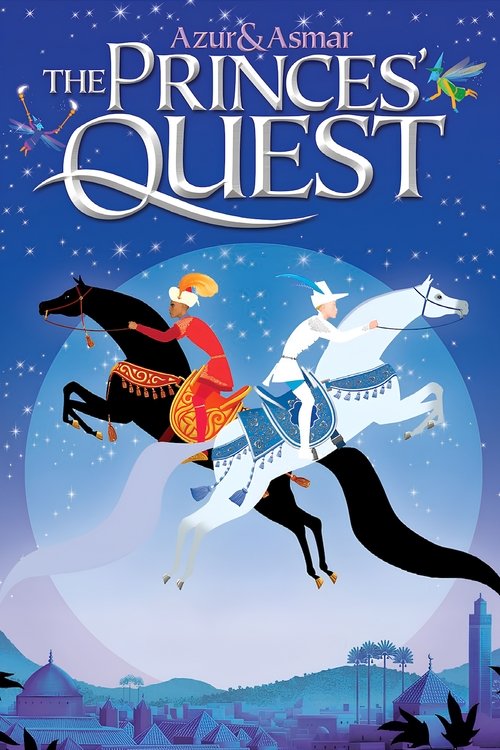
Azur & Asmar: The Princes' Quest (2006)
Directed by Michel Ocelot
Yes — Azur & Asmar: The Princes' Quest is woke, scoring 60 out of 100 on our wokeness meter.
Michel Ocelot's 2006 fairytale arrives with a director's statement attached, though the statement lives mostly in the margins: costume research at the Bardo Museum, Berber dress, a Djinn headdress lifted from an Algerian collection, and dialogue in Arabic that Ocelot refused to subtitle or dub.
Consciousness Markers
The film is explicitly a celebration of Maghreb and Islamic civilization, featuring authentic cultural details and bilingual dialogue.
The film centers on the relationship between a European and an Arab youth, with the director specifically researching Maghreb culture for authenticity.
While the director's intent is culturally celebratory, the film itself functions as a traditional fairy tale quest rather than a didactic social commentary.
The Djinn-fairy is a powerful figure, but the plot is driven by the male protagonists' quest to marry her, keeping the focus traditional.
The narrative involves wealthy princes and merchants, but offers no substantive critique of modern economic structures.
The film features a breastfeeding scene that caused controversy, but this is a narrative element rather than a deliberate body positivity statement.
No evidence of LGBTQ+ themes or characters within the narrative.
The film contains no commentary or visual representation of environmental issues or climate change.
No characters are depicted with neurodivergent traits or conditions.
The film is a fantasy based on folklore, not a reinterpretation of historical events.
Why it received this score
Michel Ocelot's 2006 fairytale arrives with a director's statement attached, though the statement lives mostly in the margins: costume research at the Bardo Museum, Berber dress, a Djinn headdress lifted from an Algerian collection, and dialogue in Arabic that Ocelot refused to subtitle or dub. That refusal is the film's most pointed gesture. The audience sits with the immigrant's problem of not understanding or being understood, which is a formal choice, not a plot point. Hiam Abbass verified the Arabic. A Kabyle singer wrote the closing song. The production notes read like an ethnography with a budget, and the screen itself largely holds up its end.
The structure underneath, however, is a fairy tale as old as the form. Two boys nursed at the same breast, separated by a cruel father, reunited as rivals for a sleeping Djinn princess. She is powerful, and she is also a prize. The quest belongs to the men, and the marriage is the finish line. We looked for other currents and found few. No queer subtext, no neurodivergent reading, no environmental lament, no assault on capital despite the merchants and princes wandering the frame. A wealthy merchant mother is a fact of the setting, not a thesis.
The film's American troubles are instructive in the driest way. Distributors balked at a nursing scene, nipples visible, and the title sat in limbo for years before landing a PG and a brief, sold-out run in New York. Ocelot would not cut it. He also gave us Crapoux, a talkative outsider standing in for his own difficulty settling in France, which is the closest the film comes to a lecture, and even that is a joke delivery system. So we get a gorgeous, patient celebration of a civilization dressed as a bedtime story, stubbornly unwilling to explain itself to anyone.
Analysis generated by our Consciousness Algorithm
Synopsis
Raised on tales of a Djinn fairy princess, Azur, a young Frenchman goes to North Africa in search of the sprite, only to discover that his close childhood friend, Asmar, an Arab youth whose mother raised both boys also seeks the genie.
Questions about Azur & Asmar: The Princes' Quest
Is Azur & Asmar: The Princes' Quest woke?
Yes — Azur & Asmar: The Princes' Quest is woke, scoring 60 out of 100 on our wokeness meter. That earns it a verdict of Woke.
What makes Azur & Asmar: The Princes' Quest woke?
2 of the 10 markers register at 30 or above, led by Racial Consciousness (85) and Representation Casting (75). On Racial Consciousness: The film is explicitly a celebration of Maghreb and Islamic civilization, featuring authentic cultural details and bilingual dialogue.
How does Azur & Asmar: The Princes' Quest compare to other 2006 movies?
It ranks #2 of the 211 films from 2006 we've scored; their average is 11. The wokest is An Inconvenient Truth (92).
How is the Woke Score calculated?
An AI-assisted process researches the film and its reception, scores it 0–100 on ten markers, then combines those into one 0–100 Woke Score. It measures a specific set of 2020s cultural themes, not film quality.