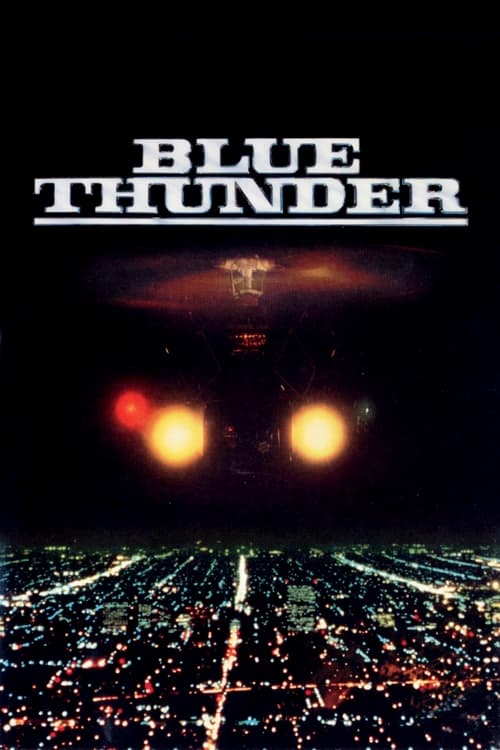
Blue Thunder (1983)
Directed by John Badham
No — Blue Thunder is not woke, scoring 7 out of 100 on our wokeness meter.
Blue Thunder arrives as a kinetic blur of high-tech paranoia and excessive combustion, a cinematic fever dream of Los Angeles authority and secret surveillance.
Consciousness Markers
The cast is overwhelmingly white and male, with Black actors Ed Bernard and Jason Bernard in minor supporting roles that carry no commentary; diversity is incidental at best.
There is a faint political undercurrent about surveillance and civic control, but it is delivered through action set-pieces rather than preachy monologues.
The film gestures at government overreach and a militarized police state via the T.H.O.R. conspiracy, but this is anti-authoritarian paranoia rather than an eat-the-rich economic critique.
Murphy is depicted as a traumatized Vietnam veteran with PTSD, but the film treats this as gritty character texture rather than a neurodivergence-affirming narrative.
Candy Clark's Kate is a largely passive girlfriend figure who exists to retrieve a tape; the film offers no feminist critique or agency-driven female arc.
Race is never a subject of the film; the conspiracy and its players are racially unmarked and the narrative engages no racial themes.
No LGBTQ+ characters, themes, or subtext appear anywhere in the film.
No environmental or climate content whatsoever.
No body-positivity themes or messaging present.
The film is a fictional conspiracy thriller and makes no revisionist claims about historical events.
Why it received this score
Blue Thunder arrives as a kinetic blur of high-tech paranoia and excessive combustion, a cinematic fever dream of Los Angeles authority and secret surveillance. It is a spectacle, certainly, but one which operates in a cultural vacuum. We observe a narrative that remains largely untroubled by the complex social dynamics of its era, focusing instead on the visceral thrill of a military helicopter grappling with a shadowy government conspiracy. The film’s ambition, if it has one, never quite reached the heights of modern progressive sensibilities.
The handling of the lead character’s trauma is perhaps the most telling element. His struggles with post-traumatic stress are presented as grit and character texture, rather than as a point for deeper exploration of mental health or societal failure. While the film gestures vaguely at government overreach through a militarized police state, it offers nothing of the critical, anti-capitalist heft demanded by contemporary discourse. Representation is incidental; the world it inhabits is overwhelmingly white and male, with any minor presence of color serving only to populate the background. The political undercurrent exists only within the action sequences.
Ultimately, Blue Thunder is a product of a specific, less socially aware time. It is a straightforward action piece where the social consciousness is limited to the act of resisting an oppressive state. We are left with a high-octane exercise in aerial combat that avoids the complexities of gender, race, or environment entirely. It is a wonderfully pulpy piece of work, but one that leaves us feeling the distinct chill of a cultural oversight.
Analysis generated by our Consciousness Algorithm


Synopsis
Los Angeles, California. Officer Murphy, a veteran Metropolitan Police helicopter pilot suffering from severe trauma due to his harsh experiences during the Vietnam War, and Lymangood, his resourceful new partner, are tasked with testing an advanced and heavily armed experimental chopper known as Blue Thunder.
Questions about Blue Thunder
Is Blue Thunder woke?
No — Blue Thunder is not woke, scoring 7 out of 100 on our wokeness meter. That earns it a verdict of Ultra Based.
Does Blue Thunder have any woke elements?
Very few. None of the 10 markers reaches 30, the level where a marker counts as present; the highest is Lecture Energy at 12.
How does Blue Thunder compare to other 1983 movies?
It ranks #18 of the 38 films from 1983 we've scored; their average is 10. The wokest is Sans Soleil (68).
How is the Woke Score calculated?
An AI-assisted process researches the film and its reception, scores it 0–100 on ten markers, then combines those into one 0–100 Woke Score. It measures a specific set of 2020s cultural themes, not film quality.