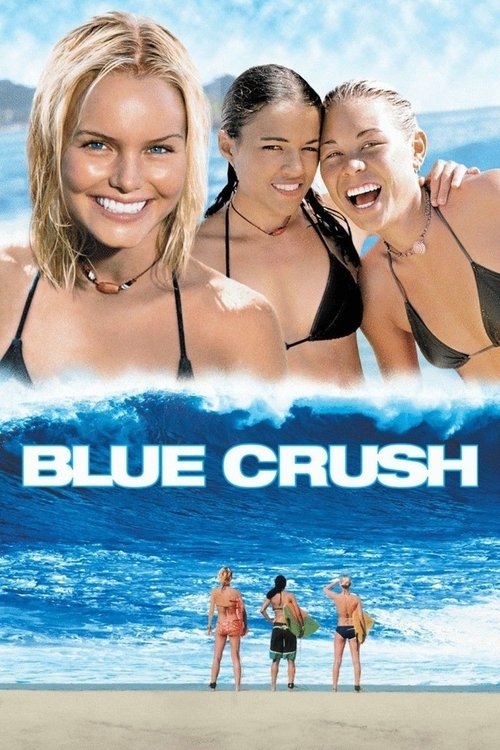
Blue Crush (2002)
Directed by John Stockwell
No — Blue Crush is not especially woke, scoring 23 out of 100 on our wokeness meter.
Blue Crush arrives in 2002 carrying a surfboard, a beach shack, and an entirely sincere belief that a young woman overcoming her fear of large waves constitutes a complete emotional arc.
Consciousness Markers
Centers a female surfer's athletic ambition, female friendship, and sisterhood in a male-dominated surf world, but frames it within a conventional sports-romance narrative.
The film features a female-led ensemble with Michelle Rodriguez and Sanoe Lake in prominent roles and a Hawaiian/local surf cast, though the diversity is organic rather than a modern representation checklist.
Shows working-class women cleaning luxury resort rooms and needing sponsorship to escape near-poverty, but offers no systemic anti-capitalist critique.
The empowerment and friendship themes are present but not delivered as a preachy lecture.
No LGBTQ+ characters or themes are present.
The Hawaiian setting and local characters are present, but the film does not engage racial identity or racism as a theme.
No climate or environmental advocacy themes.
No body-positivity messaging; the film uses conventional athletic/bikini imagery.
No neurodivergence themes or characters.
No historical revisionism.
Why it received this score
Blue Crush arrives in 2002 carrying a surfboard, a beach shack, and an entirely sincere belief that a young woman overcoming her fear of large waves constitutes a complete emotional arc. The film follows Anne Marie, her sister Penny, and two friends who clean luxury resort rooms by day and chase the North Shore swell before dawn. It is a sports picture wearing a romance picture's clothes, and it never once apologizes for the arrangement.
For its era, the casting is quietly notable. A female ensemble carries the film, and Michelle Rodriguez and Sanoe Lake are given genuine weight beside Kate Bosworth, while the local Hawaiian surf community appears with the ease of people who were simply there. The ambition on display belongs to a woman in a male-dominated sport, and the friendship among the leads is treated as the actual spine of the story. There is no sermon attached to any of it, which is its own kind of restraint. The film has progressive bones, but it does not stop to point at them.
What it does point at, occasionally, is the economic arrangement holding its characters one bad month from ruin. Anne Marie needs a sponsor to lift her friends out of near-poverty, and the film notices hotel guests trashing rooms for maids to clean. It simply declines to build a thesis from the observation. There is no environmental crusade here, no examination of race, no curiosity about bodies beyond their athletic function. The result is a modest, sunburned entertainment that predates the age of the preachy sports drama and, for that, retains a strange and largely unearned dignity.
Analysis generated by our Consciousness Algorithm
Part of


Synopsis
Nothing gets between Anne Marie and her board. Living in a beach shack with three roommates, she is up before dawn every morning to conquer the waves and count the days until the Pipe Masters competition. Having transplanted herself to Hawaii with no one's blessing but her own, Anne Marie finds all she needs in the adrenaline-charged surf scene - until pro quarterback Matt Tollman comes along...
Questions about Blue Crush
Is Blue Crush woke?
No — Blue Crush is not especially woke, scoring 23 out of 100 on our wokeness meter. That earns it a verdict of Based.
Does Blue Crush have any woke elements?
2 of the 10 markers register at 30 or above, led by Feminist Agenda (50) and Representation Casting (45). On Feminist Agenda: Centers a female surfer's athletic ambition, female friendship, and sisterhood in a male-dominated surf world, but frames it within a conventional sports-romance narrative.
How does Blue Crush compare to other 2002 movies?
It ranks #19 of the 150 films from 2002 we've scored; their average is 12. The wokest is Far from Heaven (78).
How is the Woke Score calculated?
An AI-assisted process researches the film and its reception, scores it 0–100 on ten markers, then combines those into one 0–100 Woke Score. It measures a specific set of 2020s cultural themes, not film quality.