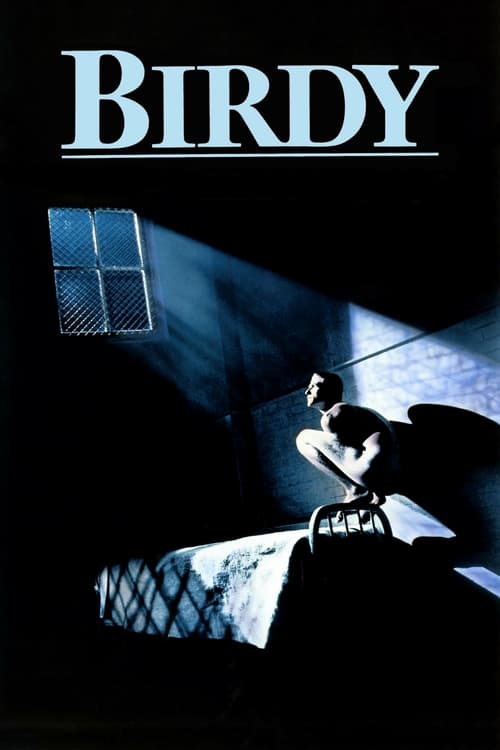
Birdy (1984)
Directed by Alan Parker
No — Birdy is not woke, scoring 9 out of 100 on our wokeness meter.
Alan Parker's Birdy arrives from 1984 with the solemn air of a film that has no interest in being liked by a focus group.
Consciousness Markers
The protagonist is institutionalized with a trauma-induced dissociative condition and bird-identification, portrayed with sympathy, though this is 1980s mental-illness drama rather than modern neurodivergence framing.
The film is a quiet, poetic character study with no preachy messaging or moralizing monologues directed at the audience.
The cast is overwhelmingly white, and the one notable minority performer (Danny Glover) had his scene cut from the final film. No deliberate representation casting is present.
The film contains no LGBTQ+ characters or themes; the central relationship is a platonic male friendship.
Female characters (Doris, Rosanne) exist only as romantic foils, and Birdy's rejection of Doris is framed as his own alienation rather than any feminist statement.
Race is entirely absent from the film's concerns; it is a story about two white working-class Philadelphia boys and the Vietnam War.
No environmental or climate themes appear; the landfill and refinery settings are incidental backdrops, not ecological commentary.
A minor beat has Birdy refuse money on principle after his car is sold, but this is a character gesture, not an anti-capitalist thesis.
The film deals with war disfigurement and trauma but makes no body-positivity argument; Al's injuries are presented as horror, not affirmation.
The Vietnam War setting is a straightforward relocation of the novel's WWII backdrop; no historical revisionism is attempted.
Why it received this score
Alan Parker's Birdy arrives from 1984 with the solemn air of a film that has no interest in being liked by a focus group. Matthew Modine plays the title character, a Philadelphia boy who loves pigeons, canaries, and the idea of flight, while Nicolas Cage plays Al, his friend, whose face is wrapped in bandages after Vietnam. The film moves between memory and hospital ward, treating Birdy's silence and bird identification as a private catastrophe. It is a patient, poetic character study, and its rewards are quiet ones.
Judged by the contemporary social ledger, the film is nearly empty. The cast is white, and the one notable minority performer, Danny Glover, had his scene removed, so no representation program is in evidence. The central bond between Birdy and Al is a platonic male friendship, with no LGBTQ current. Women appear as romantic foils, and Birdy's rejection of Doris is framed as his alienation, not a feminist argument. Race does not enter the film's concerns. The landfill and refinery are backdrops, not ecological sermons. A moment where Birdy refuses money for his sold car is a character gesture, not an anti-capitalist thesis. Al's disfigurement is presented as horror, not body affirmation. The novel's World War II setting becomes Vietnam, but the shift is a generational relocation, not historical revisionism.
The one area where the film brushes against modern categories is its sympathetic portrait of psychological distress. Birdy is institutionalized with a trauma-induced dissociative condition, and the film grants him dignity without turning him into a case study. That is 1980s mental illness drama, not the vocabulary of neurodivergence we use now. Preaching is absent. No monologue instructs us on how to feel. The result is a serious film about damage and friendship, made before the cultural checklist became a genre unto itself. It remains watchable, sad, and mostly uninterested in our current arguments.
Analysis generated by our Consciousness Algorithm


Synopsis
Two young men are seriously affected by the Vietnam War. One of them has always been obsessed with birds - but now believes he really is a bird, and has been sent to a mental hospital. Can his friend help him pull through?
Questions about Birdy
Is Birdy woke?
No — Birdy is not woke, scoring 9 out of 100 on our wokeness meter. That earns it a verdict of Ultra Based.
Does Birdy have any woke elements?
Very few. None of the 10 markers reaches 30, the level where a marker counts as present; the highest is Neurodivergence at 15.
How does Birdy compare to other 1984 movies?
It ranks #12 of the 51 films from 1984 we've scored; their average is 7. The wokest is Revenge of the Nerds (30).
How is the Woke Score calculated?
An AI-assisted process researches the film and its reception, scores it 0–100 on ten markers, then combines those into one 0–100 Woke Score. It measures a specific set of 2020s cultural themes, not film quality.