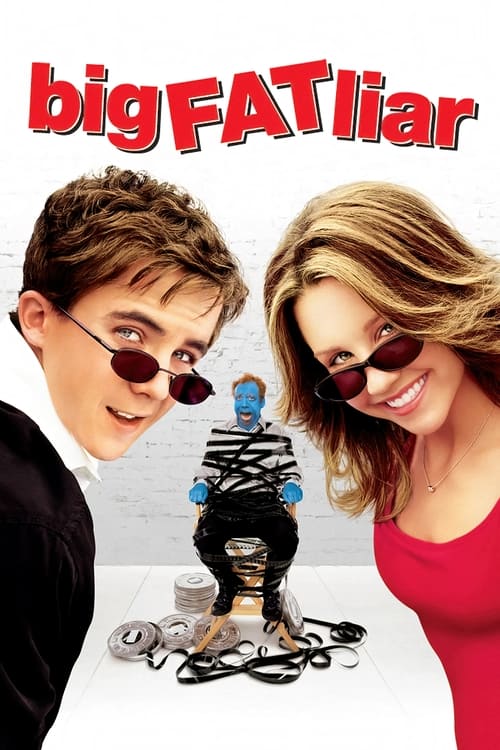
Big Fat Liar (2002)
Directed by Shawn Levy
No — Big Fat Liar is not woke, scoring 13 out of 100 on our wokeness meter.
Big Fat Liar arrives from 2002, a year when a Hollywood producer could still serve as a serviceable villain without anyone reaching for a manifesto.
Consciousness Markers
The villain is an arrogant, exploitative Hollywood producer whose tormented employees rally together to bring him down, giving the film a mild 'little guy versus the powerful boss' streak, though it is personal rather than systemic.
The cast includes Sandra Oh, Russell Hornsby, and Donald Faison in supporting roles, but their presence is incidental and unremarked upon, typical of early-2000s ensemble casting.
Amanda Bynes's Kaylee is a competent and proactive sidekick who drives much of the scheming, but the film offers no feminist critique or commentary.
The story gestures at a moral about honesty and the value of truth, but it delivers this through slapstick revenge rather than preachy sermonizing.
The film is entirely devoid of racial themes or commentary; minority cast members exist without any narrative acknowledgment of race.
No LGBTQ+ characters, themes, or subtext appear anywhere in the film.
There is no environmental or climate-related content in the film.
No body positivity themes or messaging are present.
No neurodivergent characters or themes are depicted.
The film is a contemporary fictional comedy with no historical subject matter to revise.
Why it received this score
Big Fat Liar arrives from 2002, a year when a Hollywood producer could still serve as a serviceable villain without anyone reaching for a manifesto. Shawn Levy directs the tale of Jason Shepherd, a fourteen-year-old compulsive liar whose stolen essay becomes a studio tentpole, and the film treats the theft as a personal grievance to be settled with blue dye and industrial adhesive. The Aesop scaffolding is present, the boy who cried wolf finally telling the truth, but the machinery runs on slapstick. It is a revenge fantasy for children, and it knows it.
The antagonist, Marty Wolf, is a petty tyrant who torments his assistant, his driver, and his staff. When those employees rally to expose him, the film acquires a faint populist tingle, the little people against the man with the limousine. It stays personal, never systemic. Nobody mentions labor, only a specific jerk who deserves what he gets. Amanda Bynes supplies Kaylee, a sidekick with genuine initiative and most of the useful ideas, though the script grants her competence without comment. Sandra Oh, Russell Hornsby, and Donald Faison appear in supporting turns that the film neither explains nor examines, which is standard practice for the era and reads as neither virtue nor failing.
The closing lesson concerns honesty, and it is administered by way of a rooftop confession broadcast to the media. The film has a moral, then, but it prefers a groin kick to a sermon. The residue is a brisk, harmless comedy that gestures toward fairness of a small, domestic sort, the kind that ends when the credits roll and the bully gets a clown suit. It is not a document of any movement. It is a kids' movie about a stolen story, and it remains exactly that.
Analysis generated by our Consciousness Algorithm


Synopsis
After one of his class papers is stolen and turned into a movie, a young student and his best friend exact a hilarious, slapstick revenge on the Hollywood hot shot who has taken credit!
Questions about Big Fat Liar
Is Big Fat Liar woke?
No — Big Fat Liar is not woke, scoring 13 out of 100 on our wokeness meter. That earns it a verdict of Ultra Based.
Does Big Fat Liar have any woke elements?
Very few. None of the 10 markers reaches 30, the level where a marker counts as present; the highest is Eat the Rich at 28.
How does Big Fat Liar compare to other 2002 movies?
It ranks #40 of the 150 films from 2002 we've scored; their average is 12. The wokest is Far from Heaven (78).
How is the Woke Score calculated?
An AI-assisted process researches the film and its reception, scores it 0–100 on ten markers, then combines those into one 0–100 Woke Score. It measures a specific set of 2020s cultural themes, not film quality.