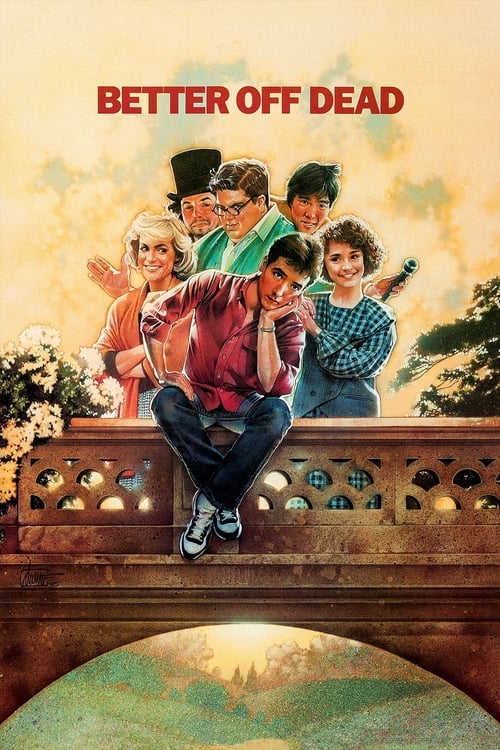
Better Off Dead... (1985)
Directed by Savage Steve Holland
No — Better Off Dead... is not woke, scoring 6 out of 100 on our wokeness meter.
Better Off Dead... arrives from 1985 as a cult teen comedy with absurdist charm, yet its social consciousness registers as a near-total void.
Consciousness Markers
Monique is a capable mechanic and skier who helps Lane, but the film remains a male-centered teen comedy without an explicit feminist message.
The cast is almost entirely white, with the only non-white characters being two Japanese drag racers played as broad ethnic stereotypes for comic relief, which is not progressive representation.
No LGBTQ+ characters, themes, or subtext.
The film engages in racial stereotyping of its Japanese characters rather than any racial consciousness or social commentary.
No environmental themes.
The fast-food job is played for humiliation comedy, not as a critique of capitalism.
No body positivity themes.
The protagonist's suicidal ideation and hallucinations are comic devices, not a portrayal of neurodivergence.
No historical revisionism.
The film is absurdist comedy and does not lecture the audience on social issues.
Why it received this score
Better Off Dead... arrives from 1985 as a cult teen comedy with absurdist charm, yet its social consciousness registers as a near-total void. The cast is uniformly white, and the only non-white characters are two Japanese drag racers presented as broad ethnic stereotypes for comic relief. This is not representation; it is caricature. The film offers no LGBTQ+ presence, no environmental concern, and no critique of capitalism. The protagonist's humiliating fast-food job exists solely for humiliation comedy, not as a systemic indictment. There is no body positivity, no neurodivergent portrayal (the suicidal ideation and hallucinations are comic devices), and no revisionist history. The lecture energy is absent; this is not a film that preaches. It simply revels in surreal gags.
The sole point of progressive interest is Monique, the French exchange student who proves to be a capable mechanic and skier. She helps the male protagonist fix his car and build his confidence. This offers a faint feminist note, but the film remains squarely male-centered. Monique's competence serves the hero's arc. The film does not interrogate gender roles; it merely allows a woman to be useful. Beyond this, the social landscape is barren. Racial consciousness is absent, replaced by stereotyping. The film's treatment of suicide as slapstick is a relic of its era, not a statement on mental health.
In sum, Better Off Dead... is a product of its time, with minimal social consciousness and no preachy tendencies. It earns its cult following through anarchic humor, not through cultural awareness. For the modern classifier, it presents a straightforward case: a film that neither offends with explicit messaging nor impresses with progressive sensibilities. It simply exists, a curious artifact of mid-1980s teen cinema, content to be absurd rather than aware.
Analysis generated by our Consciousness Algorithm


Synopsis
High school student Lane Meyer sinks into suicidal depression when his girlfriend dumps him for jock Roy Stalin, the high school ski racing champion. Meanwhile, he has to deal with his eccentric family, a tenacious paperboy and an obnoxious neighbor whose mother is hosting a beautiful French exchange student named Monique.
Questions about Better Off Dead...
Is Better Off Dead... woke?
No — Better Off Dead... is not woke, scoring 6 out of 100 on our wokeness meter. That earns it a verdict of Ultra Based.
Does Better Off Dead... have any woke elements?
Very few. None of the 10 markers reaches 30, the level where a marker counts as present; the highest is Feminist Agenda at 10.
How does Better Off Dead... compare to other 1985 movies?
It ranks #27 of the 68 films from 1985 we've scored; their average is 8. The wokest is The Color Purple (62).
How is the Woke Score calculated?
An AI-assisted process researches the film and its reception, scores it 0–100 on ten markers, then combines those into one 0–100 Woke Score. It measures a specific set of 2020s cultural themes, not film quality.