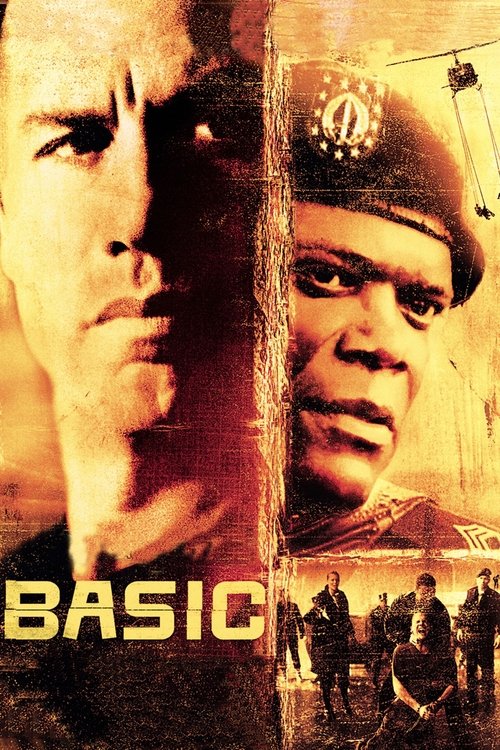
Basic (2003)
Directed by John McTiernan
No — Basic is not woke, scoring 18 out of 100 on our wokeness meter.
The film's social consciousness registers as ambient noise, the hum of a procedural that absorbed the era's casting habits without absorbing any of its arguments.
Consciousness Markers
An ensemble that includes Samuel L. Jackson, Taye Diggs, Roselyn Sánchez and Cristián de la Fuente alongside a female co-lead; diversity is present but entirely unremarked upon, which is standard procedural casting rather than a statement.
Lieutenant Kendall is explicitly described as the homosexual son of a Joint Chiefs of Staff general, and his sexuality is floated as a possible motive for the abusive sergeant's animus. The queerness functions as a plot lever for suspicion, not as a theme.
Connie Nielsen's Captain Julia Osborne begins sidelined by the men around her, is relieved of duty by her commander, then does the deciding work and shoots the villain, earning a place in the covert unit. It's a competent-woman-in-a-boys-club framework, not a feminist argument.
The film's excesses are structural rather than rhetorical: it stacks twist upon twist until the story devours itself, but it never pauses to instruct the audience on how to feel about anything. McTiernan's own verdict was that it 'still makes no sense.'
No engagement with racial themes whatsoever; the film's Black and Latino cast members occupy military roles indistinguishable from anyone else's and nothing about race is ever raised.
The hurricane is a tactical complication for a jungle exercise and a plot device for washed-away evidence, nothing more. No environmental argument is made or implied.
The villains are corrupt officers running a cocaine-smuggling side operation; this is criminal malfeasance within an institution, not a critique of capitalism or wealth.
No body-diversity themes or messaging of any kind.
No neurodivergent characters, diagnoses, or thematic content.
A wholly invented story with no historical claims, correct or otherwise, to revise.
Why it received this score
The film's social consciousness registers as ambient noise, the hum of a procedural that absorbed the era's casting habits without absorbing any of its arguments. The ensemble is diverse by 2003 standards: Samuel L. Jackson, Taye Diggs, Roselyn Sánchez, Cristián de la Fuente, and Connie Nielsen as the female co-lead. Nobody in the film remarks on any of it. Race never enters the conversation, which keeps that ledger clean. The one identity that does surface is Lieutenant Kendall's homosexuality, disclosed as the homosexual son of a Joint Chiefs of Staff general and then immediately converted into a suspicion lever: perhaps the abusive sergeant hated him for it. Queerness arrives as motive and departs as motive. Nielsen's Captain Osborne follows a similar arc of utility. She is sidelined. Her commander relieves her of duty. Then she does the deciding work, shoots the villain, and earns an invitation to the secret unit. A competent woman in a boys' club, rewarded for competence. That is a staffing decision, not a thesis.
Elsewhere the cupboard is bare. The hurricane exists to wash away evidence and complicate a jungle exercise. No environmental argument is offered. The villains are corrupt officers running a cocaine side operation, which is criminal malfeasance inside an institution, not an indictment of wealth or markets. There is no body-diversity messaging, no neurodivergent character or diagnosis, and no historical record to revise, since the film invents its Panama from scratch.
Where the picture does exert pressure, it is structural. Twist stacks on twist until the narrative eats its own tail. Roger Ebert concluded it was not a film that could be understood. John McTiernan, who directed it, later described the story as making no sense at all, and he was in the room. Yet the film never stops to instruct us on how to feel about any of it. It simply keeps explaining itself until comprehension dissolves. There is something almost admirable in that commitment. Almost.
Analysis generated by our Consciousness Algorithm


Synopsis
When a hurricane hits a US Army base on the edge of the Panama Canal, an elite covert operations team of US Army Rangers recruits are on a routine jungle training exercise that goes horribly awry. Only two recruits are rescued, one of which is badly injured, but both have different accounts regarding the fate of their leader, legendary and ruthless Army Ranger Drill Sergeant Nathan West, and the rest of their platoon. Tom Hardy, an ex-army Ranger turned maverick DEA agent is brought in to solve the mystery and uncover what really happened out there.
Questions about Basic
Is Basic woke?
No — Basic is not woke, scoring 18 out of 100 on our wokeness meter. That earns it a verdict of Ultra Based.
Does Basic have any woke elements?
1 of the 10 markers register at 30 or above, led by Representation Casting (35). On Representation Casting: An ensemble that includes Samuel L.
How does Basic compare to other 2003 movies?
It ranks #33 of the 150 films from 2003 we've scored; their average is 12. The wokest is Mona Lisa Smile (60).
How is the Woke Score calculated?
An AI-assisted process researches the film and its reception, scores it 0–100 on ten markers, then combines those into one 0–100 Woke Score. It measures a specific set of 2020s cultural themes, not film quality.