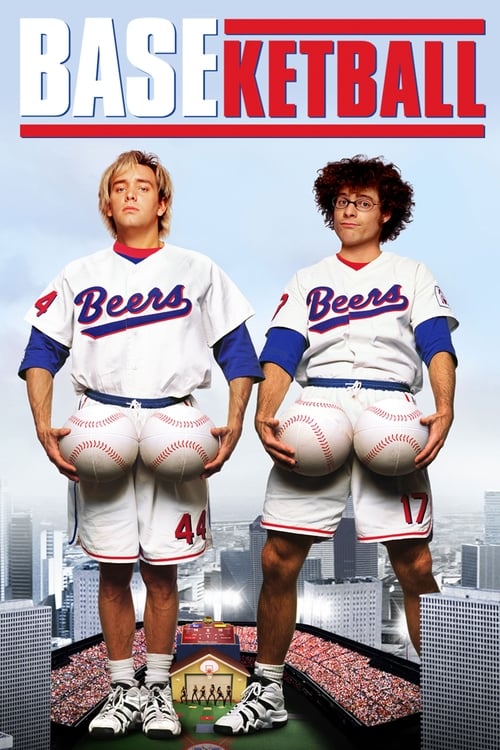
BASEketball (1998)
Directed by David Zucker
No — BASEketball is not woke, scoring 16 out of 100 on our wokeness meter.
BASEketball arrives from 1998, a year when a comedy could still be assembled from a driveway, a La-Z-Boy, and the combined star power of two men who had recently made a cartoon about a foul-mouthed third grader.
Consciousness Markers
The central conflict is explicitly about resisting corporate monetization: Denslow's founding rules ban sponsorship, team relocation, and unequal pay, while villain Baxter Cain schemes to commercialize the sport, cut foundation funding, and exploit child labor.
Squeak delivers an impassioned motivational speech about loyalty and the purity of the game, and the anti-corporate moral is stated fairly directly, though it is wrapped in broad comedy rather than preached.
The cast is overwhelmingly white, led by Trey Parker, Matt Stone, and a supporting roster of white comedians; there is no deliberate diverse or inclusive casting agenda.
Yasmine Bleeth and Jenny McCarthy function primarily as a romantic interest and a scheming widow/eye candy respectively; the film makes no feminist argument and was even Razzie-nominated for its female performances.
A late subplot involves child labor in Calcutta, but it is deployed as a blackmail gag rather than any examination of race or racial justice.
No LGBTQ+ characters, themes, or subtext appear anywhere in the film.
There is no environmental or climate-related content in the film.
The film trades heavily in gross-out and physical-comedy gags about bodies rather than any body-positive messaging.
No neurodivergent characters or themes are present.
The film is a wholly fictional comedy with no historical narrative to revise.
Why it received this score
BASEketball arrives from 1998, a year when a comedy could still be assembled from a driveway, a La-Z-Boy, and the combined star power of two men who had recently made a cartoon about a foul-mouthed third grader. David Zucker directs with the loose, elbows-out energy of a man who once helped invent the disaster spoof and is now reduced to inventing a sport. The sport is the joke, and the joke is sturdy enough: a hybrid of basketball and baseball played with a psychic free throw and a great deal of trash talk.
The film's spine, such as it is, concerns the resistance of the game's founding charter to corporate appetite. Ted Denslow's rules forbid sponsorship, relocation, and unequal pay, and the villain, Baxter Cain, exists chiefly to dismantle them. This gives the picture an anti-monetization streak that arrived well ahead of the current fashion for such gestures, though it is delivered through a blackmail subplot involving child labor in Calcutta that treats the whole affair as a punchline. It is not a film with a thesis so much as a film with a grudge against men in suits.
The women fare poorly. Yasmine Bleeth is the girlfriend, Jenny McCarthy the scheming widow, and both were rewarded with Razzie nominations for their trouble. The cast is white, the humor is anatomical, and the emotional climax is a motivational speech from a sidekick named Squeak, which tells you where the priorities lie. It is a dumb movie that occasionally stumbles into saying something, and it would be furious to be told so.
Analysis generated by our Consciousness Algorithm
Part of


Synopsis
Two losers from Milwaukee, Coop and Remer, invent a new game combining basketball with the rules of baseball. When the game becomes a huge success, they, along with a billionaire's help, form the Professional Baseketball League where everyone gets the same pay and no team can change cities. When a rival owner wants to institute major rule changes, Coop and Remer's team is the only one standing in the way.
Questions about BASEketball
Is BASEketball woke?
No — BASEketball is not woke, scoring 16 out of 100 on our wokeness meter. That earns it a verdict of Ultra Based.
Does BASEketball have any woke elements?
1 of the 10 markers register at 30 or above, led by Eat the Rich (55). On Eat the Rich: The central conflict is explicitly about resisting corporate monetization: Denslow's founding rules ban sponsorship, team relocation, and unequal pay, while villain Baxter Cain schemes to commercialize the sport, cut foundation funding, and exploit child labor.
How does BASEketball compare to other 1998 movies?
It ranks #27 of the 118 films from 1998 we've scored; their average is 12. The wokest is Show Me Love (60).
How is the Woke Score calculated?
An AI-assisted process researches the film and its reception, scores it 0–100 on ten markers, then combines those into one 0–100 Woke Score. It measures a specific set of 2020s cultural themes, not film quality.