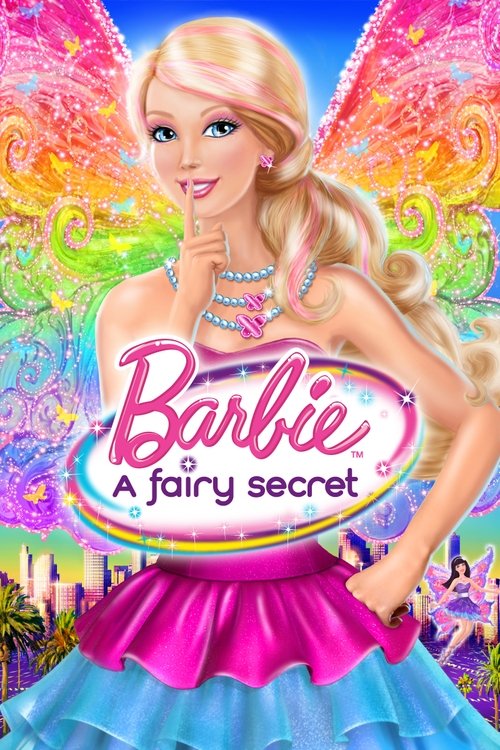
Barbie: A Fairy Secret (2011)
Directed by Terry Klassen
No — Barbie: A Fairy Secret is not woke, scoring 6 out of 100 on our wokeness meter.
Barbie: A Fairy Secret arrives from 2011 as the nineteenth entry in a franchise that has never pretended to be anything other than a merchandising apparatus with a runtime.
Consciousness Markers
The film features a female protagonist and female friendships, but it does not advance a modern feminist agenda or critique patriarchal structures.
The film delivers gentle moral lessons about friendship and forgiveness, but it does not preach modern social or political messages.
The voice cast is predominantly white and offers no notable racial or ethnic diversity; the female-centric cast is inherent to the Barbie brand rather than a deliberate representation push.
No LGBTQ+ characters, themes, or subtext appear in the film.
Race is not addressed or made a theme; the film is set in a fantasy world with no racial commentary.
There is no environmental or climate-related messaging in the story.
The film is a Mattel toy commercial and contains no anti-capitalist or eat-the-rich themes.
Body image or body positivity is not a subject of the film.
No neurodivergent characters or themes are present.
The film is a fantasy story with no historical revisionism.
Why it received this score
Barbie: A Fairy Secret arrives from 2011 as the nineteenth entry in a franchise that has never pretended to be anything other than a merchandising apparatus with a runtime. The plot concerns a secret fairy city called Gloss Angeles, a love potion administered to a princess, and three consecutive duels, which is to say it concerns almost nothing at all. The production companies listed are Mattel and Mattel Entertainment, and the film's relationship to commerce is not subtext. It is the text. A viewer searching for an anti-capitalist reading will find only the receipt.
What the film does possess is a modest emotional architecture built on female friendship. Barbie and her rival Raquelle spend the middle act imprisoned in spheres of fury and emerge as allies once they apologize, and the film's thesis is that forgiveness grants flight, literally. This is a female-led story with female friendships at its center, and it stops there. There is no critique of the structures surrounding these women, no interrogation of the fashion industry on display, no suggestion that the world ought to be rearranged. Race goes unmentioned in a fantasy realm populated by white voice actors. Queerness does not appear. The body is a fixed plastic object and is never discussed as anything else. Climate, neurodivergence, and recorded history are all absent, and the film does not seem to miss them.
The moral instruction is gentle and entirely pre-modern: apologize to your rival, forgive your friends, do not slip people love potions. No contemporary social argument is advanced. No viewer is scolded. This is a toy commercial that teaches basic decency, and it carries the cultural politics of a greeting card. It is not offensive. It is not anything else either.
Analysis generated by our Consciousness Algorithm


Synopsis
Barbie realises that fairies secretly surround everybody. She, along with the help of her friends, Taylor and Carrie, sets out to rescue Ken. He is taken to the secret fairy city, Gloss Angeles.
Questions about Barbie: A Fairy Secret
Is Barbie: A Fairy Secret woke?
No — Barbie: A Fairy Secret is not woke, scoring 6 out of 100 on our wokeness meter. That earns it a verdict of Ultra Based.
Does Barbie: A Fairy Secret have any woke elements?
Very few. None of the 10 markers reaches 30, the level where a marker counts as present; the highest is Feminist Agenda at 10.
How does Barbie: A Fairy Secret compare to other 2011 movies?
It ranks #148 of the 245 films from 2011 we've scored; their average is 11. The wokest is Paul (68).
How is the Woke Score calculated?
An AI-assisted process researches the film and its reception, scores it 0–100 on ten markers, then combines those into one 0–100 Woke Score. It measures a specific set of 2020s cultural themes, not film quality.