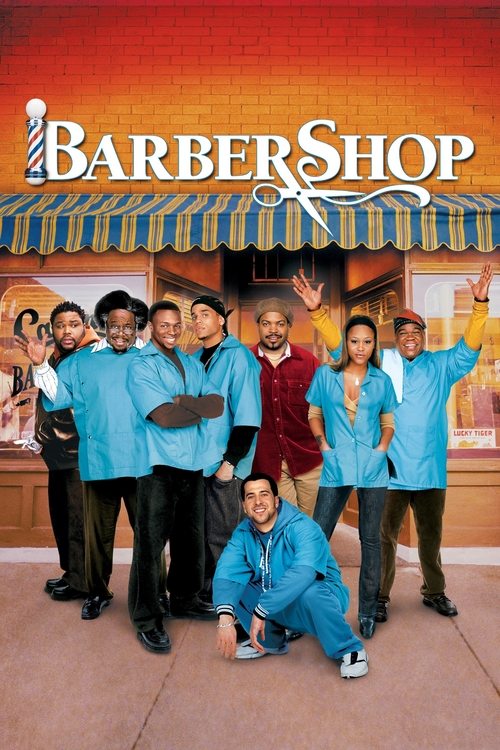
Barbershop (2002)
Directed by Tim Story
No — Barbershop is not especially woke, scoring 38 out of 100 on our wokeness meter.
Barbershop arrives from 2002, a year when a major studio could release a comedy set in a South Side Chicago barbershop with a predominantly Black ensemble and consider the matter settled.
Consciousness Markers
The film is steeped in Black community life, gentrification anxiety, and a white barber who 'acts Black,' engaging race directly, though largely through comedy rather than activism.
A predominantly Black ensemble cast centered on Black life on Chicago's South Side, notable for 2002, though the casting reflects the story's natural setting rather than a modern diversity mandate.
The plot pits a community barbershop against a predatory loan shark who wants to convert it into a strip club, valorizing community value over profit, though the resolution is a reward-money windfall.
The film carries a warm message about community and not selling out one's legacy, delivered through sentiment rather than preachy monologue.
A subplot has the Nigerian barber Dinka smitten with a plus-size customer, gently affirming her beauty, but it is a minor comedic thread rather than a body-positive statement.
Eve's Terri is a capable female barber with her own romantic subplot, but the film offers no feminist critique or gender-power commentary.
No LGBTQ+ characters, themes, or subtext appear anywhere in the film.
No environmental or climate themes are present.
No neurodivergent characters or themes are depicted.
The film's controversial Rosa Parks and MLK jokes mock civil rights icons rather than reinterpret history through a progressive lens, so this marker does not apply.
Why it received this score
Barbershop arrives from 2002, a year when a major studio could release a comedy set in a South Side Chicago barbershop with a predominantly Black ensemble and consider the matter settled. Calvin Palmer inherits his father's failing business, sells it to a loan shark who intends to convert it into a strip club, and spends the rest of the day learning that the shop means more than the ledger suggests. The casting reflects the neighborhood it depicts. Nobody pauses to explain this, and the ensemble's easy authenticity is its own quiet argument. The film simply assumes its audience knows these people. That assumption now looks almost radical.
The film engages race directly, mostly through comedy. A white barber named Isaac has absorbed Black speech and mannerisms so thoroughly that the shop cannot decide whether to mock him or accept him. Gentrification anxiety hums beneath the banter, and the villain's plan to swap a community institution for a strip club gives the plot its moral spine. The resolution arrives as a fifty thousand dollar reward for a recovered ATM, a curious way to celebrate community over profit. The film wants us to honor legacy, then hands its hero a windfall. The sentiment is warm. The economics are muddled.
Elsewhere the film is gentler than its reputation suggests. Dinka, the Nigerian barber, adores a plus-size customer, and the film treats her beauty as self-evident, a minor thread that never hardens into a statement. Eve's Terri holds her own among the men, though the script offers no real gender critique. Eddie's routines about Rosa Parks and Martin Luther King Jr. drew protests from Al Sharpton and Jesse Jackson, and they mock the icons instead of reinterpreting them, which places the film nowhere near any progressive rewriting of history. What remains is a hangout comedy with a large heart, delivering its sermon about not selling out through affection for its characters. It lectures no one. It lets the day unfold.
Analysis generated by our Consciousness Algorithm


Synopsis
A day in the life of a barbershop on the south side of Chicago. Calvin, who inherited the struggling business from his deceased father, views the shop as nothing but a burden and waste of his time. After selling the shop to a local loan shark, Calvin slowly begins to see his father's vision and legacy and struggles with the notion that he just sold it out.
Questions about Barbershop
Is Barbershop woke?
No — Barbershop is not especially woke, scoring 38 out of 100 on our wokeness meter. That earns it a verdict of Based.
Does Barbershop have any woke elements?
3 of the 10 markers register at 30 or above, led by Racial Consciousness (60), Representation Casting (55) and Eat the Rich (35). On Racial Consciousness: The film is steeped in Black community life, gentrification anxiety, and a white barber who 'acts Black,' engaging race directly, though largely through comedy rather than activism.
How does Barbershop compare to other 2002 movies?
It ranks #10 of the 150 films from 2002 we've scored; their average is 12. The wokest is Far from Heaven (78).
How is the Woke Score calculated?
An AI-assisted process researches the film and its reception, scores it 0–100 on ten markers, then combines those into one 0–100 Woke Score. It measures a specific set of 2020s cultural themes, not film quality.