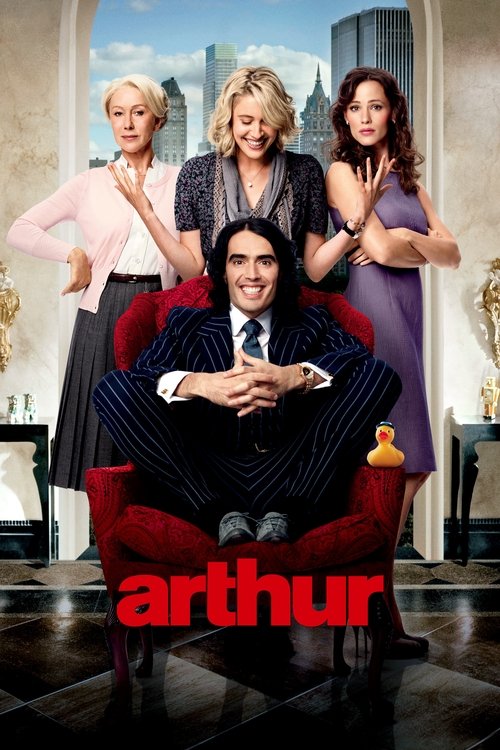
Arthur (2011)
Directed by Jason Winer
No — Arthur is not woke, scoring 7 out of 100 on our wokeness meter.
The 2011 remake of Arthur arrives with the confidence of a trust-fund heir who has never been told no.
Consciousness Markers
Arthur theatrically strips to renounce dependency on his mother's fortune, and the plot gestures at money not buying happiness, but he ultimately reclaims his inheritance by running the family charity, undercutting any real critique.
The cast is overwhelmingly white, with Luis Guzmán in a supporting chauffeur role and an Evander Holyfield cameo; there is no deliberate diversity push or color-conscious casting.
A mother who runs a corporation and a strong-willed nanny provide faint agency, but the film is a man-child romcom where women function largely as love interests and obstacles.
The film offers no social sermonizing; its only mild moralizing is the generic 'follow your heart' sentiment of the ending.
No LGBTQ+ characters, themes, or subtext appear anywhere in the film.
The film engages no racial themes or commentary whatsoever; the minority chauffeur role is a stock comedic presence with no racial dimension.
There is no environmental or climate content in the film.
No body-positivity themes or messaging are present.
Arthur's alcoholism and immaturity are framed as character flaws, not neurodivergence, and no neurodivergent identity is explored.
The film is a contemporary romantic comedy with no historical subject matter to revise.
Why it received this score
The 2011 remake of Arthur arrives with the confidence of a trust-fund heir who has never been told no. Russell Brand plays a drunken playboy, Helen Mirren plays the long-suffering nanny, Greta Gerwig plays the free-spirited love interest, and Jennifer Garner plays the suitable bride. It is a man-child romantic comedy, and its social consciousness is thin, almost transparent. The cast is overwhelmingly white, with Luis Guzman as the chauffeur and an Evander Holyfield cameo. That is not a diversity initiative. It is staffing.
On matters of identity and ideology, the film is a vacuum. No LGBTQ characters or themes appear. No racial consciousness stirs. The chauffeur exists for laughs, not commentary. There is no climate content, no body positivity, and no exploration of neurodivergence. Arthur's drinking and immaturity are treated as flaws, not as a condition. Historical revision is impossible because there is no history, only penthouses and candy stores. The feminist current is faint. Vivienne runs Bach Worldwide, and Hobson has spine and a late emotional arc, but the women still orbit Arthur as love interests, obstacles, or maternal substitutes. The movie is not interested in power structures unless they can be resolved by a wedding interruption.
The closest thing to a critique of wealth is posturing. Arthur strips down at his wedding to reject dependence on his mother's fortune, and the script suggests money cannot buy happiness. Then he gets the inheritance back by running the family charity, which is less eat the rich and more let the rich manage the leftovers. Sermonizing is minimal. Hobson's letter advises him to follow his heart, and the film does not push beyond that greeting-card sentiment. It is a harmless, unnecessary remake, culturally weightless, and that may be its only honest achievement.
Analysis generated by our Consciousness Algorithm
Part of


Synopsis
A drunken playboy stands to lose a wealthy inheritance when he falls for a woman that his family doesn't like.
Questions about Arthur
Is Arthur woke?
No — Arthur is not woke, scoring 7 out of 100 on our wokeness meter. That earns it a verdict of Ultra Based.
Does Arthur have any woke elements?
Very few. None of the 10 markers reaches 30, the level where a marker counts as present; the highest is Eat the Rich at 15.
How does Arthur compare to other 2011 movies?
It ranks #133 of the 245 films from 2011 we've scored; their average is 11. The wokest is Paul (68).
How is the Woke Score calculated?
An AI-assisted process researches the film and its reception, scores it 0–100 on ten markers, then combines those into one 0–100 Woke Score. It measures a specific set of 2020s cultural themes, not film quality.