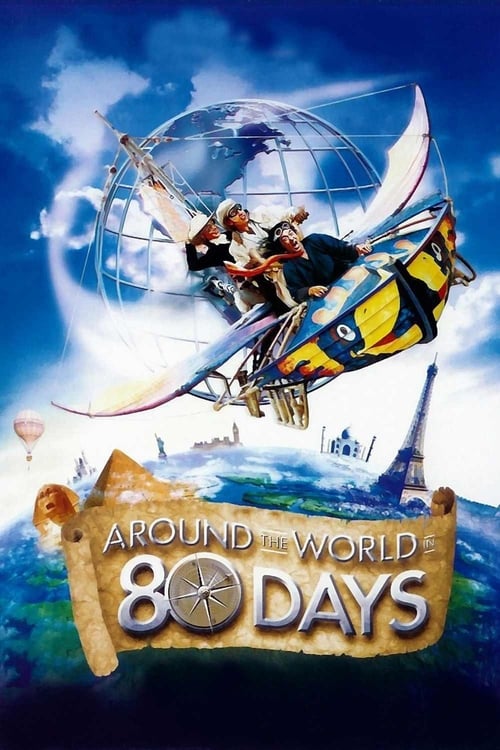
Around the World in 80 Days (2004)
Directed by Frank Coraci
No — Around the World in 80 Days is not woke, scoring 18 out of 100 on our wokeness meter.
There is a particular kind of 2004 studio product that arrives with a balloon, a steam engine, and no agenda whatsoever, and Frank Coraci's loose pass at Jules Verne is a fine specimen of the type.
Consciousness Markers
An unusually international cast for 2004, with Jackie Chan and Karen Mok as Chinese leads and Cécile de France as a French co-star, plus a Chinese village setting. The diversity is organic to the globe-trotting premise rather than a self-conscious statement.
The plot includes a Chinese protagonist reclaiming a stolen Jade Buddha for his village and a villain who deploys colonial authorities in India, giving a faint anti-imperialist coloring, but race is never examined as a theme.
Monique La Roche is a capable, independent aspiring artist who joins the journey on her own terms and resists being made Prince Hapi's seventh wife, but she remains a supporting companion rather than a vehicle for any feminist argument.
A lighthearted, goofy family adventure that preaches nothing; any moral about trust and friendship is delivered through slapstick rather than sermon.
Lord Kelvin is a stuffy establishment villain who prizes tradition over innovation, but the conflict is institutional vanity rather than a critique of wealth or capitalism.
Phileas Fogg is an eccentric inventor mocked by his peers for his unconventional ways, a mild 'quirky genius' coding, but the film never frames this as neurodivergence.
The film deliberately deviates from Verne's novel and stuffs in anachronisms like the Wright Brothers, but this is comedic license rather than a modern reinterpretation of history through a social-justice lens.
No LGBTQ+ characters, themes, or subtext appear anywhere in the film.
No environmental or climate themes are present; the hot-air balloon and steam technology are pure adventure spectacle.
No body-positivity themes or messaging of any kind.
Why it received this score
There is a particular kind of 2004 studio product that arrives with a balloon, a steam engine, and no agenda whatsoever, and Frank Coraci's loose pass at Jules Verne is a fine specimen of the type. An international co-production with a genuinely international cast, it hands Jackie Chan and Karen Mok the Chinese roles and Cécile de France the French one, arrangements that feel less like a casting statement than simple arithmetic for a story about circling the globe. The diversity is baked into the itinerary. Nobody pauses to congratulate themselves for it, which is its own modest virtue.
The faint progressive signals here are faint indeed. Monique La Roche is a capable painter who joins the expedition on her own terms and declines to become Prince Hapi's seventh wife, though she remains a companion on someone else's journey. Lau Xing reclaims a stolen Jade Buddha for his village and the villain deploys colonial authorities in India, gestures toward empire that the film never bothers to examine. Lord Kelvin is a stuffy traditionalist and an institutional snob, not a critique of capital. Fogg's eccentricity reads as quirky-inventor coding, not neurodivergence. There is no environmental message, no body-positive messaging, no LGBTQ presence, and the historical anachronisms (the Wright Brothers, chiefly) are comedic license rather than reinterpretation. The film lectures no one. Its morals about trust and friendship arrive via slapstick and are gone before you can object.
What remains is a $110 million bauble that lost money and earned a Razzie nomination for its trouble. It is amiable, weightless, and innocent of ideology. We classify it accordingly, with the mild satisfaction of a sommelier identifying a wine that turns out to be fizzy and forgettable. A book adaptation, loosely speaking. Barely even that.
Analysis generated by our Consciousness Algorithm
Part of


Synopsis
A bet pits a British inventor, a Chinese thief and a French artist on a worldwide adventure that they can circle the globe in 80 days.
Questions about Around the World in 80 Days
Is Around the World in 80 Days woke?
No — Around the World in 80 Days is not woke, scoring 18 out of 100 on our wokeness meter. That earns it a verdict of Ultra Based.
Does Around the World in 80 Days have any woke elements?
1 of the 10 markers register at 30 or above, led by Representation Casting (45). On Representation Casting: An unusually international cast for 2004, with Jackie Chan and Karen Mok as Chinese leads and Cécile de France as a French co-star, plus a Chinese village setting.
How does Around the World in 80 Days compare to other 2004 movies?
It ranks #37 of the 178 films from 2004 we've scored; their average is 12. The wokest is Tropical Malady (62).
How is the Woke Score calculated?
An AI-assisted process researches the film and its reception, scores it 0–100 on ten markers, then combines those into one 0–100 Woke Score. It measures a specific set of 2020s cultural themes, not film quality.