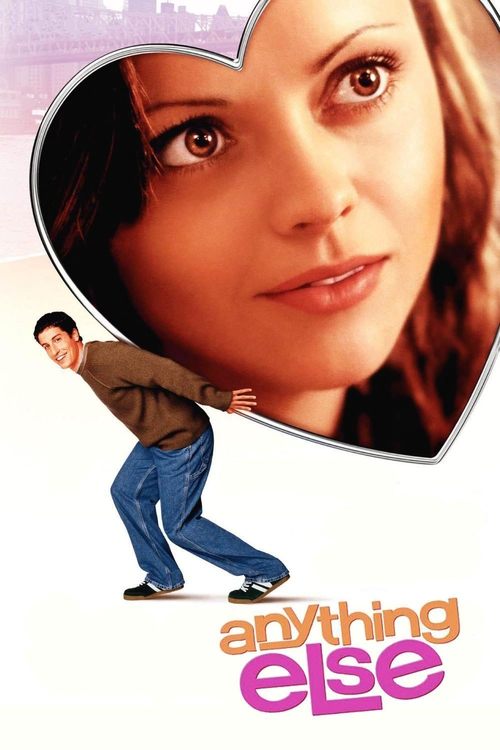
Anything Else (2003)
Directed by Woody Allen
No — Anything Else is not woke, scoring 2 out of 100 on our wokeness meter.
Woody Allen's Anything Else arrives in 2003 with the confidence of a man recycling his own furniture.
Consciousness Markers
Dobel delivers philosophical musings on existence and self-reliance, but these are character dialogue rather than preachy social messaging.
Amanda is a free-spirited character, but the film is a male-centric Woody Allen relationship comedy with no feminist framing or critique of patriarchy.
The cast is uniformly white, with no meaningful representation casting or diverse ensemble to speak of.
No LGBTQ+ characters, themes, or subtext appear anywhere in the film.
A passing antisemitic remark by a state trooper and Dobel's Jewishness exist as plot texture, not as racial consciousness or commentary.
No environmental or climate themes whatsoever.
Dobel distrusts psychiatry, religion, and dependence, but this is personal paranoia rather than an anti-capitalist or eat-the-rich message.
No body positivity themes or body-diverse representation present.
Jerry's neuroticism and psychoanalysis are period Woody Allen tropes, not a modern neurodivergence narrative.
No historical revisionism; the film is a contemporary relationship comedy with no historical subject matter.
Why it received this score
Woody Allen's Anything Else arrives in 2003 with the confidence of a man recycling his own furniture. Jason Biggs plays Jerry Falk, a young comedy writer who wants to be a novelist, worries about death, and cannot end a relationship, a job, or a course of psychoanalysis. Christina Ricci drifts through as Amanda, a free spirit whose main function is to withhold affection and explain herself at length. Allen casts himself as David Dobel, a paranoid older mentor who lectures in Central Park about self-reliance, firearms, and the collapse of civilization. The film is talky, white, and set in a New York of comfortable apartments and jazz, which is to say it is a Woody Allen film from 2003.
On the cultural ledger, this one is close to bare. The cast is uniformly white, the romance is heterosexual and male-centric, and the philosophical musings belong to the characters, not to a sermon the film is delivering. Jerry's neuroses are period furniture from the Allen catalog, not a modern account of mental health. Dobel distrusts psychiatry and religion, but his suspicion reads as personal paranoia, the worldview of a man collecting canned goods, and it never hardens into a critique of money or power. Amanda's restlessness hints at an inner life, though the camera keeps returning to Jerry's hurt feelings, so the film offers no real feminist argument. There is nothing here about climate, bodies, race, or history. A state trooper mutters an antisemitic remark, and it functions as plot mechanics, not as commentary.
The result is a modest, melancholic comedy that mistakes repetition for wisdom and calls it a philosophy. Ebert found the conversation musical. Leonard Maltin gave it a bomb. Both are defensible. What we have is a film about a man learning to be alone, told by a director who has told it before and will tell it again. It is pleasant, overlong, and largely innocent of the social enthusiasms of its era, which is its own quiet kind of distinction.
Analysis generated by our Consciousness Algorithm


Synopsis
Jerry Falk, an aspiring writer in New York, falls in love at first sight with a free-spirited young woman named Amanda. He has heard the phrase that life is like "anything else," but soon he finds that life with the unpredictable Amanda isn't like anything else at all.
Questions about Anything Else
Is Anything Else woke?
No — Anything Else is not woke, scoring 2 out of 100 on our wokeness meter. That earns it a verdict of Ultra Based.
Does Anything Else have any woke elements?
Very few. None of the 10 markers reaches 30, the level where a marker counts as present; the highest is Lecture Energy at 8.
How does Anything Else compare to other 2003 movies?
It ranks #125 of the 150 films from 2003 we've scored; their average is 12. The wokest is Mona Lisa Smile (60).
How is the Woke Score calculated?
An AI-assisted process researches the film and its reception, scores it 0–100 on ten markers, then combines those into one 0–100 Woke Score. It measures a specific set of 2020s cultural themes, not film quality.