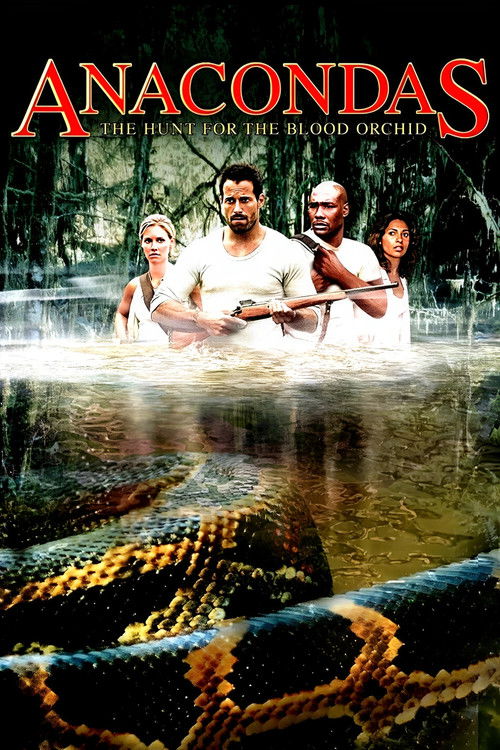
Anacondas: The Hunt for the Blood Orchid (2004)
Directed by Dwight H. Little
No — Anacondas: The Hunt for the Blood Orchid is not woke, scoring 11 out of 100 on our wokeness meter.
A pharmaceutical firm with offices in New York dispatches a research team into the Borneo jungle to retrieve a flower that promises extended life.
Consciousness Markers
The cast includes several non-white actors in supporting roles, but their presence is not framed as a statement or given thematic weight.
Sam Rogers is a capable female lead who fights and survives, but the film does not advance a feminist agenda or critique patriarchy.
There are no LGBTQ+ characters, themes, or subtext in the film.
Race is not addressed or explored; the diverse cast exists without racial commentary.
The Borneo jungle setting is merely a backdrop for creature horror, with no environmental or climate message.
A pharmaceutical company funds the expedition, but the film does not critique capitalism or corporate greed as a system.
There is no body-positive messaging or challenge to conventional body standards.
No neurodivergent characters or themes are present.
The film is a fictional creature feature and does not revise or reinterpret historical events.
The film is a B-movie monster thriller with no preachy or didactic social messaging.
Why it received this score
A pharmaceutical firm with offices in New York dispatches a research team into the Borneo jungle to retrieve a flower that promises extended life. This is a premise with a certain economic logic, and the film declines to interrogate it. The company funds the expedition and then recedes from the narrative, leaving the characters to contend with weather, water, and very large reptiles. The jungle functions as a jungle. No speech arrives to inform us that the forest is dying or that the corporation is itself a monster. The monster is a snake, and it is roughly forty feet long.
The cast includes a capable woman who beheads an anaconda with a machete and later climbs free of a pit while the female pursues her. She does this without commentary, and the film offers no argument about what her competence signifies. The ensemble also features several non-white performers in roles that never pause to announce themselves. Race goes unmentioned. So does nearly everything else, since the screenplay's attention stays fixed on the question of which character the snake will swallow next.
Anacondas are native to South America, a fact the production ignores with serene confidence. Geography here is a set, not a subject. The film wants to frighten us with computer-generated reptiles, and it succeeds often enough to earn a modest grade from audiences and a harsher one from critics. Not a single scene stops to instruct the viewer on how to think or how to vote. In a marketplace that increasingly treats entertainment as a syllabus, there is something restful about a picture that only wants to put a snake in a cave and watch everyone run.
Analysis generated by our Consciousness Algorithm


Synopsis
A scientific expedition sets out for Borneo to seek a flower called the Blood Orchid, which could grant extended life. Meanwhile, they run afoul of snakes and each other.
Questions about Anacondas: The Hunt for the Blood Orchid
Is Anacondas: The Hunt for the Blood Orchid woke?
No — Anacondas: The Hunt for the Blood Orchid is not woke, scoring 11 out of 100 on our wokeness meter. That earns it a verdict of Ultra Based.
Does Anacondas: The Hunt for the Blood Orchid have any woke elements?
1 of the 10 markers register at 30 or above, led by Representation Casting (30). On Representation Casting: The cast includes several non-white actors in supporting roles, but their presence is not framed as a statement or given thematic weight.
How does Anacondas: The Hunt for the Blood Orchid compare to other 2004 movies?
It ranks #65 of the 178 films from 2004 we've scored; their average is 12. The wokest is Tropical Malady (62).
How is the Woke Score calculated?
An AI-assisted process researches the film and its reception, scores it 0–100 on ten markers, then combines those into one 0–100 Woke Score. It measures a specific set of 2020s cultural themes, not film quality.