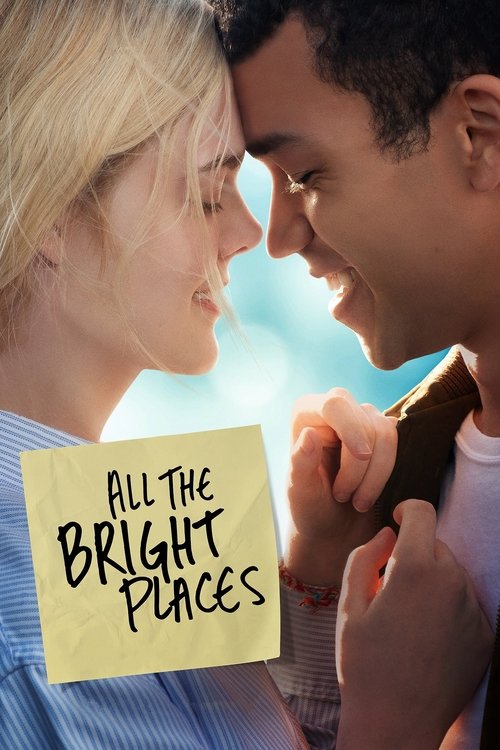
All the Bright Places (2020)
Directed by Brett Haley
No — All the Bright Places is not especially woke, scoring 22 out of 100 on our wokeness meter.
Netflix's adaptation of Jennifer Niven's young adult novel arrives with the quiet confidence of a film that knows precisely which tears it intends to extract.
Consciousness Markers
The film features a Black male co-lead (Justice Smith) opposite Elle Fanning, with additional Black performers in supporting roles, offering meaningful on-screen diversity without foregrounding race as a theme.
Finch's depression, mood episodes, and PTSD are depicted with sustained empathy and complexity, positioning mental health as a central concern rather than a plot device, though it is not framed through the explicit neurodivergence-advocacy lens.
The film delivers gentle but deliberate messaging about mental health and suicide awareness, including resource information placed at the end of the credits, though it generally prioritizes emotional storytelling over preaching.
Violet is a central female protagonist processing grief and reclaiming her identity as a writer, but the film frames this as personal healing rather than a feminist statement.
No LGBTQ+ characters or themes appear anywhere in the narrative.
Race is never addressed or thematized; the diverse casting carries no explicit racial commentary.
No environmental or climate themes are present.
No economic critique or anti-capitalist messaging appears in the film.
No body image or body positivity themes are present.
The film is a contemporary fictional story with no historical revisionism.
Why it received this score
Netflix's adaptation of Jennifer Niven's young adult novel arrives with the quiet confidence of a film that knows precisely which tears it intends to extract. Violet Markey (Elle Fanning) has stopped writing since the crash that killed her sister. Theodore Finch (Justice Smith) runs everywhere, smiles too widely, and vanishes for days at a time. They meet on a bridge, which is where these things happen, and a school project about the wonders of Indiana becomes a courtship conducted in state parks and half-forgotten roadside attractions. The premise is sturdy. The execution is gentle. The film has no interest in surprising anyone who has sat through a teenage romance before, and it does not pretend otherwise.
Mr. Smith's casting opposite Ms. Fanning yields a biracial love story that the film never bothers to discuss, which is either a quiet victory of normalization or an oversight, depending on the temperament of the viewer. The picture is stronger for the silence. Violet's grief is given room to breathe, and her return to the page carries a personal weight that stops well short of a manifesto. Where the film does lean forward is in its handling of Finch's depression and the episodes he calls dark moods. These passages are afforded patience and a refusal to tidy them up, and the film earns its final, sobering turn without exploiting it.
The closing credits offer mental health resources, a gesture that is now standard and still welcome. The advocacy here is soft-spoken, embedded in character instead of announced from a lectern. It amounts to a modest achievement: a sincere romance that treats adolescent despair as mattering, without converting its audience into a congregation. Recommended for those who enjoy crying on public transportation.
Analysis generated by our Consciousness Algorithm


Synopsis
Two teens facing personal struggles form a powerful bond as they embark on a cathartic journey chronicling the wonders of Indiana.
Questions about All the Bright Places
Is All the Bright Places woke?
No — All the Bright Places is not especially woke, scoring 22 out of 100 on our wokeness meter. That earns it a verdict of Based.
Does All the Bright Places have any woke elements?
1 of the 10 markers register at 30 or above, led by Representation Casting (45). On Representation Casting: The film features a Black male co-lead (Justice Smith) opposite Elle Fanning, with additional Black performers in supporting roles, offering meaningful on-screen diversity without foregrounding race as a theme.
How does All the Bright Places compare to other 2020 movies?
It ranks #73 of the 227 films from 2020 we've scored; their average is 21. The wokest is One Night in Miami... (83).
How is the Woke Score calculated?
An AI-assisted process researches the film and its reception, scores it 0–100 on ten markers, then combines those into one 0–100 Woke Score. It measures a specific set of 2020s cultural themes, not film quality.