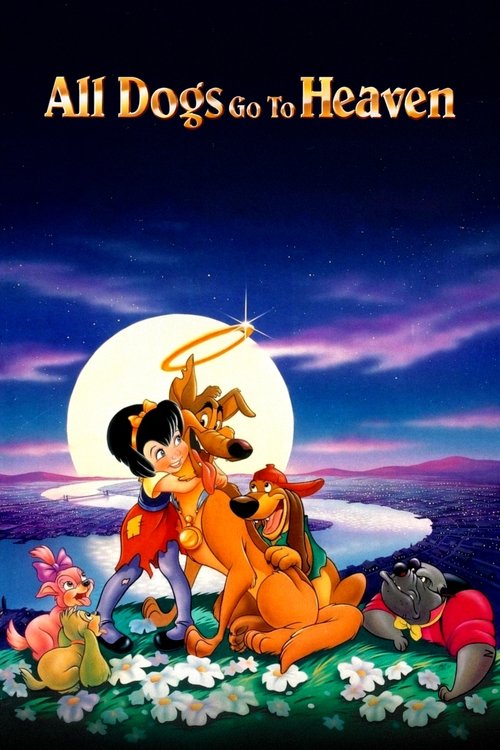
All Dogs Go to Heaven (1989)
Directed by Don Bluth
No — All Dogs Go to Heaven is not woke, scoring 3 out of 100 on our wokeness meter.
Don Bluth's 1989 feature concerns Charlie B. Barkin, a German Shepherd racketeer who is murdered by his business partner, talks his way out of paradise, and spends the remainder of the running time learning that love is worth more than a casino.
Consciousness Markers
The film delivers gentle moral lessons about kindness, sacrifice, and love, but in a traditional family-film register rather than modern preachy messaging.
Black performers Melba Moore and Ken Page voice the angel Annabelle and King Gator, but these are incidental voice-casting choices for animal characters with no representational intent.
Greed and casino profiteering drive the villain, but the moral is about personal redemption and friendship, not systemic anti-capitalism.
No LGBTQ+ characters, themes, or subtext of any kind.
Female characters (Anne-Marie, Flo, Annabelle) exist within traditional roles; no feminist critique or agenda is present.
Despite a 1939 New Orleans setting, the film engages no racial themes or commentary whatsoever.
No environmental or climate themes; an oil fire serves only as a climactic action set piece.
No body-positivity themes or messaging.
Itchy's anxiety and Killer's fidgeting are played as comic quirks, not as neurodivergence representation.
A fantasy period piece with no historical revisionism.
Why it received this score
Don Bluth's 1989 feature concerns Charlie B. Barkin, a German Shepherd racketeer who is murdered by his business partner, talks his way out of paradise, and spends the remainder of the running time learning that love is worth more than a casino. The theology is stated plainly in the title and never questioned. It is a Sunday school parable wearing a fedora, set in a 1939 New Orleans of riverboat gambling and speaking orphans, and it plays exactly as that description suggests: warm, sentimental, and entirely comfortable inside the moral vocabulary it inherited.
On the markers of contemporary social consciousness, the film is close to barren. There is no LGBTQ content of any kind. The women, an orphan, a collie, and a whippet angel, occupy traditional roles without a whisper of critique. The Louisiana period setting engages no racial themes whatsoever, which is a choice, if not an examined one. An oil fire consumes the climax, but as spectacle, not as environmental sermon. Carface's greed drives the plot, yet the resolution is one dog's personal redemption, not an indictment of the profit motive. Melba Moore and Ken Page lend their voices to an angel and an alligator, incidental casting for animal characters with no representational design behind it.
The film does lecture, gently. Charlie is taught kindness, sacrifice, and the value of friendship, and the audience is invited to absorb the same lesson. The register is that of a mid-century family picture, not a modern seminar. Itchy's anxiety and Killer's fidgeting are comic business, not a study of the neurodivergent mind. There is no body positivity, no historical revisionism, no climate concern. The leftovers are an earnest, occasionally grim fairy tale about a dead dog who earns his wings. We have classified it. We feel no need to see it again.
Analysis generated by our Consciousness Algorithm


Synopsis
When a casino-owning dog named Charlie is murdered by his rival Carface, he finds himself in Heaven. Wanting to get back at his killer, he cons his way back to the living with the warning that doing so damns him to Hell. Once back, he teams with his old partner, Itchy, to prep his retaliation. He stumbles upon an orphan girl who can talk to the animals, thus allowing him to get the inside info on the races to ensure his wins to finance his plans. However, all the while, he is still haunted by nightmares of what's waiting for him on the other side unless he can prove that he is worthy of Heaven again.
Questions about All Dogs Go to Heaven
Is All Dogs Go to Heaven woke?
No — All Dogs Go to Heaven is not woke, scoring 3 out of 100 on our wokeness meter. That earns it a verdict of Ultra Based.
Does All Dogs Go to Heaven have any woke elements?
Very few. None of the 10 markers reaches 30, the level where a marker counts as present; the highest is Lecture Energy at 10.
How does All Dogs Go to Heaven compare to other 1989 movies?
It ranks #56 of the 68 films from 1989 we've scored; their average is 10. The wokest is Do the Right Thing (72).
How is the Woke Score calculated?
An AI-assisted process researches the film and its reception, scores it 0–100 on ten markers, then combines those into one 0–100 Woke Score. It measures a specific set of 2020s cultural themes, not film quality.