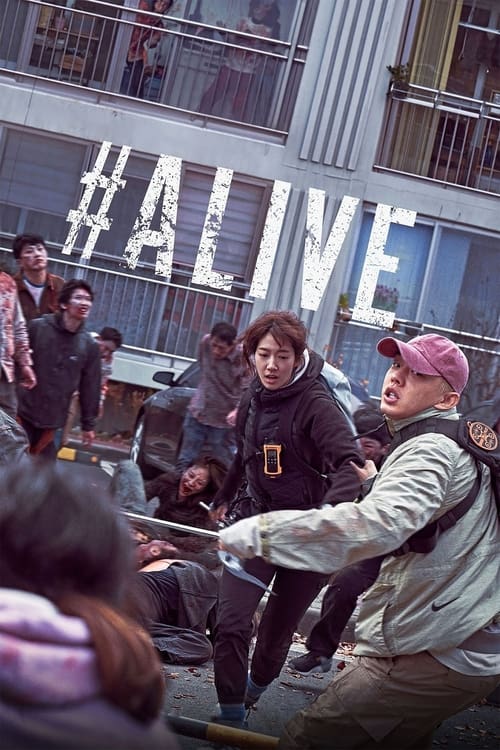
#Alive (2020)
Directed by Cho Il
No — #Alive is not woke, scoring 2 out of 100 on our wokeness meter.
#Alive arrives from South Korea with a premise trimmed to the bone: a young livestreamer named Joon-woo barricades himself inside his family's apartment while a virus turns Seoul into a city of the hungry dead.
Consciousness Markers
The cast is entirely Korean, which is simply the natural demographic of a South Korean production rather than a deliberate diversity-casting initiative.
No LGBTQ+ characters, relationships, or themes appear anywhere in the film.
Yoo-bin is a capable axe-wielding survivor, but the film presents her competence as genre convention rather than a feminist statement or agenda.
The film engages no racial themes, commentary, or identity politics whatsoever.
The apocalypse here is a viral zombie outbreak, with no environmental or climate dimension.
There is no critique of wealth, class, or capitalism; the antagonist is a deranged survivor, not a system.
No body-positivity themes or messaging are present.
The gamer protagonist's isolation is situational, not framed as neurodivergence.
The film is a fictional zombie thriller with no historical subject matter to revise.
The closing anchor voiceover merely explains the rescue mechanics; the film never pauses to preach a social message.
Why it received this score
#Alive arrives from South Korea with a premise trimmed to the bone: a young livestreamer named Joon-woo barricades himself inside his family's apartment while a virus turns Seoul into a city of the hungry dead. Cho Il-hyung directs with the patience of a man who trusts an empty hallway and a broken refrigerator to do the heavy lifting. There are drones, a zip line, a neighbor with an axe, and a great deal of waiting. The film opened in the summer of 2020, when the rest of us were also acquiring an unwelcome expertise in isolation, and it captures that claustrophobia without ever stopping to announce what it is doing.
This is a genre picture, and it conducts itself accordingly. The cast is Korean because the story is set in Seoul, not because anyone assembled a demographic checklist and worked backward toward a screenplay. Park Shin-hye's Yoo-bin dispatches zombies with a hand axe and a booby-trapped door, and the film regards her competence as a survival requirement instead of a statement. The villain is one deranged man who drugs two strangers and feeds them to his infected wife. He stands for no system, no class, no ideology. He is simply the worst neighbor imaginable, which is a category the genre has kept well stocked for fifty years.
The closing minutes offer an anchor's voiceover explaining that wireless networks are returning and the military is collecting survivors who posted online. That is the nearest the film comes to a thesis, and the thesis concerns logistics. No sermon follows. Nobody turns to the camera to instruct us on how to live or whom to blame. What remains is a tight, well-acted thriller that wants to frighten us for ninety minutes and then release us into the street. By the standards of contemporary social messaging it is a desert. A clean, well-executed desert.
Analysis generated by our Consciousness Algorithm


Synopsis
As a grisly virus rampages a city, a lone man stays locked inside his apartment, digitally cut off from seeking help and desperate to find a way out.
Questions about #Alive
Is #Alive woke?
No — #Alive is not woke, scoring 2 out of 100 on our wokeness meter. That earns it a verdict of Ultra Based.
Does #Alive have any woke elements?
No. All 10 markers score zero.
How does #Alive compare to other 2020 movies?
It ranks #205 of the 227 films from 2020 we've scored; their average is 21. The wokest is One Night in Miami... (83).
How is the Woke Score calculated?
An AI-assisted process researches the film and its reception, scores it 0–100 on ten markers, then combines those into one 0–100 Woke Score. It measures a specific set of 2020s cultural themes, not film quality.