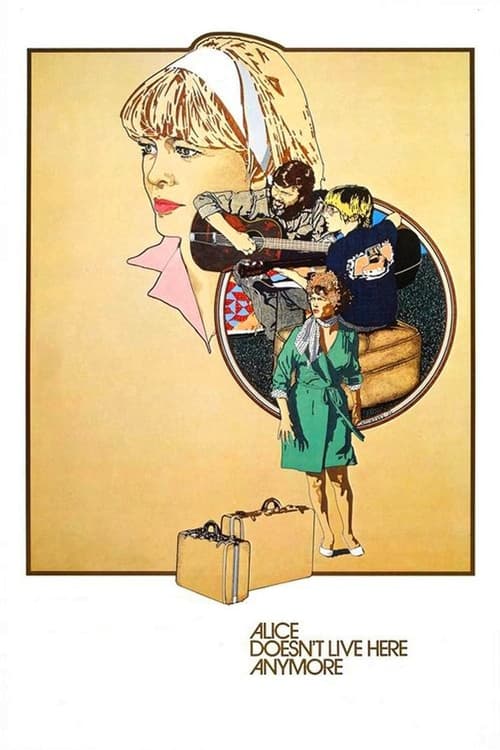
Alice Doesn't Live Here Anymore (1974)
Directed by Martin Scorsese
No — Alice Doesn't Live Here Anymore is not woke, scoring 18 out of 100 on our wokeness meter.
Ellen Burstyn, freshly possessed of the cultural capital that only a demonic possession picture can confer, used her leverage to build a film around a woman she recognized.
Consciousness Markers
Burstyn explicitly conceived the project as a film from a woman's point of view during the early women's movement, centering a widow's self-determination and her bonds with fellow waitresses Flo and Vera. It is a genuine woman-centered narrative, though it predates and largely sidesteps the modern ideological framing.
Ebert noted the film 'belongs somewhere outside ideology'; it observes its characters with warmth and humor rather than delivering a message, keeping didacticism minimal.
The film depicts working-class economic precarity and the indignities of low-wage waitressing, but it does so as lived circumstance rather than as a systemic critique of capitalism.
The cast is almost entirely white, drawn from the standard 1970s Hollywood pool; no meaningful diverse or color-conscious casting is present.
No LGBTQ+ characters, themes, or subtext appear anywhere in the film.
Race is not a subject of the film; the story unfolds in a uniformly white Southwestern milieu with no racial commentary.
No environmental or climate themes are present.
No body-positivity themes or messaging appear.
No neurodivergence is depicted or addressed.
The film is a contemporary character drama with no historical revisionism.
Why it received this score
Ellen Burstyn, freshly possessed of the cultural capital that only a demonic possession picture can confer, used her leverage to build a film around a woman she recognized. Alice Hyatt, widowed by a Coca-Cola truck, drives her son across the Southwest in search of a singing career and settles, through financial necessity, into a Tucson diner. Scorsese, directing his first studio picture, keeps the camera restless and the tone loose. The result is a woman-centered story that predates the vocabulary we now apply to such things and, mercifully, declines to speak it.
On representation, the film is a product of its moment: a uniformly white Southwestern milieu, no racial commentary, no LGBTQ presence, no interest in bodies as political statements or minds as diagnostic categories. Climate change does not intrude. History is not revised, because history is not the subject. What remains is the feminist current, and it is genuine, if unlabeled. Burstyn conceived the project during the early stirrings of the women's movement, and the film honors a widow's self-determination and her bonds with Flo and Vera without converting them into a thesis. Ebert's observation that the picture sits somewhere outside ideology is the correct one.
The economic texture deserves a nod. Alice waits tables, counts tips, and flees a violent man because she cannot afford to stay. That is precarity as lived circumstance, not as a systemic indictment, and the film never pauses to explain it. Its sermonizing is minimal, confined mostly to the small moral corrections of melodrama. A quiet, humane, occasionally shapeless picture. It asks for our attention and mostly earns it, and it manages this without a single placard.
Analysis generated by our Consciousness Algorithm
Part of


Synopsis
After her husband dies, Alice and her son, Tommy, leave their small New Mexico town for California, where Alice hopes to make a new life for herself as a singer. Money problems force them to settle in Arizona instead, where Alice takes a job as waitress in a small diner.
Questions about Alice Doesn't Live Here Anymore
Is Alice Doesn't Live Here Anymore woke?
No — Alice Doesn't Live Here Anymore is not woke, scoring 18 out of 100 on our wokeness meter. That earns it a verdict of Ultra Based.
Does Alice Doesn't Live Here Anymore have any woke elements?
1 of the 10 markers register at 30 or above, led by Feminist Agenda (45). On Feminist Agenda: Burstyn explicitly conceived the project as a film from a woman's point of view during the early women's movement, centering a widow's self-determination and her bonds with fellow waitresses Flo and Vera.
How does Alice Doesn't Live Here Anymore compare to other 1974 movies?
It ranks #4 of the 29 films from 1974 we've scored; their average is 10. The wokest is Ali: Fear Eats the Soul (42).
How is the Woke Score calculated?
An AI-assisted process researches the film and its reception, scores it 0–100 on ten markers, then combines those into one 0–100 Woke Score. It measures a specific set of 2020s cultural themes, not film quality.