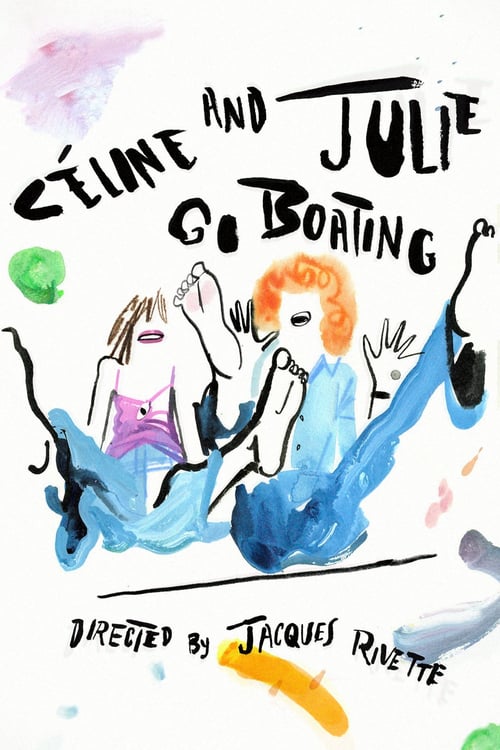
Céline and Julie Go Boating (1974)
Directed by Jacques Rivette
No · Ultra Based
How we score movies →Consciousness Markers
The film centers female protagonists and celebrates their agency and pleasure without victimhood narratives. However, it predates contemporary feminist discourse and does not engage with systemic critique.
There are hints of erotic ambiguity and intimacy between the two female leads, but the film does not explicitly code them as LGBTQ+ or make this a thematic concern.
Rivette's film is playful and associative rather than preachy. It does not lecture the audience about its themes but instead invites them into its ludic world.
The film stars two women in leading roles, but this reflects casting choices rather than a deliberate diversity agenda. The supporting cast is not analyzed through a demographic lens.
While the film celebrates leisure and play over productivity, it does not articulate any explicit critique of capitalism or economic systems.
The female leads are conventionally attractive by the standards of 1974 cinema. No particular engagement with body diversity or body politics is evident.
The film is set in Paris with an entirely white French cast. No meaningful engagement with race or racial representation is present.
Climate concerns are entirely absent from the film's narrative and thematic preoccupations.
The film contains no representation of or engagement with neurodivergence as a concept or lived experience.
The film is a contemporary fantasy comedy with no historical content to revise or reframe.

Synopsis
Julie, a daydreaming librarian, meets Céline, an enigmatic magician, and together they become the heroines of a time-warping adventure involving a haunted house, psychotropic candy, and a murder-mystery melodrama.
Why it received this score
Jacques Rivette's "Céline and Julie Go Boating" presents a curious case study in temporal displacement. Here is a 1974 French film that centers its entire narrative on the relationship between two women, emphasizes female agency and pleasure, and celebrates play as a form of liberation. By any reasonable measure of progressive cinema, it is exemplary. Yet to apply the language of contemporary cultural consciousness to this work is to commit a kind of anachronism, a retroactive inflation of historical importance.
The film's female-centric perspective emerges not from a programmatic commitment to social consciousness as we understand it today, but rather from Rivette's own aesthetic preoccupations with cinema as play, with the pleasures of narrative itself, and with the traditions of early cinema comedy. The two women are not presented as victims requiring liberation or as representatives of demographic categories. They are simply the protagonists of a fantastical adventure. This is, in other words, what feminism looked like before it became a checklist. The film treats women as fully realized human beings without needing to announce that fact or append it with contemporary signifiers.
To score this masterpiece highly on contemporary wokeness metrics would be to misunderstand both the film and the concept. "Céline and Julie Go Boating" is a work of genuine artistic achievement that happens to center women. It is not a work about centering women. The distinction matters. We must resist the temptation to colonize the past with the vocabulary of the present, no matter how much we admire both.
Analysis generated by our Consciousness Algorithm
Critic Reviews
“The pace is daringly languid — at times it seems more like a daydream on a sunny park bench than a movie — but you'll emerge from this wonderland as if from vacation, and you'll never look at the intersection between life and storytelling in quite the same way.”
“The playfulness of Rivette's sublime female-buddy picture, recalling the fun of "Gentlemen Prefer Blondes," would inform Susan Seidelman's "Desperately Seeking Susan" 11 years later.”
“By the time they've taken full control of the movie's alternate universe—as the melodrama morphs with marvelous ease into a musical comedy—you feel like anything is possible.”
“A super collaboration where no idea is discarded and lets the imagination run wild.”