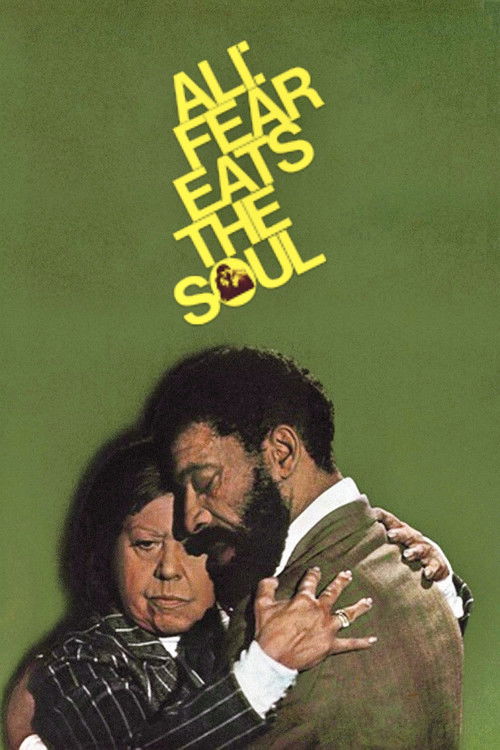
Ali: Fear Eats the Soul (1974)
Directed by Rainer Werner Fassbinder
Partly · Woke-Adjacent
How we score movies →Consciousness Markers
The film directly addresses racism and xenophobia as systemic forces affecting immigrant communities in Germany. However, it approaches these themes with irony and detachment rather than explicit advocacy or consciousness-raising.
The film casts an Arab actor in a major role and centers immigrant experience, but does so from a position of aesthetic distance rather than celebratory representation. The approach is more about documenting marginality than affirming identity.
Class precarity and economic vulnerability inform the narrative, but the film does not mount explicit critique of capitalism. Fassbinder documents economic anxiety without prescribing systemic solutions.
Emmi is an active agent in pursuing her own happiness, but the film does not foreground gender politics or feminist ideology. Her agency emerges from loneliness and desire rather than feminist consciousness.
While the film communicates its themes clearly, it does so through formal cinematic language and narrative structure rather than through explicit exposition or preachy dialogue. The tone is observational rather than pedagogical.
The film addresses historical racism and immigration policy in 1970s Germany, but does not engage in the kind of revisionist historical narrative common to contemporary progressive cinema.
No LGBTQ themes present. The film centers a heterosexual romance between an elderly German woman and a middle-aged Arab man.
No climate-related themes present. The film is concerned with intimate social dynamics and class relations, not environmental consciousness.
No body positivity themes. The film does not engage with contemporary discourse around bodies, beauty standards, or physical acceptance.
No neurodivergence representation or themes present.


Synopsis
Emmi Kurowski, a cleaning lady, is lonely in her old age. Her husband died years ago, and her grown children offer little companionship. One night she goes to a bar frequented by Arab immigrants and strikes up a friendship with middle-aged mechanic Ali. Their relationship soon develops into something more, and Emmi's family and neighbors criticize their spontaneous marriage. Soon Emmi and Ali are forced to confront their own insecurities about their future.
Why it received this score
Fassbinder's 1974 meditation on xenophobia and class anxiety presents a cross-cultural romance that challenges the viewer's comfort, though not necessarily in ways that align with contemporary progressive frameworks. The film's treatment of racism is clinical and observational rather than preachy. Emmi and Ali's relationship functions as a mirror held up to the petty cruelties of family and society, but Fassbinder maintains a cool distance from moral instruction, preferring instead to document the texture of social prejudice with the precision of an anthropologist. The work is undeniably serious about its subject matter, yet it operates in a register of irony and formal experimentation that resists the earnest advocacy one associates with modern progressive cinema.
What distinguishes this film from contemporary approaches to similar themes is its refusal to center the emotional validation of its marginalized characters. Ali remains largely opaque, a figure around which anxiety circulates rather than a fully realized consciousness demanding our recognition. This is not a failure of the film so much as a deliberate aesthetic choice, one that reflects Fassbinder's skepticism about cinema's capacity to generate authentic empathy. The work challenges racism not by inviting identification with the oppressed but by implicating the viewer in systems of casual cruelty and economic precarity that transcend race itself.
The film's modest social consciousness score reflects the gap between its genuine engagement with xenophobia and the specific vocabulary of 2020s progressive sensibility. It is a work of moral intelligence, not a work of contemporary woke cinema. Its power derives from formal sophistication and emotional restraint rather than from the kind of explicit representation politics that define modern progressive filmmaking.
Analysis generated by our Consciousness Algorithm
Critic Reviews
“Ali is a bruiser, unwieldy in length and ambition. But Mann and Smith deliver this powerhouse with the urgency of a champ's left hook.”
“It's one of the most ambitious biographical films ever made in this country, and one of the most unusual, moving and exciting.”
“Michael Mann is a fluent, evocative filmmaker, and the movie is well written, expertly staged, and beautifully edited. [24 & 31 Dec 2001, p. 126]”
“Will Smith flies like a butterfly, but what director Michael Mann does to the greatest fighter of all time just stings.”