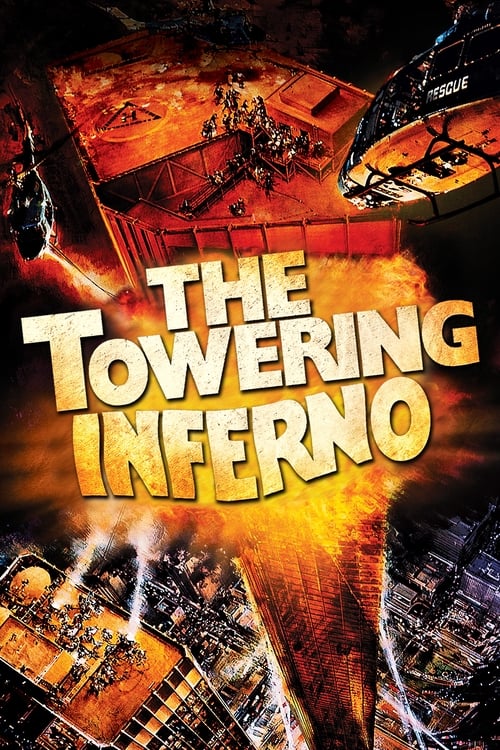
The Towering Inferno (1974)
Directed by John Guillermin
No · Ultra Based
How we score movies →Consciousness Markers
The film critiques corporate corner-cutting and negligence that prioritizes profit over safety, but this critique is incidental rather than central to the narrative.
Faye Dunaway plays a journalist, suggesting some inclusion of women in professional roles, but she remains sidelined by the male action heroes and her character lacks agency.
Cast includes O.J. Simpson and other minorities in supporting roles, reflecting 1970s integration efforts, but they function as background characters without development or centering.
Minor moralizing about safety standards and corporate responsibility exists, but such themes are woven into the action narrative rather than delivered as preachy lectures.
Diverse casting reflects the era's minimal integration efforts, but there is no conscious engagement with racial themes or examination of race in the narrative.
No LGBTQ+ representation or themes. The film operates within standard heteronormative 1970s conventions.
The fire results from poor construction and corporate negligence, not environmental concerns. No climate messaging is present.
Standard 1970s Hollywood aesthetics with no commentary on body diversity or representation.
No representation of or engagement with neurodivergent characters in the film.
A contemporary disaster narrative with no historical pretensions or revisionist elements.
Synopsis
At the opening party of a colossal but poorly constructed skyscraper, a massive fire breaks out, threatening to destroy the tower and everyone in it.
Why it received this score
The Towering Inferno arrives as a period artifact of 1974, a moment when progressive sensibilities had not yet calcified into their modern forms. The film presents an ensemble cast of considerable star power, including O.J. Simpson and Faye Dunaway, yet neither presence signals anything beyond standard Hollywood integration of the era. Dunaway's journalist character could have been a meaningful exploration of women in professional spaces, but instead she functions as decoration in the margins of a film obsessed with masculine heroics and spectacle. The narrative tension between corporate negligence and individual heroism occasionally brushes against capitalist critique, but these moments remain incidental to the primary purpose of watching buildings burn.
What distinguishes this film from a genuine engagement with social consciousness is its fundamental indifference to the implications of its own narrative. The disaster serves as backdrop for action sequences rather than occasion for meaningful examination. The diverse casting reads as tokenism rather than representation, a checkbox marked without conviction. There is no attempt to center or develop the experiences of minority characters, who appear primarily to react to catastrophe alongside their white counterparts.
By contemporary standards, The Towering Inferno registers as politically inert, a film made in an era before the specific cultural markers we evaluate today had crystallized. It is neither progressive nor regressive in the modern sense. It simply is a disaster film, concerned with spectacle and star power, asking nothing of its audience beyond engagement with the mechanics of survival and heroism.
Analysis generated by our Consciousness Algorithm
Critic Reviews
“The Towering Inferno is one of the greatest disaster pictures made, a personal and professional triumph for producer Irwin Allen.”
“The fun of watching The Towering Inferno is in figuring out which old star Allen is going to indiscriminately kill off, as well as watching ultramodern décor go up in flames while a bunch of stubborn egotists refuse to listen to reasonable men.”
“Much more than a way to pass a rainy bank holiday afternoon, this is rocking good superleague disaster adventure.”
“The movie doesn’t stick together in one’s head; this thing is like some junky fairground show—a chamber of horrors with skeletons that jump up. ”