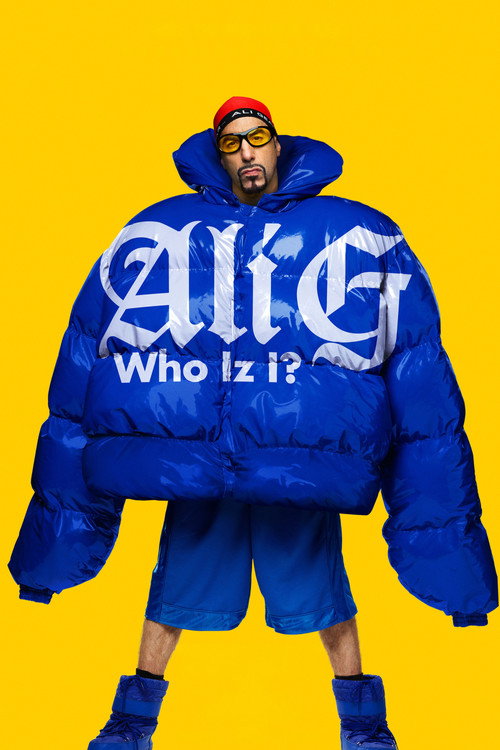
Ali G: Who Iz I? (2026)
Directed by Sacha Baron Cohen
Yes — Ali G: Who Iz I? is woke, scoring 66 out of 100 on our wokeness meter.
Sacha Baron Cohen returns to the character that made him famous, armed this time with a Voltaire epigraph, a Time magazine op-ed, and what appears to be a sincere desire to explain himself.
Consciousness Markers
Racial consciousness is the film's explicit organizing principle: Baron Cohen publicly frames Ali G as a satire of white cultural appropriation, the film opens with a Voltaire quote about absurdity and atrocity, and the director published a Time essay on satire as a weapon against bigotry. Critics noted this justificatory scaffolding felt heavy-handed.
The film opens with a Voltaire quote, deploys a left-wing academic character to mock progressive jargon, and was accompanied by a director's essay in Time magazine explaining what satire is for. Radio Times noted the heavy-handed quality of Baron Cohen's need to justify the character as a moral instrument, and critics described the result as 'uncharacteristically timid' precisely because the moralizing impulse constrained the anarchy.
The supporting cast includes A$AP Rocky, Rihanna, Tiffany Haddish, and DJ Jazzy Jeff, lending the film a deliberately diverse hip-hop cultural milieu. This is complicated, however, by the fact that the film's entire premise rests on a white British comedian occupying the center of that milieu while the film insists this is satire.
No LGBTQ+ themes, characters, or storylines are present in the available research or metadata.
No feminist agenda or gender-politics framing surfaces in the film's plot, reception, or cultural commentary.
No climate themes are present in the film's plot, promotional materials, or critical reception.
No anti-capitalist or class-critique framing is evident in the available research.
No body positivity themes are present in the film's content or reception.
No neurodivergence themes or representation are present in the available research.
The film is a contemporary mockumentary comedy with no revisionist historical framing.
Why it received this score
Sacha Baron Cohen returns to the character that made him famous, armed this time with a Voltaire epigraph, a Time magazine op-ed, and what appears to be a sincere desire to explain himself. This is, in the taxonomy of comedy, a worrying combination. Ali G was funny in 2000 because it was a grenade thrown without a safety briefing. It is considerably less funny in 2026 because the grenade now arrives with a twelve-page pamphlet explaining that grenades are a metaphor for disinformation.
The film's central sociological argument, that Ali G satirizes white suburban cultural appropriators rather than Black hip-hop culture, is not wrong. It is also the kind of argument that, when stated aloud in press interviews and encoded into the film's opening frames, performs the precise opposite of what satire requires. The inclusion of Dr. Nira Cain-N'Degeocello, Baron Cohen's hyper-progressive academic character, suggests the film is attempting bipartisan skewering: right-wing militarism via Col. Erran Morad, left-wing campus jargon via the good Doctor. The gesture is noted. The execution, critics suggest, is timid. A 50% on Rotten Tomatoes is the cinema's way of saying "we see what you were going for."
The supporting cast of A$AP Rocky, Rihanna, Tiffany Haddish, and DJ Jazzy Jeff signals cultural legitimacy with the subtlety of a credential wall. Their presence is meant to confer permission. Whether it does is a question the film raises and then, by all accounts, declines to answer with any particular conviction. Baron Cohen is a genuinely gifted provocateur who has, in this installment, made the career-limiting decision to be thoughtful about it. The racial consciousness is real. The lecture energy is real. The comedy, reviewers suggest, is intermittent.
Analysis generated by our Consciousness Algorithm

Synopsis
After twenty years spent "chillin', tokin' and bonin'", Ali G is shocked to discover that his long-term girlfriend, Julie, is 8 months pregnant. Faced with an extra mouth to feed, he gets off his batty and heads to America to reclaim his former glory… but soon encounters adversaries who will ultimately threaten his and his child's very existence.
Questions about Ali G: Who Iz I?
Is Ali G: Who Iz I? woke?
Yes — Ali G: Who Iz I? is woke, scoring 66 out of 100 on our wokeness meter. That earns it a verdict of Woke.
What makes Ali G: Who Iz I? woke?
3 of the 10 markers register at 30 or above, led by Racial Consciousness (68), Lecture Energy (62) and Representation Casting (52). On Racial Consciousness: Racial consciousness is the film's explicit organizing principle: Baron Cohen publicly frames Ali G as a satire of white cultural appropriation, the film opens with a Voltaire quote about absurdity and atrocity, and the director published a Time essay on satire as a weapon against bigotry.
How does Ali G: Who Iz I? compare to other 2026 movies?
It ranks #51 of the 800 films from 2026 we've scored; their average is 23. The wokest is Between Us (89).
How is the Woke Score calculated?
An AI-assisted process researches the film and its reception, scores it 0–100 on ten markers, then combines those into one 0–100 Woke Score. It measures a specific set of 2020s cultural themes, not film quality.