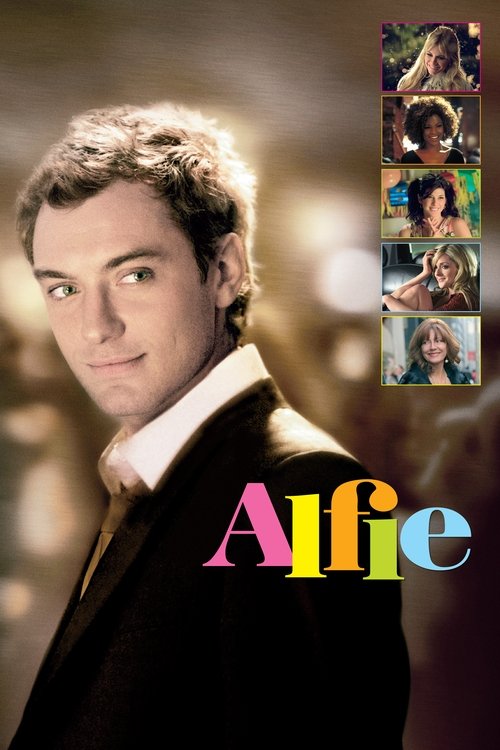
Alfie (2004)
Directed by Charles Shyer
No — Alfie is not especially woke, scoring 21 out of 100 on our wokeness meter.
The 2004 iteration of Alfie presents a study in detached moral ambiguity, filtered through a lens of highly polished mainstream cinema.
Consciousness Markers
The 2004 remake diversifies the original's all-white British cast, giving Alfie a Black best friend (Omar Epps) and Black love interest (Nia Long) alongside Marisa Tomei and Susan Sarandon, though the casting is colorblind and never commented upon.
The film is told entirely from the womanizer's perspective and treats women largely as conquests, though it does show his behavior producing consequences and loneliness; this is character drama, not a feminist agenda.
There is mild moralizing about commitment and love ('find somebody to love'), but it is delivered through character reflection and fourth-wall narration rather than preachy sermonizing.
No LGBTQ+ characters or themes appear anywhere in the film.
Race is never addressed or thematized; the diverse casting is entirely incidental to the story.
No environmental or climate content whatsoever.
Alfie's ambitions are entrepreneurial (he and Marlon want to start a limo company); there is no critique of wealth or class.
No body-positivity themes; the film's aesthetic is conventional romantic-comedy attractiveness.
Nikki's instability and going off her medication is framed as a romantic obstacle, not as neurodivergence advocacy or representation.
No historical revisionism; the film is a contemporary-set relationship drama.
Why it received this score
The 2004 iteration of Alfie presents a study in detached moral ambiguity, filtered through a lens of highly polished mainstream cinema. The central protagonist, a philosophical womanizer navigating the Manhattan dating scene, functions primarily as a vehicle for observing shifting contemporary social dynamics, if one chooses to be observant. The casting choices, though not driven by any discernible social agenda, introduce a degree of racial variation that serves only to color the landscape without offering any deeper cultural analysis. We observe a collection of progressive sensibilities in this film, yet they remain entirely superficial, mostly confined to the periphery of the lead's pursuit of fleeting satisfaction.
The narrative offers glimpses of interpersonal conflict, specifically through a character who appears unstable, yet this is treated strictly as a romantic inconvenience rather than a subject worthy of deeper consideration. The film avoids the kind of systemic critiques or environmental urgency that defines more ambitious cultural statements. Its focus remains stubbornly intimate, centered on the machinations of the individual heart. Any attempt at a serious socio-economic commentary is absent; the character's entrepreneurial interests in the livery industry serve as mere backdrop to his personal failings. The film does not engage with the larger structures of society, opting instead for a self-contained examination of a man's desire for permanence in an ephemeral landscape.
There is a slight presence of moralizing, delivered not through a heavy-handed sermon, but through the protagonist's self-reflective fourth-wall interactions. He poses questions to the audience about commitment and purpose, a subtle nod to the complexities of modern connection. This subtle questioning prevents the film from being a total void of contemplation, providing a modest amount of intellectual texture to what is ultimately a glossy character drama. It is a piece of highly marketable, commercially viable entertainment that manages to skirt the edges of social awareness without ever fully committing to the heavier demands of modern progressive discourse.
Analysis generated by our Consciousness Algorithm
Part of


Synopsis
A tale of a philosophical womanizer who is forced to question his seemingly carefree existence.
Questions about Alfie
Is Alfie woke?
No — Alfie is not especially woke, scoring 21 out of 100 on our wokeness meter. That earns it a verdict of Based.
Does Alfie have any woke elements?
1 of the 10 markers register at 30 or above, led by Representation Casting (35). On Representation Casting: The 2004 remake diversifies the original's all-white British cast, giving Alfie a Black best friend (Omar Epps) and Black love interest (Nia Long) alongside Marisa Tomei and Susan Sarandon, though the casting is colorblind and never commented upon.
How does Alfie compare to other 2004 movies?
It ranks #35 of the 178 films from 2004 we've scored; their average is 12. The wokest is Tropical Malady (62).
How is the Woke Score calculated?
An AI-assisted process researches the film and its reception, scores it 0–100 on ten markers, then combines those into one 0–100 Woke Score. It measures a specific set of 2020s cultural themes, not film quality.