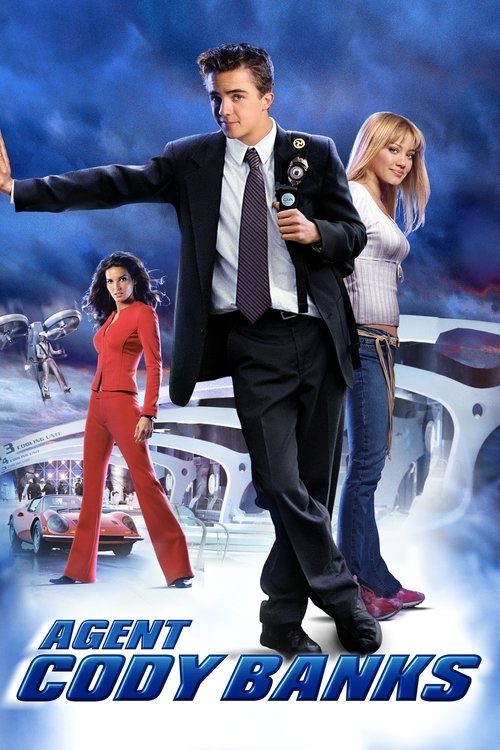
Agent Cody Banks (2003)
Directed by Harald Zwart
No — Agent Cody Banks is not woke, scoring 8 out of 100 on our wokeness meter.
The classification of Agent Cody Banks proceeds with the grim efficiency of a CIA handler assigning a fifteen-year-old to infiltrate a prep school.
Consciousness Markers
The film includes Keith David and Angie Harmon in supporting roles, but its casting reflects standard 2003 teen-spy conventions rather than a deliberate modern inclusivity agenda.
Angie Harmon's Ronica Miles is a capable CIA operative who fights henchmen, but the plot still largely treats Natalie as a damsel and romantic reward, with no feminist thesis.
There are no LGBTQ+ characters, themes, or subtext in the film.
The film contains no exploration of race, racism, or racial identity.
Environmental themes or climate advocacy are entirely absent.
The villain is a generic mad-scientist/SPECTRE-style figure, not a critique of capitalism or wealth.
There is no body-positivity messaging or challenge to conventional body standards.
The film includes criticized special-education jokes, but no positive or deliberate neurodivergence representation.
The story is fictional and does not revise or reinterpret historical events.
The film is a light teen spy comedy and does not pause for moral or social lectures.
Why it received this score
The classification of Agent Cody Banks proceeds with the grim efficiency of a CIA handler assigning a fifteen-year-old to infiltrate a prep school. The 2003 film stars Frankie Muniz as a nerd who is issued gadgets, trained to talk to girls by a committee of assembled experts, and dispatched to befriend Hilary Duff's Natalie so the agency can reach her scientist father. It is a formula picture, and it knows it. The critical consensus at the time was that it offered nothing new, and the critics were correct in the way critics usually are about movies built for twelve-year-olds.
On the matter of representation, the film casts Keith David and Angie Harmon in supporting roles without comment or ceremony, which is the 2003 norm and not a manifesto. Harmon's Ronica Miles fights henchmen and holds her own, though Natalie spends the final act as a hostage and the closing scene as a reward. That is a modest allowance for capability, nothing more. Elsewhere the ledger is bare. No LGBTQ presence, no engagement with race or racial identity, no environmental concern, no skepticism about wealth or corporate power. The villain is a SPECTRE-style schemer with nanobots and ice cubes, an antagonist of pure convenience.
Neurodivergence deserves a note, and the note is not flattering. The script asks twice whether Cody is in special ed, a joke that prompted MGM to append an apology to the home video release. An apology is not representation, and the film makes no effort to explore how minds work differently. Nor does it lecture. There is no sermonizing about justice, no moral instruction, no attempt to correct the viewer's politics. Agent Cody Banks wants to sell snowboard chases and a first kiss, and it does. In the taxonomy of cultural awareness, it is inert. A relic of a less self-conscious era, and content to remain one.
Analysis generated by our Consciousness Algorithm


Synopsis
Recruited by the U.S. government to be a special agent, nerdy teenager Cody Banks must get closer to cute classmate Natalie in order to learn about an evil plan hatched by her father. But despite the agent persona, Cody struggles with teen angst.
Questions about Agent Cody Banks
Is Agent Cody Banks woke?
No — Agent Cody Banks is not woke, scoring 8 out of 100 on our wokeness meter. That earns it a verdict of Ultra Based.
Does Agent Cody Banks have any woke elements?
Very few. None of the 10 markers reaches 30, the level where a marker counts as present; the highest is Representation Casting at 15.
How does Agent Cody Banks compare to other 2003 movies?
It ranks #74 of the 150 films from 2003 we've scored; their average is 12. The wokest is Mona Lisa Smile (60).
How is the Woke Score calculated?
An AI-assisted process researches the film and its reception, scores it 0–100 on ten markers, then combines those into one 0–100 Woke Score. It measures a specific set of 2020s cultural themes, not film quality.