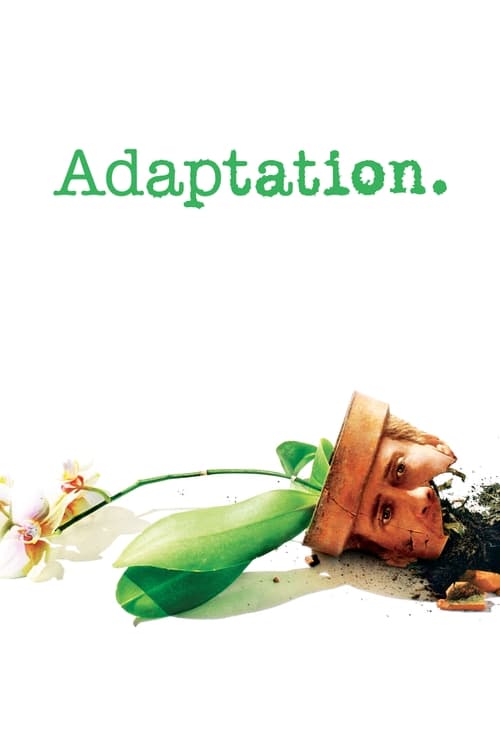
Adaptation. (2002)
Directed by Spike Jonze
No — Adaptation. is not woke, scoring 12 out of 100 on our wokeness meter.
A screenwriter is hired to adapt a nonfiction book about orchids, fails, and instead writes a film about failing, which is then made by the people he was failing for.
Consciousness Markers
Charlie Kaufman is depicted with pronounced social anxiety, depression, self-loathing, and social phobia, a sustained portrait of a neurodivergent-coded mind, though framed as character study rather than advocacy.
The film satirizes Hollywood's appetite for formulaic commercial product (Donald's cliché thriller sells for seven figures while Charlie's integrity stalls), a mild anti-industry jab rather than an eat-the-rich polemic.
The cast is overwhelmingly white, with Native American actors (Jay Tavare, Litefoot, Roger Willie) appearing as Seminole characters in roles that exist naturally in the plot rather than as a representational statement.
Meryl Streep's Susan Orlean is a substantial, complex female lead, but the film offers no feminist thesis or gendered critique; her arc is about obsession and longing, not patriarchy.
The film is philosophical and self-referential about creativity and obsession, but it dramatizes its ideas through farce and meta-structure rather than preaching them at the audience.
Seminole characters and the orchid-poaching subplot touch on indigenous land and commerce, but race is never foregrounded as a consciousness-raising theme.
No LGBTQ+ characters, themes, or subtext of any kind appear in the film.
Nature and orchids are present as objects of obsession, but there is no environmental or climate advocacy whatsoever.
Cage wore a fatsuit for the dual role, but the film makes no statement about body image or body acceptance.
The film invents events around real people (Kaufman, Orlean, Laroche) but presents them as confessed fiction, not as a corrective rewriting of history.
Why it received this score
A screenwriter is hired to adapt a nonfiction book about orchids, fails, and instead writes a film about failing, which is then made by the people he was failing for. This is either the most honest studio product of its decade or an elaborate act of self-defense, and the film declines to settle the question. Nicolas Cage plays both the anxious twin and the confident one, wearing a padded suit for reasons the movie never bothers to justify. Meryl Streep gives Susan Orlean a full inner life of longing and disappointment. The Seminole orchid poachers drift through the Florida sections as part of the plot's machinery, never as a lesson. Nobody in this film is being taught anything about themselves by the screenplay, which is a courtesy the modern studio comedy rarely extends.
The picture has one real target, and it is not capitalism in general but the market for formulaic screenwriting. Donald's idiotic thriller sells for seven figures while his brother's integrity stalls at the typewriter, a joke the film makes twice and enjoys thoroughly. Beyond that, the movie is content to be about obsession and self-loathing. Charlie's depression, social phobia, and reflexive self-criticism are rendered with sustained attention, though the film treats them as the weather rather than a diagnosis to be explained. The orchid is a beautiful object. It is not a metaphor for the planet.
What keeps the whole contraption from becoming insufferable is that it never stops moving. The structure folds back on itself, the farce accelerates, and the last act turns into the very cliché thriller it spent an hour mocking, which is either a capitulation or the point. The Academy gave Chris Cooper a statuette for his teeth. We are left with a clever, restless, faintly smug object that flatters its audience for keeping up. It has aged well. It has not aged into a sermon.
Analysis generated by our Consciousness Algorithm


Synopsis
Charlie Kaufman is a confused L.A. screenwriter overwhelmed by feelings of inadequacy, sexual frustration, self-loathing, and by the screenwriting ambitions of his freeloading twin brother Donald. While struggling to adapt "The Orchid Thief," by Susan Orlean, Kaufman's life spins from pathetic to bizarre. The lives of Kaufman and Orlean's book become strangely intertwined as each one's search for passion collides with the other's.
Questions about Adaptation.
Is Adaptation. woke?
No — Adaptation. is not woke, scoring 12 out of 100 on our wokeness meter. That earns it a verdict of Ultra Based.
Does Adaptation. have any woke elements?
Very few. None of the 10 markers reaches 30, the level where a marker counts as present; the highest is Neurodivergence at 20.
How does Adaptation. compare to other 2002 movies?
It ranks #45 of the 150 films from 2002 we've scored; their average is 12. The wokest is Far from Heaven (78).
How is the Woke Score calculated?
An AI-assisted process researches the film and its reception, scores it 0–100 on ten markers, then combines those into one 0–100 Woke Score. It measures a specific set of 2020s cultural themes, not film quality.