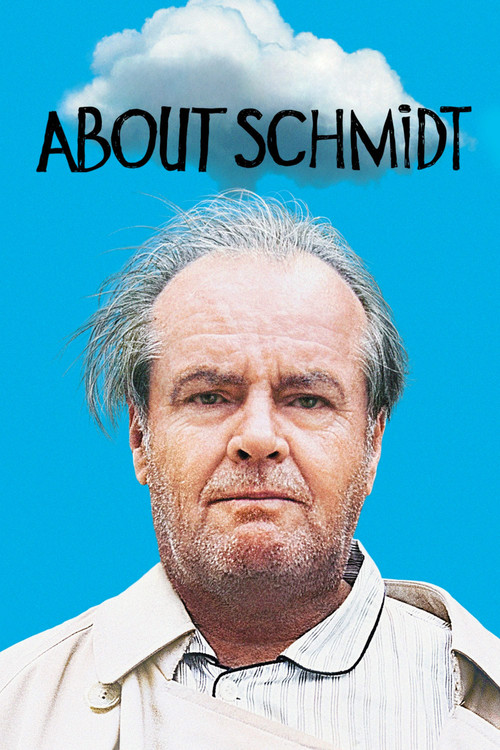
About Schmidt (2002)
Directed by Alexander Payne
No — About Schmidt is not woke, scoring 7 out of 100 on our wokeness meter.
Alexander Payne's study of a newly retired Omaha actuary arrives with a cultural footprint so faint it barely registers on the instruments.
Consciousness Markers
The film gently satirizes corporate emptiness, the soulless retirement dinner, and Randall's waterbed pyramid scheme, but offers no systemic anti-capitalist critique.
Payne's film observes and reflects rather than preaches, delivering its themes of mortality and regret through quiet character moments instead of moralizing.
The film mildly critiques Schmidt's neglect of his wife and features a sexually forward older woman in Roberta, but it is a character study of a man's midlife reckoning, not a feminist statement.
Kathy Bates's nude hot tub scene shows a middle-aged, non-conventional body without shame, though it is staged for awkward comedy rather than as a body-positivity statement.
The cast is overwhelmingly white, with the Tanzanian foster child Ndugu serving as an off-screen narrative device rather than a developed character. No meaningful diverse casting in the modern sense.
The Childreach sponsorship of a Tanzanian boy provides emotional catharsis for Schmidt but engages no racial commentary or consciousness whatsoever.
No LGBTQ+ characters, themes, or subtext appear anywhere in the film.
No environmental or climate themes are present; the Winnebago is a symbol of retirement freedom, not ecological concern.
No neurodivergent characters or themes are explored in the film.
The film is a contemporary fictional character study with no historical subject matter to revise.
Why it received this score
Alexander Payne's study of a newly retired Omaha actuary arrives with a cultural footprint so faint it barely registers on the instruments. Warren Schmidt sponsors a Tanzanian child through a television charity appeal, and the boy, Ndugu, functions as a silent confessor, a mailbox in Africa who absorbs a lifetime of grievance without ever becoming a character. This is a device, not a statement. The cast is white, the concerns are white, and the film has no apparent interest in changing that arrangement. There is no queerness here, no environmental anxiety, no neurological variety, and no history in need of correction. The Winnebago is a symbol of freedom, not a carbon footprint.
The picture does allow itself a few gestures toward contemporary feeling. Schmidt's late wife is treated shabbily in memory, and his daughter says so to his face, which gives the proceedings a mild corrective streak. Kathy Bates appears as Roberta, a woman of generous appetite who propositions our hero in a hot tub, and the camera regards her unclothed middle-aged body without apology. Payne stages the moment for squirm-inducing comedy instead of affirmation, so the gesture lands closer to farce than doctrine.
Corporate life gets a light bruise. The retirement dinner is hollow, the successor is callow, and Randall peddles waterbeds through a pyramid scheme, but the film diagnoses no system. It simply notes that some men are small and some rooms are empty. Payne observes and reflects. He does not lecture, and he never asks us to applaud his own sensitivity. A quiet portrait of regret remains, capped by a child's crayon drawing of two figures holding hands under a sun. It is moving. It is also entirely innocent of the cultural battles that would consume the following two decades.
Analysis generated by our Consciousness Algorithm


Synopsis
A recently retired man embarks on a journey to his estranged daughter's wedding, only to discover more about himself and life than he ever expected.
Questions about About Schmidt
Is About Schmidt woke?
No — About Schmidt is not woke, scoring 7 out of 100 on our wokeness meter. That earns it a verdict of Ultra Based.
Does About Schmidt have any woke elements?
Very few. None of the 10 markers reaches 30, the level where a marker counts as present; the highest is Eat the Rich at 12.
How does About Schmidt compare to other 2002 movies?
It ranks #92 of the 150 films from 2002 we've scored; their average is 12. The wokest is Far from Heaven (78).
How is the Woke Score calculated?
An AI-assisted process researches the film and its reception, scores it 0–100 on ten markers, then combines those into one 0–100 Woke Score. It measures a specific set of 2020s cultural themes, not film quality.