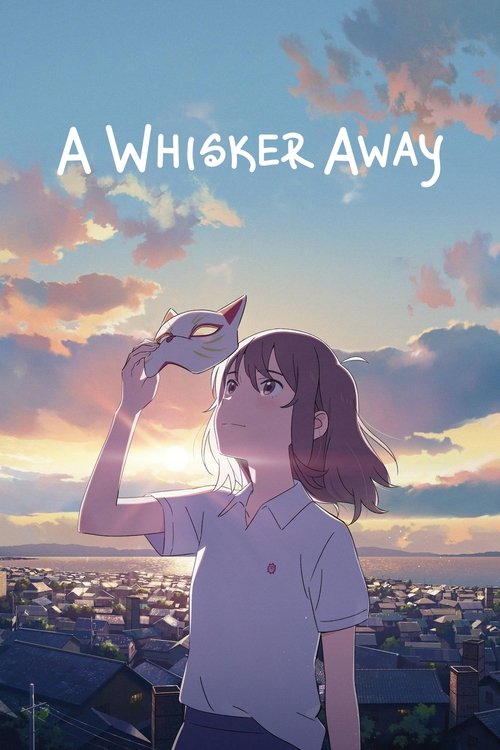
A Whisker Away (2020)
Directed by Tomotaka Shibayama
No — A Whisker Away is not woke, scoring 3 out of 100 on our wokeness meter.
A Whisker Away arrives from Studio Colorido with a premise that sounds like a cautionary tale and plays like a warm bath.
Consciousness Markers
Miyo is an assertive, agency-driven female protagonist who pursues her own desires, but the film frames this as quirky teen romance rather than any feminist thesis. No structural gender critique is offered.
Themes of bullying, family reconciliation, and personal growth are present but delivered through gentle storytelling rather than preachy moralizing. The film never stops to lecture its audience.
The voice cast is entirely Japanese, which is the natural default for a domestic anime production rather than a deliberate diversity-casting statement. No conscious representation agenda is present.
The romance is a conventional heterosexual junior-high crush between Miyo and Hinode. No LGBTQ+ characters or themes appear.
The film is set in a homogeneous Japanese small town and engages no racial or ethnic themes whatsoever.
There is no environmental or climate-related content in the story.
Hinode's family pottery shop faces closure due to financial hardship, but this is treated as personal family drama rather than a critique of capitalism or class.
No body-image or body-acceptance themes are present.
Miyo is described as 'peculiar' and socially awkward, but the film never frames this through a neurodivergence lens; it is simply characterization.
The film is a contemporary fantasy with no historical subject matter to revise.
Why it received this score
A Whisker Away arrives from Studio Colorido with a premise that sounds like a cautionary tale and plays like a warm bath. A fourteen-year-old girl named Miyo Sasaki acquires a magical Noh mask, becomes a cat, and spends her afternoons curled in the lap of the boy who ignores her human form. The setting is Tokoname, a ceramics town rendered with the sort of affectionate specificity that comes from a director drawing his own childhood. There is a talking cat peddler, a promised island, a stepmother who is trying her best. It is all very pleasant, and pleasantness has never been a crime.
For those of us who spend our evenings cataloguing the ideological contents of animated features, this one is a quiet room. Miyo is loud, stubborn, and entirely in charge of her own pursuit, which registers as a mild feminist hum and nothing more. The film has no interest in gender as a structure, only in a girl who will not sit down. Her classmates exist as classmates. The town is homogeneous and the film never notices. Hinode's family pottery shop is going under, and the film treats this as sadness rather than economics, which is either a limitation or a mercy depending on your appetite. Bullying appears, is named, and is addressed with a hug and an apology.
The final act delivers a boy who admits he lied, a cat who chooses to give the face back, and a couple holding hands on the way home. Lessons are present, but they are whispered into the ear of the protagonist, not broadcast at the audience. We have here a film of genuine sweetness and almost no cultural friction. It will not radicalize anyone. It will not offend anyone either, which in this climate is its own small achievement.
Analysis generated by our Consciousness Algorithm


Synopsis
A peculiar girl transforms into a cat to catch her crush's attention. But before she realizes it, the line between human and animal starts to blur.
Questions about A Whisker Away
Is A Whisker Away woke?
No — A Whisker Away is not woke, scoring 3 out of 100 on our wokeness meter. That earns it a verdict of Ultra Based.
Does A Whisker Away have any woke elements?
Very few. None of the 10 markers reaches 30, the level where a marker counts as present; the highest is Feminist Agenda at 5.
How does A Whisker Away compare to other 2020 movies?
It ranks #199 of the 227 films from 2020 we've scored; their average is 21. The wokest is One Night in Miami... (83).
How is the Woke Score calculated?
An AI-assisted process researches the film and its reception, scores it 0–100 on ten markers, then combines those into one 0–100 Woke Score. It measures a specific set of 2020s cultural themes, not film quality.